
Accounts payable resume keywords should identify the records you processed and the controls you followed. Common terms include invoice entry, document matching, coding, reconciliation, discrepancy follow-up, and payment processing. They do not all mean the same thing. A clerk may prepare an invoice for review without approving it or releasing money. Compare the specific job posting to your real duties, and write a bullet that makes the handoff visible. An employer may use applicant tracking software, but no universal keyword ratio or invented success score can demonstrate that a candidate has handled payments correctly.
Organize payable keywords by document and duty
Begin with the actual documents: supplier invoice, purchase order, receiving record, account statement, or approval record. Then match the operation you performed: entering, coding, comparing, filing, noting a discrepancy, or preparing a report. O*NET lists verification of figures and documents, coding, recording and reconciling transactions, and comparing orders with invoices as common accounting-clerk tasks. That occupational summary is a reference for possible duties, not evidence that you did them. If your history involves invoice scanning only, do not turn it into full-cycle accounts payable processing.
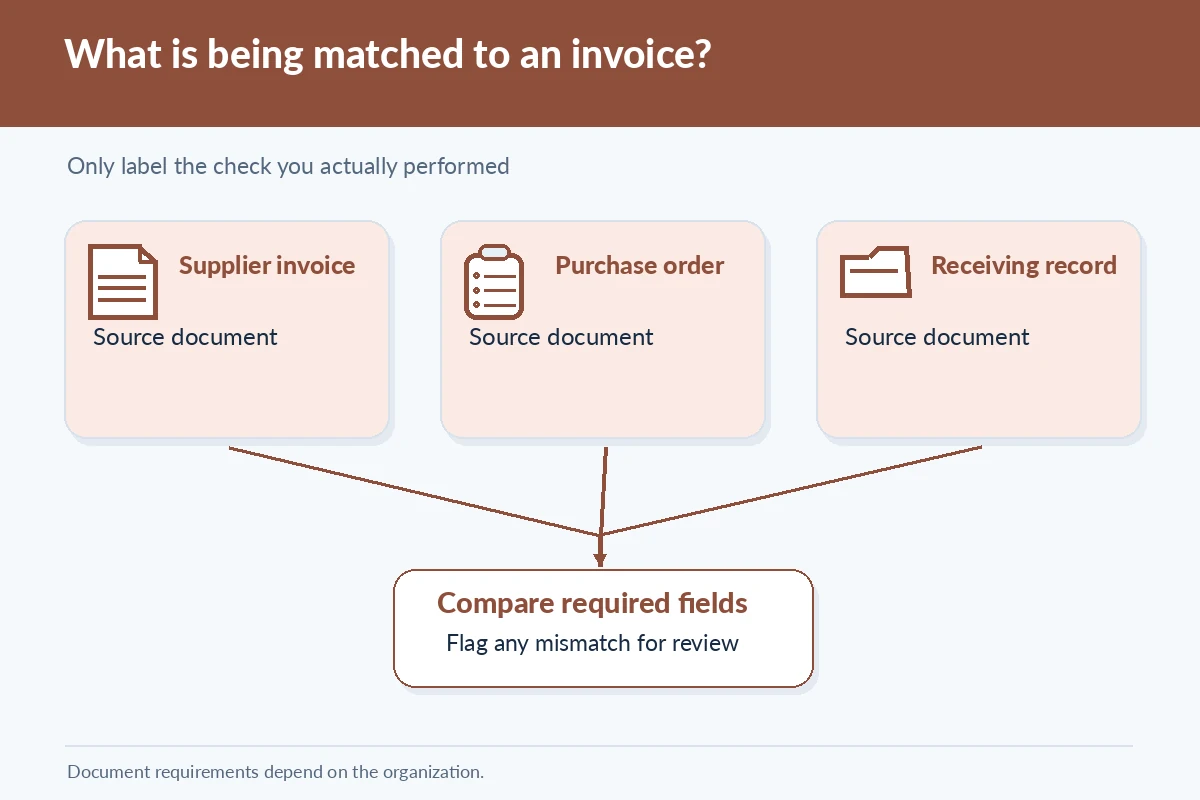
Understand two-way and three-way matching claims
A role may request “two-way match” or “three-way match.” These terms refer to comparing specified documents such as invoices, purchase orders, and evidence of receipt, according to company procedure. Only use a precise term if you used the relevant records and know what your organization required. A hypothetical bullet might read, “Compared supplier invoice amounts with approved purchase orders and reported differences to the AP lead.” That does not claim physical receipt verification, authorization of payment, or reconciliation of an entire ledger. If you do not remember the exact matching process, describe the documents you did check instead of guessing a label.
Make exception handling sound as careful as it is
Processing a mismatch is not the same as resolving it alone. An invoice may have a different quantity, missing purchase order, unusual vendor name, duplicate reference, or coding question. Depending on the organization, an AP clerk can flag the exception, request documentation, or route it for approval. A strong hypothetical example is “Logged invoice mismatches, retained source references, and escalated unresolved items to the finance reviewer.” Use the words “exception log” or “discrepancy follow-up” only when they fit the work. Do not imply you bypassed a hold, changed banking instructions, or authorized a disputed payment.
Distinguish posting, reconciliation, and payment release
Entering a payable in software, comparing an account statement, and sending an approved payment are separate tasks with different authorization requirements. “Payment processing” can be misleading if you merely assembled a batch for approval. Prefer “prepared payment documents for review” when that is the truth. If you maintained a reconciliation spreadsheet, say what was compared and what you did when values did not agree. Avoid broad claims like “managed company finances” for clerical work. Accuracy and respect for controls are stronger evidence than inflated ownership language.
| Job posting term | Evidence you could describe | Important limitation |
|---|---|---|
| Invoice entry | Recorded verified invoice fields | Do not imply payment release |
| PO matching | Compared specified source documents | Name only checks performed |
| Exception queue | Flagged differences for reviewer | Do not claim to waive controls |
| Reconciliation | Compared ledger or statement records | Identify the actual scope |
Use accounting software names only with proof
Some postings name ERP, QuickBooks, spreadsheet functions, or a specific financial system. If you used the system, describe the entry or check you performed. If you practiced in a classroom simulation, label that as coursework. Do not rename a generic spreadsheet exercise as a production ERP implementation. A tools section may contain Excel or invoice-entry software, but include skill descriptions only when you can explain the workflow. Never invent certification, reconciliation responsibility, or a software version. An employer can teach its internal procedure; your resume should describe prior abilities honestly.

Protect vendor information in examples and portfolios
Financial records may include supplier identities, bank numbers, invoices, purchase rates, or internal approvals. Do not upload real screenshots to a public resume or an AI tool without authorization. Use fictional example data clearly marked hypothetical when illustrating a workflow. A high-quality bullet should not reveal a vendor’s payment terms or a company’s financial amounts. For example, “Checked invoice coding and routed unclear entries to the AP supervisor” communicates useful evidence without sharing private records. The employer will be able to ask for a process explanation in an interview.
Tailor one resume to the employer’s actual AP process
A smaller office may combine entry, filing, and statement review, while a larger finance team separates invoice intake, matching, exception resolution, and release. Compare the posting’s wording to your own role before choosing keywords. If it lists “reconciliation,” explain whether you reconciled, assisted, or simply supplied records. If it lists “purchase orders,” do not claim creating them when you only matched them to invoices. Use the correct employer names, dates, and job titles, plus standard resume headings and a readable single-column layout where practical.
Distinguish invoice volumes from processing accuracy
If your team handled a large set of invoices, do not automatically claim that whole volume as your individual achievement. A candidate who reviewed a subset can describe the subset only when an authorized record supports it. If no count is available, a work-process description remains useful: explain how you checked vendor invoice fields, compared source documents, recorded discrepancies, and handed exceptions to a reviewer. Avoid fake efficiency gains and invented error percentages. AP work depends on trustworthy records, which is exactly what an evidence-based resume should demonstrate.

Review every accounting verb for authority
As a final audit, circle verbs such as approved, authorized, released, paid, reconciled, reviewed, and posted. Ask whether each describes your own documented task or someone else’s decision. “Reviewed for completeness” can be valid when you checked fields; it is not the same as financial approval. Replace unsupported claims and keep only the terms that you can explain with a safe, non-confidential example. The best payable resume shows the exact scope of financial handling and the controls you respected.
How We Research Resume Keywords and Evidence
We compared university career-center recommendations about resume tailoring and ATS readability with O*NET OnLine occupational task descriptions. The occupational task inventory describes possible work, not what any reader personally performed; the hypothetical resume lines demonstrate how to show scope without inventing responsibility. The sources linked below were checked on November 15, 2026. Employers configure application systems differently and descriptions can change, so use the current posting and your actual records before submitting.
Sources consulted: University of Maryland resume guide; Georgetown resume and ATS advice; O*NET Accounts Payable occupational tasks; University of Florida application tailoring. These references support process advice and occupational context, not ATS acceptance guarantees.
For site partnerships, promotional links, and editorial disclosures, see the JobAsk affiliate disclosure.
More Resume and Cover Letter Guides
Only if your duties genuinely covered the full described process. Otherwise name the steps you performed.
No. Describe scanning and routing accurately unless you also verified, coded, or entered them.
Only when you used it in real work or clearly labeled training.
State what you compared, what you recorded, and which reviewer received unresolved issues.
Only if accurate, authorized, and not confidential. Useful process evidence usually does not require dollar amounts.