
An admissions counselor cover letter without direct admissions employment should establish what you genuinely know how to do: welcome prospective students, explain verified information, organize an outreach event, or guide a question to the correct office. It should not claim you decided who was admitted, interpreted eligibility rules independently, or promised scholarships. Start with the exact counselor or admissions-support job posting; some counselor openings require a degree or prior recruiting work. The fictional sample below demonstrates transferable communication without pretending those qualifications are universal.
Check whether the opening is truly suitable for a beginner
Titles vary between colleges. Some admissions counselor roles include territory travel, school visits, application review, or recruitment goals; others focus on front-line information and events. BLS discusses admissions responsibilities under postsecondary education administrators, but an individual counselor’s qualifications depend on the employer. Read the required degree, driving or travel expectations, schedule, and system skills. An entry-level candidate should not assume all roles are open without experience. If the posting clearly requires credentials you lack, target related admissions assistant, ambassador, or outreach-support roles instead of claiming a degree or qualifications not yet earned.
Translate student-facing activities into outreach evidence
A campus ambassador who helped prospective students find a registration desk may have relevant visitor-service experience. A club presenter who answered questions about a public event can demonstrate clear communication. Describe only verified details you actually provided and how you referred policy questions to authorized staff. Do not say you advised students on admission eligibility or financial aid because you showed someone around campus. Select one genuine episode: the audience, the question, your response, and what you did when you did not know. Clear boundaries can reassure a recruiter that you will not improvise policy advice.

Open with an interest in accurate student guidance
The first paragraph can state that you are applying for a specific admissions counselor position and link your strongest real skill to its posted duties. For example, you may enjoy explaining schedules to visitors and checking that they receive the right published information. Avoid claiming a personal connection to the institution unless it is true. If the college has published distinctive student-support or access programs and you have read about them, you can reference one accurately; do not invent diversity initiatives or tuition outcomes. Your opening should demonstrate interest and competence rather than a generic “dream school” statement.
Show how you handle a question outside your knowledge
Admissions offices have detailed rules on admissions criteria, document deadlines, scholarships, and program-specific requirements. A beginner’s responsible action is to use current official information or refer the student to an authorized advisor when uncertain. A fictional campus event example could involve a visitor asking whether particular credits transfer. The ambassador says they cannot determine transfer eligibility, provides the approved office contact, and alerts the event lead to the question. This is real outreach logic without pretending that the ambassador made an institutional determination. Replace the example with your own experience rather than presenting it as a true past event.
Read this fictional cover letter paragraph
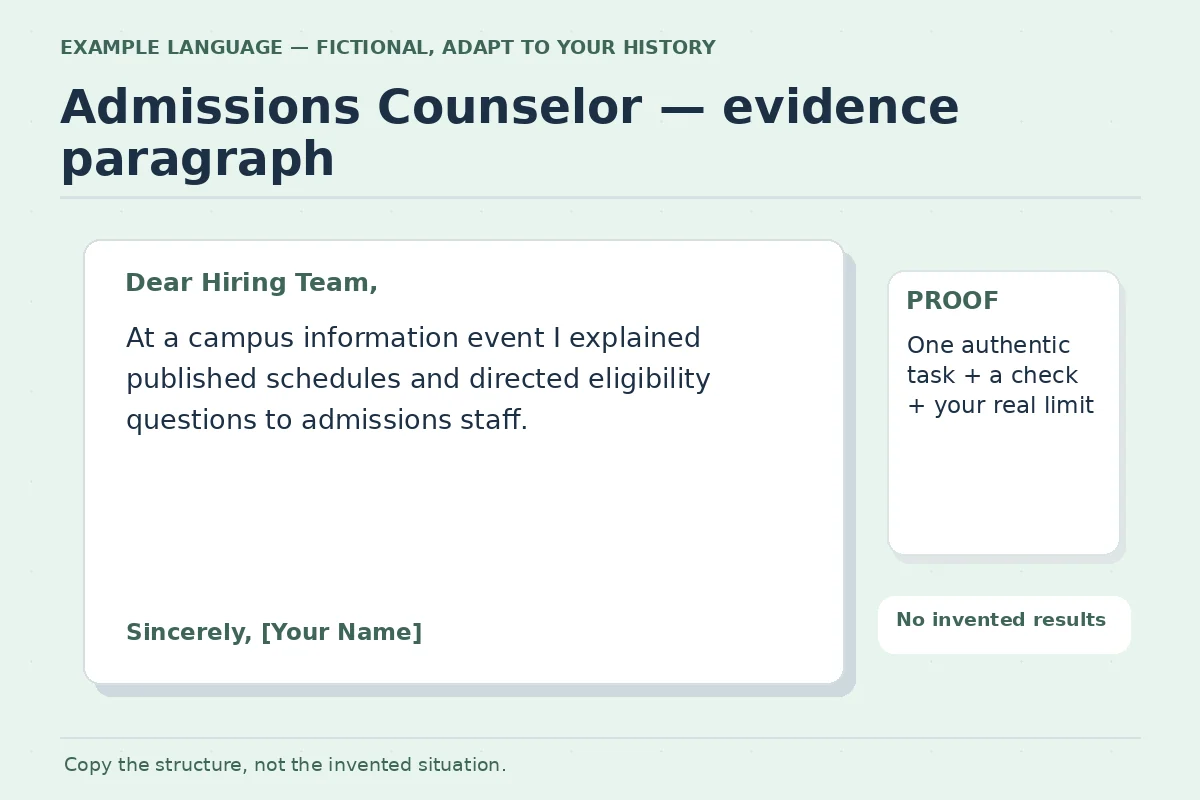
Fictional admissions letter excerpt: “Dear Hiring Committee, I am applying for the admissions counselor opening. While helping at a campus information event, I organized printed session schedules, explained the published check-in process to visitors, and referred program-specific eligibility questions to the admissions staff. I learned that accurate information and a calm handoff can make unfamiliar processes easier for prospective students. I would welcome a conversation about how my communication and event-support skills fit your outreach team, and I am prepared to learn the institution’s policies and systems. Thank you for considering my application.” Do not present the invented event as your own history.
| Your draft element | Evidence to look for | Misleading version to remove |
|---|---|---|
| Opening | Exact role and genuine reason for applying | Unverified employer praise |
| Evidence paragraph | One real task, check and handoff | Invented years or results |
| Training note | Specific procedure to learn | Claimed authorization you lack |
| Closing | Correct name, attachments and application route | Conflicting dates or fake credentials |
Use a proof paragraph that identifies the actual audience
Explain who you helped, what information you prepared, how you checked its accuracy, and the observable outcome. A genuine school open-house helper might have updated a schedule display based on instructions and directed families to staff presentations. That is enough to show organization and respectful service; do not add an invented attendance figure or admissions conversion rate. If your strongest example is presenting a class project, describe the project and the feedback you received, not an imaginary recruitment result. The relevance is the skill of translating clear information for an unfamiliar audience while knowing when to seek a specialist.
Treat student information and recruiting claims cautiously
Do not include a prospective student’s name, application file, admission result, test scores, or financial circumstances in your letter. Avoid claiming that you independently reviewed confidential applications or determined applicant suitability. If your actual background includes a supervised admissions office internship, specify the tasks you performed and the supervision involved. Your future employer will teach its own policies, technology, and approval pathways. Applicants should not promise improved enrollment numbers without evidence. A precise statement about helping visitors navigate published event details is preferable to a grand claim about recruiting entire student cohorts.

Close with the role requirements and evidence in view
Before submitting, compare your letter to the announcement again. If travel, evening events, degree requirements, or student-data tools are essential, address only the qualifications you truly have. Check the school and department name, accurate job title, and application portal. Your closing can welcome a conversation about student service, clear communication, and willingness to learn institutional procedures. Avoid saying you will make admission decisions independently. If your experience is mainly campus volunteering, name it plainly. A short honest letter tied to real outreach is a useful starting point even when the exact counselor role is a stretch for an applicant.
Practice this specific cover letter rewrite
Create two columns headed outreach support and admission decision. Place your actual experiences in the first column only when they really happened: explaining published schedules, arranging event rooms, or speaking with visitors. Place duties such as approving applicants or evaluating official credentials in the second column unless you genuinely held authorized responsibility. Then look at the job posting and identify which tasks need degrees, travel, or system access. Your cover letter should prove your readiness for the parts you can support and acknowledge learning requirements, not obscure missing mandatory qualifications. Delete private student information from any draft example.
How We Research Entry-Level Cover Letters
We reviewed these original sources on 2026-11-07: cloudfront.careeronestop.org (CareerOneStop explains the structure and evidence requirements of an effective cover letter.); www.bls.gov (BLS describes responsibilities of postsecondary admissions administrators and variations among institutional roles.); careercenter.umich.edu (University of Michigan career guidance recommends examples from educational and co-curricular experiences.). Each source supports general cover-letter methods or the occupational limits identified in this guide; none confirms that any particular applicant holds a credential or has performed the fictional example. Roles and employer requirements vary, so compare claims against the actual posting and your records. Sample stories and examples above are hypothetical teaching materials, not employment testimonials.
This is independent career-writing education, not a promise of interviews or hiring. We do not claim an affiliate arrangement for the organizations cited. See the JobAsk affiliate disclosure for further transparency. Do not attach confidential workplace or student records to prove past experience.
More Resume and Cover Letter Guides
Possibly, depending on the posting. Some roles require a degree, travel, recruitment experience, or other qualifications; check each opening.
No. It can show outreach, visitor assistance, and accurate referral, but not admissions selection authority.
Only with appropriate privacy and evidence; generally avoid personal outcomes and discuss your own outreach tasks instead.
Describe checking official materials and referring the question to the qualified staff member rather than improvising an answer.
Yes. Identify them as class presentations and explain what you actually prepared and communicated.