
A barista cover letter should make the reader picture how you would contribute to a café shift. That does not require pretending to know the employer’s recipes or espresso machine. It requires a truthful example of taking an order, serving a customer, communicating a correction, keeping a station organized, or learning a documented routine. Adapt the evidence to the advertisement: a busy counter needs reliable handoffs, but a specialty coffee position may have different preparation requirements.
The approach also follows University of Pennsylvania Career Services, which advises tailoring the letter to the employer and using evidence rather than generic praise. In the working sections below, any letter example is explicitly hypothetical. Replace every detail with your own truthful experience before applying.
Read the Specific Job Posting Before Drafting
Food and beverage service includes taking orders, preparing or retrieving food and drinks, accepting payments, restocking, and maintaining clean work areas, as summarized by the Bureau of Labor Statistics. The exact balance changes by café. When the posting emphasizes guest experience, choose a real service exchange and explain how you listened and responded. If it emphasizes preparation, discuss an authentic food-handling routine or training. Do not claim mastery of latte art, specific machines, or food-safety credentials you have not earned.
Counter-service hiring may include early, late, or weekend shifts, but the actual employer determines the schedule. A cover letter can mention availability when it genuinely matches the ad, without offering more than you can do. Some postings require local food-handling preparation or prior machine skills; verify those conditions rather than assuming all entry-level café jobs have identical rules. Your strongest transferable evidence might come from helping a customer calmly, following a checklist, or keeping shared supplies easy to find.
Turn One Real Task Into Relevant Evidence
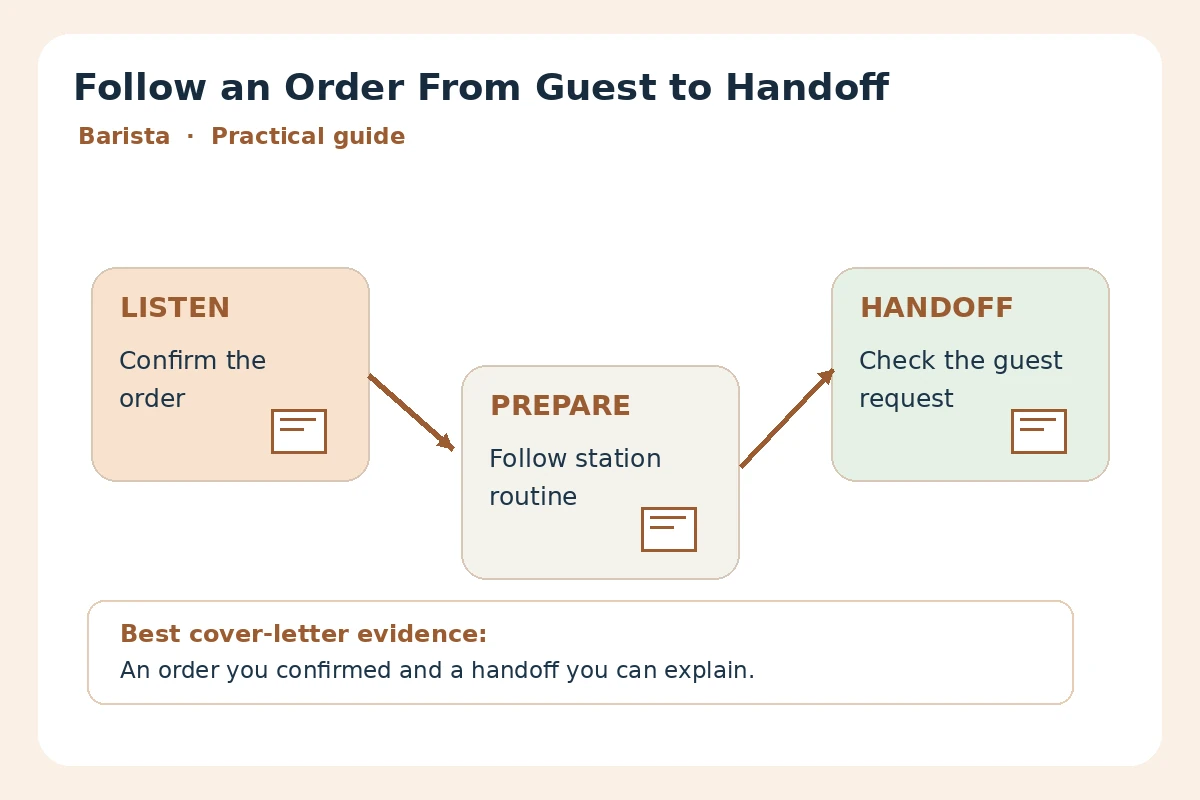
Use a service sequence: notice the request, confirm details, act within procedure, and complete the handoff. A school fundraiser or counter-service job can provide an honest example if the tasks match. Name what you personally did and what others handled. Suppose you confirmed an order before passing it to the preparation area: that speaks to accuracy even if you did not make the drink. Keep any performance numbers out unless you know their source and can explain your individual role.
Use the first diagram as a working worksheet, not a claim that every employer follows one process. When a posting asks you to confirm the order, consider where you did comparable work. For the next step, follow station routine, identify any instructions, tools, or supervision that applied. The final step—check the guest request—asks for a concrete and defensible action, not a guessed result. Your cover letter may contain only one of these steps if that is your strongest honest evidence. If you have never completed a duty, describe adjacent skills without relabeling them as direct experience. For the fuller picture, see our dental receptionist cover letter guide.
Use This Hypothetical Letter as a Structure
The following complete example is hypothetical. Its position description and candidate activities are illustrative; it is not an account of a real applicant, employer, or hiring result.
Hypothetical sample letter: Dear Café Hiring Team, I am applying for your Barista opening. In a hypothetical community event shift, I took drink orders, repeated custom requests to confirm them, and passed written tickets to the preparation team. When a guest had a question, I checked with the team instead of guessing. I enjoyed helping the counter stay organized while keeping conversations friendly. Your posting highlights order accuracy, collaboration, and a welcoming guest experience, so I would bring those habits and a willingness to learn your preparation standards. Thank you for considering my application. Sincerely, Applicant Name.
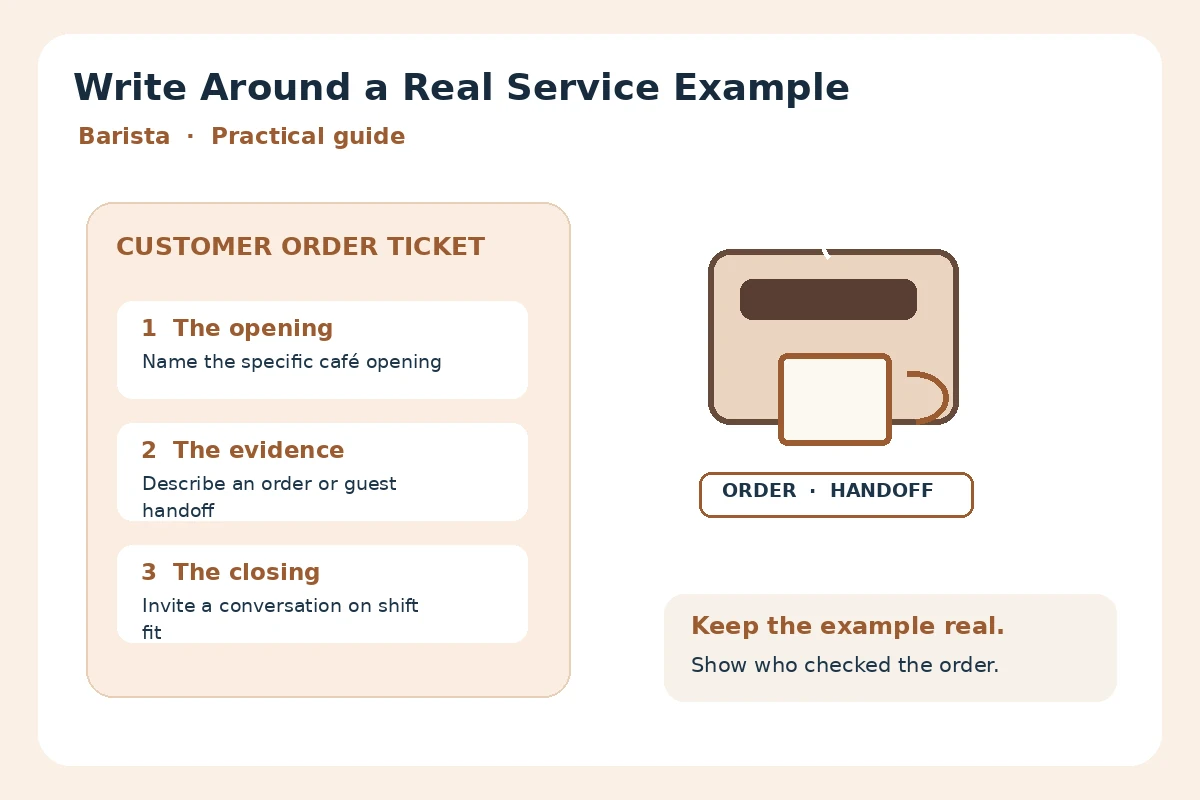
Do not paste the sample into an actual application unchanged. Its applicant, setting, and experience are hypothetical, even where they sound realistic. Start instead with the employer’s job description, keep the opening about the specific position, use an action you personally took, and check the closing against what you actually want to discuss. A credible letter has a narrower claim than a fictional one-size-fits-all success story. Its job is to invite scrutiny, not to bypass it.
Adapt the Letter to Your Actual Background
If you have previous café training, specify what it covered and avoid inflating the level. If you are new to food service, choose retail checkout, school events, or a volunteer service shift, clearly naming its setting. For a location serving breakfast rushes, discuss how you double-checked order details under interruptions; for a quieter café, a customer communication example may be stronger. The O*NET counter-service description provides related tasks, but your actual posting decides which evidence is useful.
If your strongest experience comes from volunteering, coursework, or supervised practice, identify that setting plainly. A hiring manager should be able to tell what you did, where you did it, and which steps you were authorized or trained to perform. Avoid implying independent responsibility merely because you were present when a larger team completed the work.
Avoid Claims That Do Not Hold Up
‘I love coffee’ is not a substitute for service evidence. Neither is ‘I can handle anything’ without a specific example. Remove assumptions about a shop’s menu, customer volume, tips, or required certificates. Don’t state that you worked a cash register if you only watched someone else. Avoid exaggerated outcomes such as claiming you eliminated all customer complaints. Replace them with an authentic, bounded action: for example, you verified an item and corrected the ticket according to the shift procedure.
Before sending, compare your letter with your resume for consistent dates, role labels, and tool names. An adjective such as “expert” invites questions about level and evidence; a precise description of a task is easier for the reader to assess. If the posting asks for a certification, verify its exact name and status instead of using a vague shorthand.
Review the Draft for Clarity and Fit
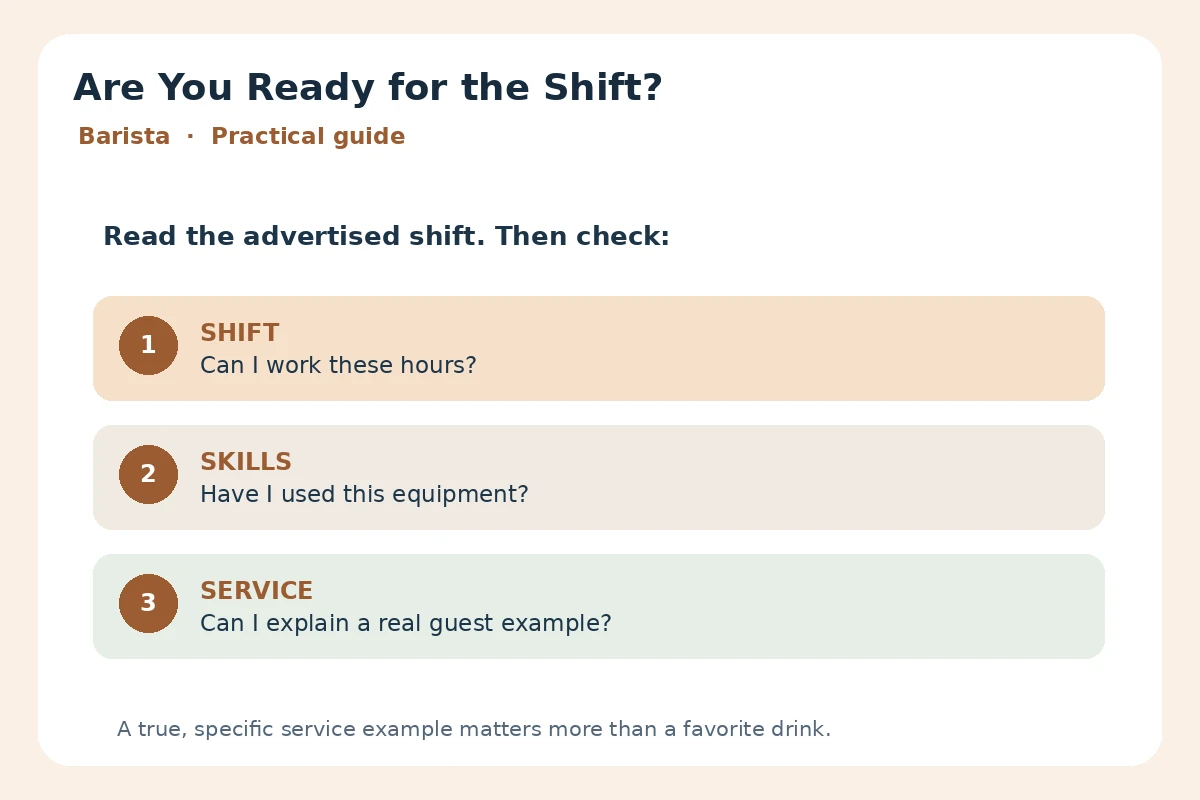
Read your letter out loud and underline every activity claimed. Ask whether you could give a straightforward account of it without changing the story. Check that the letter is about this employer’s advertised tasks rather than a generic love of hospitality. Confirm your availability separately when requested; do not insert unverified claims about open scheduling. End with a courteous invitation to discuss the shift and training expectations. One concise, accurate story often does more work than several paragraphs of enthusiasm. Our warehouse associate cover letter guide goes into more detail.
After proofreading, inspect the letter for needless personal information and unsupported claims. Confirm that the greeting matches the employer or use a neutral hiring-team greeting. Keep plain language for actions and do not borrow a professional title merely because you supported someone who held it. If applying through a portal with a text box, keep the essential opening, evidence, and closing while following that portal’s instructions; the employer’s requested format takes precedence.
How We Research Cover Letter Examples
How We Research: We reviewed Penn’s cover-letter guidance, the relevant occupation description, and additional professional guidance on 2026-10-23. Occupational descriptions provide context, not evidence that an individual employer requires every listed task. Our decision maps and hypothetical letter are original teaching examples, not actual employment histories or claims of hiring effectiveness. Requirements may vary by employer and state. No affiliate relationship is presumed; read the JobAsk affiliate disclosure.
More Resume and Cover Letter Guides
- Barista Resume Skills: Show Orders, POS Accuracy, and Safe Cleaning
- Barista Resume Summary: Describe Order Accuracy and Shift Teamwork
- Research Assistant Cover Letter: Prove Methods and Careful Records
- Social Worker Cover Letter: Connect Practice, Ethics, and Fit
- Customer Service Cover Letter: Show Resolution and Clear Follow-Up
Yes. Use actual customer service, school event, or food-service work and label the setting honestly. Do not imply barista training you have not completed.
Only briefly if relevant to the employer. Proof of accuracy, customer care, or learning routines is more useful than a list of preferences.
That depends on the job advertisement. State actual experience and ask about training rather than implying that all cafés train from scratch.
Yes. Describe your specific actions and who supervised them, without representing volunteering as paid café work.
For most nonacademic openings, a concise one-page letter is a reasonable starting point; follow employer instructions.