
Business analyst career goals should specify the quality of a work product: a clarified stakeholder need, a traceable requirement, a reviewed process map or a responsibly documented change request. “Become a senior BA” is a longer-term direction, but it does not show the skills you need to practice next. The International Institute of Business Analysis explains that business analysis work spans stakeholder collaboration, understanding needs and evaluating solutions; the job title and authority vary by organization. Choose one assigned task before attaching a level to yourself.
Anchor your goals in an analysis task, not a title
First identify the actual decision the team is trying to make and who owns it. A hypothetical goal is: “For the next approved small enhancement, document the stakeholder question, current process, open assumptions and reviewer feedback before drafting a requirement.” That demonstrates analysis quality without claiming you can approve scope, funding or design. If you are a trainee or work in an adjacent role, label exercises as observed or supervised rather than independent BA ownership.
Separate business, stakeholder and solution requirements
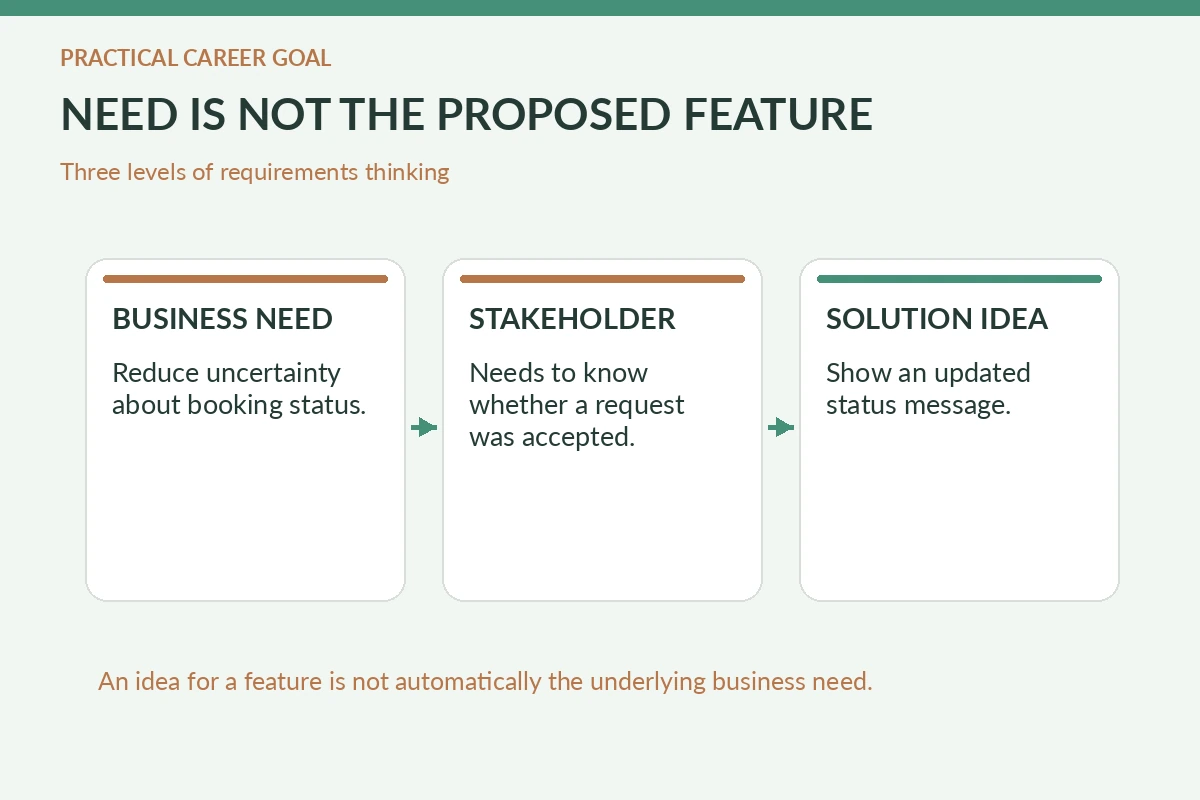
A common source of confusion is writing a requested feature as if it were the underlying business need. A business requirement concerns a desired outcome; a stakeholder requirement describes what a stakeholder needs; a solution requirement addresses the capability or quality of a solution. IIBA’s published standard distinguishes these types and also includes transition requirements. Your development goal can be to classify an approved set of examples with a reviewer and explain why each belongs in its category.
For an illustrative internal booking workflow, a business need might be to reduce uncertainty about scheduling status. A stakeholder might need confirmation of an accepted request. The proposed solution could display a status message, but that feature is a design choice, not the original business problem. Ask what evidence makes the statement accurate. Do not invent interview quotes or treat a single conversation as formal approval. Use the organization’s requirement taxonomy if it differs from the example.
Practice elicitation and confirmation as separate skills
A stakeholder meeting can produce assumptions, constraints, examples and unanswered questions. Effective elicitation means asking a question clearly; confirmation means verifying that your record reflects what was actually intended. An illustrative goal is: “Prepare a focused question guide for the next approved stakeholder workshop, then send a factual recap for the designated owner to correct.” Measure whether the recap identifies decisions, unresolved questions and owners—not merely how many attendees participated.
Avoid attributing a requirement to someone who did not confirm it. Record “proposed” or “awaiting review” until the right person confirms. When participants disagree, show the alternatives and route the decision to the agreed owner. If discussions touch confidential systems or personal records, the meeting notes belong only in approved channels. Business analysis skills include knowing what you cannot infer from incomplete input.

Connect requirements to tests and change decisions
A requirement becomes more useful when a reviewer can identify its source and understand how fulfillment would be checked. A simple traceability note might link a stakeholder need to a requirement statement, an agreed acceptance example and the person responsible for approval. Your learning goal can focus on writing clearer testable statements. Do not confuse writing acceptance criteria with independently authorizing production release or declaring a system compliant.
When someone requests a change, capture what is changing, why, which dependencies may be affected and who must decide. “Request logged and impact questions prepared” is not “change approved.” Build a decision path that ends in the official review process. If you lack access to real project artifacts, practice using fictional examples and mark them as such. Reuse an organization’s internal template only with permission; confidentiality and ownership rules still apply during training.
Review artifacts with a competency lens
IIBA offers a competency model for assessing different levels of business-analysis work, but a membership document is not necessary to start a modest improvement plan. Choose a task you have performed, describe the support required and agree with a reviewer on the next capability. For example, someone who can list requirements from a meeting might work on distinguishing confirmed facts from assumptions. Someone who already documents requirements may focus on stakeholder alignment or change impact.
Use a small set of real, permitted examples. Ask a supervisor or mentor to annotate where a requirement is ambiguous, where an assumption lacks a source, and where an approval boundary is missing. Do not turn a subjective reviewer note into a made-up performance score. Your progress can be stated accurately as “revised the draft to identify the accountable decision maker and unresolved dependency,” without claiming the project succeeded as a result.

Plan your next step without claiming decision authority
Longer-term options include specializing in a domain, improving process analysis, learning facilitation or working on solution evaluation. These routes require different experience; not every analyst aims for project management or product ownership. Review the target role’s actual expectations and find one development activity you can do within your current scope. Shadowing a decision meeting or reviewing an approved requirements set may be more useful than accumulating disconnected certificates.
For a performance discussion, bring a concise before-and-after artifact: a vague request, the clarified questions, the agreed requirement category and the outstanding decision. Redact any restricted content and keep originals inside approved systems. End with one explicit request: a mentor review, permission to participate in a workshop, or an assigned low-risk analysis task. The next milestone should depend on feedback and demonstrated work, not an invented promise of promotion or project impact.
How We Research and check these examples
This guide uses occupation or competency descriptions from the primary organizations linked below. The hypothetical goals are teaching examples, not reported employee results, prescribed quotas, legal advice or guaranteed promotion pathways. Work duties, approved tools, private records and supervisor authority differ by employer. Confirm your team’s actual procedures before using a template.
Primary sources consulted on November 9, 2026: IIBA business analysis standard. IIBA business analysis standard. IIBA business analysis standard. U.S. OPM career development. For transparency, see the JobAsk affiliate disclosure; this article includes no paid affiliate recommendations.
Explore Related Career Guides
Yes. Describe approved analysis tasks or clearly labeled practice work rather than claiming a formal title or approval rights.
Separate the underlying need from a proposed feature and confirm assumptions with the designated stakeholder reviewer.
Use reviewer feedback on clarity, traceability, unresolved questions and approval status in a permitted sample.
No. Requirements authorship and approval are different responsibilities; follow the organization’s governance.
No universal credential requirement applies to every role. Review the target job and use supervised practice to build relevant skills.