
You can write strong resume bullets without inventing percentages. Start with a task you genuinely performed, name the object of the work, and add the audience, deliverable, method or observable result you can explain in an interview. If your team never measured the impact, do not fill the gap with a guessed savings figure. A specific, defensible description is better than a dramatic but unsupported claim. This guide shows how to choose the right kind of evidence, where to stop, and how to turn plain work notes into useful resume lines.
Find the evidence that exists before drafting
Start with the actual artifact or routine: a report, an organized queue, training notes, a set of checked records, a customer handoff, or a problem documented for someone else. Ask what you touched and who used the result. A detail such as ‘weekly inventory exceptions’ is more informative than ‘improved operations’ when no formal performance measure was kept. The first can be explained; the second implies an outcome you may not know.
Create a private fact sheet with four columns: action, work object, audience and proof. Your proof might be a permitted document you created, a schedule that shows recurring responsibility, or a supervisor-approved description of a task. Do not copy restricted customer records or internal figures into your resume. The fact sheet stays private; the public bullet uses only safe, relevant details. If you cannot verify a claimed result, describe the finished work instead of changing the number.

Choose scope, deliverable, or result deliberately
Scope answers what kind of work you handled: shift coverage, a particular report, repeated transactions, or a set of support requests. A deliverable names what you made or completed, such as a checklist adopted for the next handoff. An observed result identifies what happened afterward: the next team received a revised guide or a missing-field check was included in a review process. These are different kinds of evidence, and no one bullet needs all three.
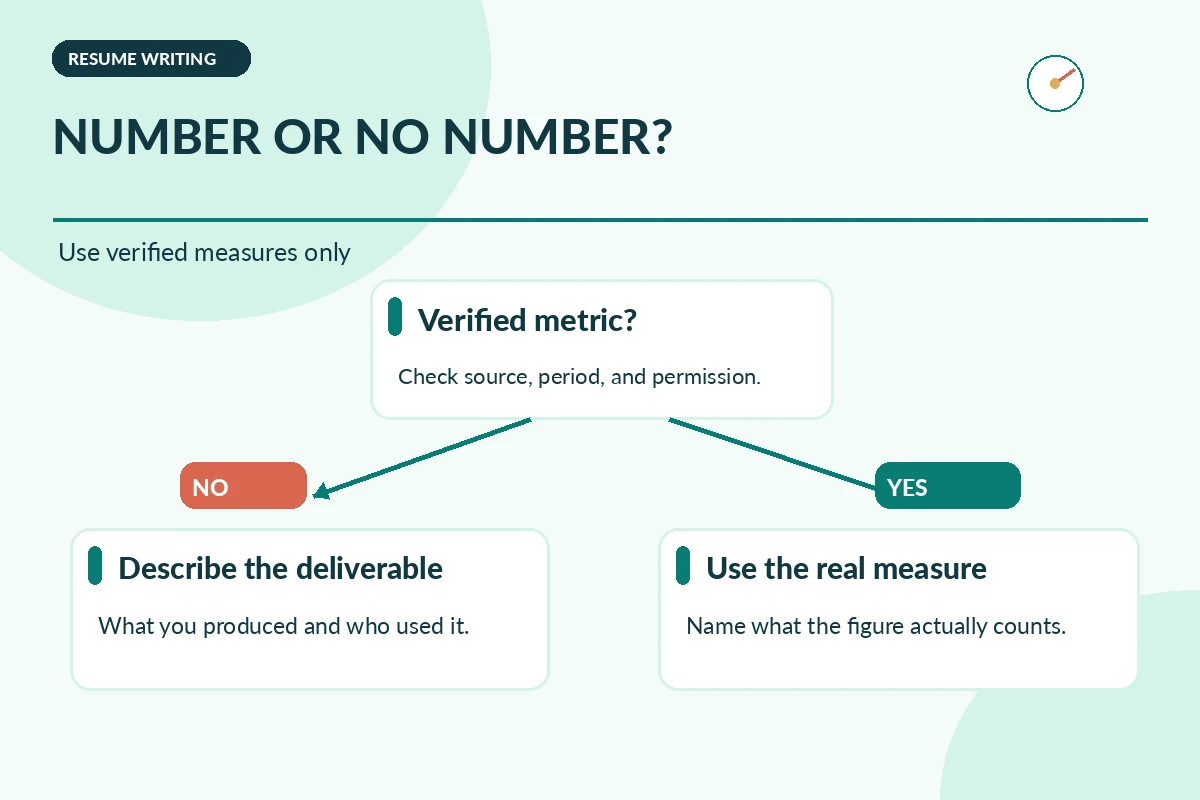
Use a simple evidence ladder. First, state an accurate duty. Second, specify the thing or process involved. Third, add verified context such as frequency or audience. Only at the final step add a measurable improvement when records support the exact claim. A hypothetical bullet might read, ‘Reviewed weekly shipment exceptions and prepared a follow-up list for purchasing staff.’ It shows work without claiming that delays fell by a particular percentage.
Rewrite vague duties with useful objects and methods
‘Responsible for customer service’ gives a reader no idea what you handled. In an illustrative retail role, a more useful line might be, ‘Answered product-availability questions, checked inventory records, and referred unresolved requests to the shift lead.’ The verbs show what happened, the object makes it concrete, and the referral keeps the boundary of authority clear. This is a sample construction, not a claim that anyone did those tasks.
For a hypothetical office role, compare ‘Improved reporting’ with ‘Compiled monthly invoice exceptions and marked missing references for a reviewer.’ The second bullet is narrower but easier to defend. Do not claim you audited a ledger, certified accuracy, or approved a payment merely because you helped prepare information. Work with verbs you can stand behind: drafted, checked, organized, summarized, documented, escalated or presented. Each implies a different level of responsibility.

Use numbers only when the source and meaning are clear
Numbers are helpful when they express a count or outcome you actually know. You might remember the number of staff you trained because the training roster is accessible to you, or you may know you prepared a report every Friday. Frequency can be useful context even without an exact quantity. Be cautious with percentages: a credible before-and-after claim needs comparable periods, a consistent definition and a source you may appropriately discuss.
If you only remember ‘many requests,’ do not convert that memory into ‘150 cases per week.’ If a manager said your work saved time but no measurement exists, say what you changed rather than attributing imaginary hours. A range can help only when the range is genuinely supported. Avoid confidential revenue, customer counts, or technical details when permission is unclear. The goal is a precise description of your work, not an accounting trick.
| Evidence level | Sample wording | What it means |
|---|---|---|
| Weak | Responsible for reports | No work object or reader |
| Defensible | Prepared weekly exception summaries | Specific deliverable and cadence |
| Conditional | Reduced errors by 35% | Only if measured and shareable |
Test each statement against an interview question
Read the bullet aloud and imagine the interviewer asking, ‘What did you do first, what did you use, and how do you know it worked?’ You should be able to provide a plain-language explanation without retracting a verb, inventing a measurement or shifting credit to yourself. If ‘managed’ makes you hesitate because you only updated a shared log, change it to ‘maintained’ or ‘updated’ if those are true.
Use a three-way review: green for a claim you can explain, yellow for a claim that needs clarification, and red for a claim that depends on a guess or confidential evidence. Retain green items, rewrite yellow items around direct tasks, and remove red items. Then keep the two or three most job-relevant statements for the role you want. Accurate scope can make a resume both shorter and stronger.
Finish the bullet without making it a paragraph
The finished line should start with the action and identify the work quickly. An illustrative final version could say, ‘Prepared a weekly equipment-inspection summary and highlighted items needing supervisor review.’ It does not promise a safety outcome; it tells the reader what you supplied and to whom. Another could read, ‘Updated onboarding notes after recurring questions from new team members.’ That describes the changed artifact without claiming improved retention.
Review your page at normal viewing size. Cut filler such as ‘successfully,’ ‘highly effective,’ and ‘various duties’ when they do not add evidence. Keep dates, job titles, and role context accurate; a concise bullet is not permission to erase material facts. If a measurable outcome is available later, update the line after checking its basis. Until then, specific work is enough.
How We Research This Resume Advice
We reviewed practical resume guidance from UC San Diego Career Center, University of Pennsylvania Career Services, Penn resume-writing guidance and UC Berkeley Career Engagement. We used those sources for the principles of task specificity, honest ownership, reader clarity and relevance. The worked examples here are hypothetical: use only facts you can personally verify, and follow the specific employer’s application instructions. We do not claim a particular format guarantees interviews or passes an applicant tracking system. Read our affiliate disclosure for the site’s relationship policy.
More Resume and Cover Letter Guides
No. A concrete action, its scope, and a relevant deliverable can be informative when a reliable percentage was never measured.
Only if the approximation is reasonably supported, clearly framed, permitted to share, and useful. Otherwise describe scope or frequency without a guessed count.
A completed guide, documented issue, resolved handoff, reviewed report or other observable output can provide context, provided you really produced it.
Describe your own task, method, and general type of deliverable without exposing customer names, protected figures, or restricted implementation details.
No. Treat generated numbers, outcomes, tools, and management claims as unverified suggestions and remove anything not supported by your own evidence.