
When a performance review asks about career aspirations, name a direction, back it with work you have actually done, and request a practical next step. For example: “I would like to develop toward coordinating cross-team projects. I have already maintained our weekly handoff tracker; could we identify one limited project for me to support and review the results next quarter?” This is an aspiration, not an assertion that a promotion has been approved.
Keep three conversations separate: what happened during the review period, what responsibility interests you next, and what support or feedback you need to test your readiness. This makes the discussion useful even if the organization has no immediate vacancy or if your manager cannot authorize the move.
Start with your actual performance evidence
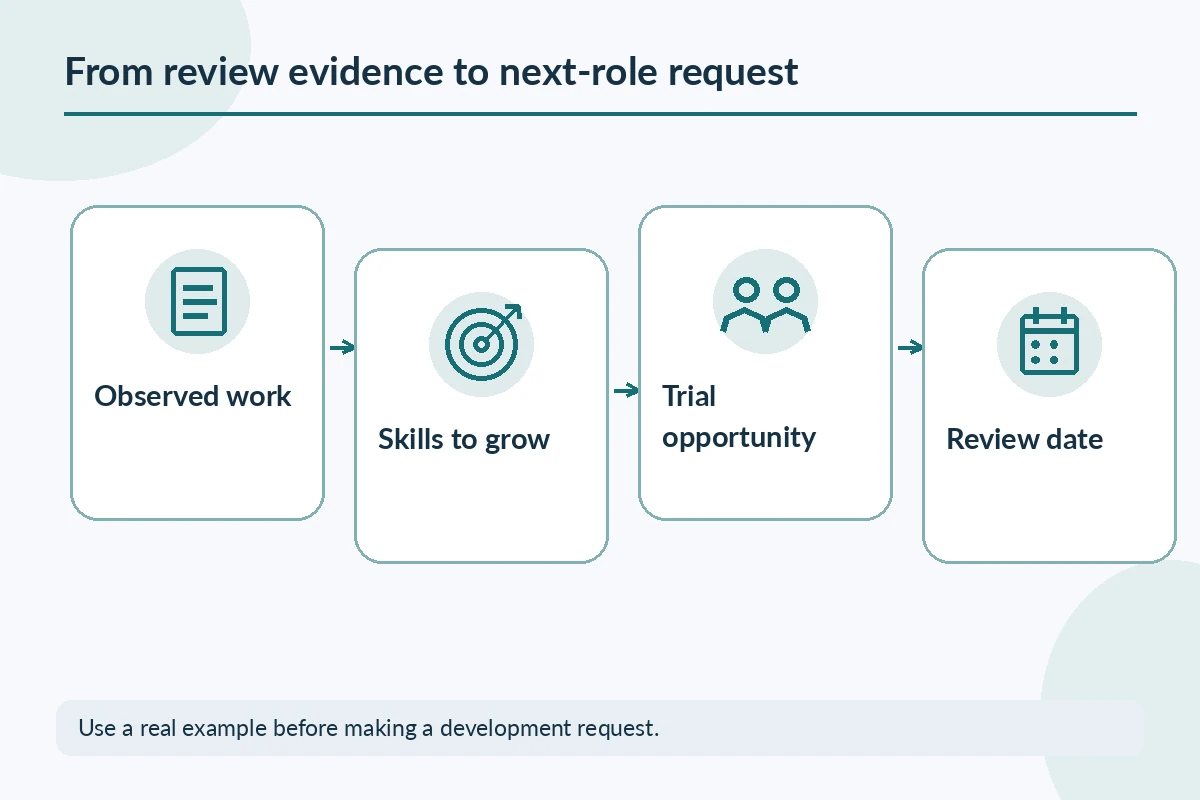
Collect two or three examples from the period under review. Name the work, the decision you were authorized to make, and what another person could verify. An accurate example might be “Maintained the shared handoff list and highlighted unresolved requests before shift change.” That is stronger than “I am ready for management” because it provides a concrete starting point, even without a management title.
Be careful with results. If you did not track response time, cost savings, or customer satisfaction, do not invent percentages. Use observable outputs such as a revised handoff guide, a meeting agenda, a completed training session, or feedback you received. Remove names and sensitive customer or coworker information before putting an example into a review document.
Name the next responsibility rather than only a job title
A title such as “team lead” can mean very different things across employers. Translate it into responsibilities: coordinating assignments, documenting changes, coaching a new hire under an approved plan, or reviewing work before it reaches customers. Then ask which of these activities is actually part of the role you hope to pursue.
It is reasonable to say that you are exploring a path rather than committing to it forever. “I want to test whether project coordination suits me” is more accurate than promising you will become a director within a fixed number of years. Ask which tasks would build evidence of readiness and which require a formal appointment or approval.
Turn your aspiration into a testable development request
Give your manager a bounded option to respond to: a shadowing session, a short-term assignment, approved training, or a chance to lead one meeting with feedback. Specify a deliverable and review point, while leaving room to adjust workload and access. For example, ask to prepare the agenda for one monthly coordination meeting and obtain written feedback afterward.
Match the request to business needs. If coverage is tight, propose a smaller trial that does not disrupt essential work. If the manager says the activity is not permitted in your current role, ask what preparation would be appropriate instead. Your long-term aspiration can remain unchanged while the immediate step changes.

Use a script that separates past work from future interest
Illustrative script: “During this cycle, I coordinated the status sheet for the weekend handoff and followed up on missing information. I would like to grow toward planning and cross-team coordination. I know I need more practice estimating work and identifying risks. Would a supervised planning assignment be possible, and what would good performance look like?” Adapt every sentence to your real experience.
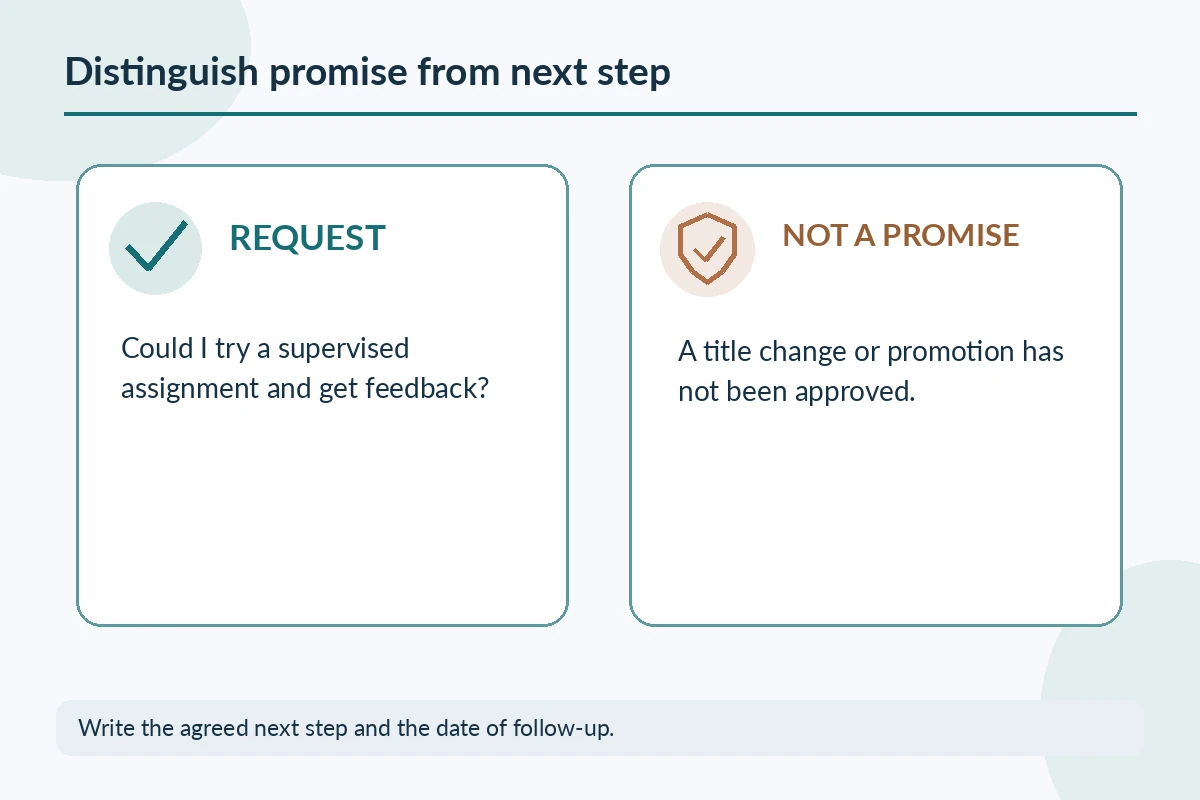
Notice what the script does not do. It does not demand a promotion, claim that colleagues endorsed you, or assume training budget approval. It gives your manager something specific to accept, modify, or decline. If the manager prefers a different development step, ask how that option connects to the skills you want to build.
Handle an uncertain or negative answer constructively
A manager may be unable to offer the opportunity because of staffing, permissions, or timing. Ask what evidence is missing, whether a smaller practice task is possible, and when a follow-up would be useful. Avoid turning the conversation into a debate over whether you deserve a title; focus on the observable work and published role requirements.
If there is no internal path, document the capabilities you can build lawfully and within your current responsibilities. External career research may become part of a private plan. You do not need to disclose a speculative external job search merely to make your workplace development statement sound ambitious.
Write a realistic checkpoint in the review form
End with one sentence each for direction, action, evidence, and timing. Example: “Explore project coordination by supporting an approved handoff improvement, documenting the issues identified, and reviewing feedback at the next quarterly check-in.” Replace “quarterly” with your actual review schedule; organizations have different cycles.
Confirm who owns the task, who will provide feedback, and where the written record belongs. Only list commitments the other person has agreed to. If the aspiration is recorded but the assignment is not approved, write “proposed” or “pending discussion” rather than presenting the trial as authorized.
Keep the aspiration aligned with your own priorities
A useful aspiration should reflect what you actually want to practice, not only what sounds impressive during appraisal season. Before writing the form, ask yourself whether the work you want involves people leadership, technical depth, planning, teaching, or a different kind of schedule. Then choose a near-term activity that lets you experience that work without committing to a role you have not tried. This avoids turning a development conversation into a rehearsed promotion pitch that may not match your interests.
You can maintain a private list of alternative paths. In the formal review, describe the direction most relevant to your current position and opportunities that your organization can reasonably discuss. Do not overstate your willingness to relocate, supervise people, or take on extra unpaid time. A good aspiration helps both sides see a feasible next step and the support it requires.
How We Research These Career Goals
We checked MIT Human Resources UC Davis Human Resources CareerOneStop on October 29, 2026, for goal-setting methods and the role-specific facts in this guide. Examples are hypothetical and intended to be adapted to actual duties, employer rules, and available opportunities; they are not evidence that a promotion, assignment, credential, or clinical authority is guaranteed.
JobAsk prioritizes practical informational guidance and internal reading paths. Read our affiliate disclosure; links here do not indicate a paid partnership or a verified employment outcome. Confirm any internal eligibility, training, or access requirements with the relevant organization.
Explore Related Career Guides
- How to Respond When You Disagree With a Performance Review
- Annual Performance Review Questions: Ask About Evidence and Priorities
- Performance Review Goals: Set Measurable Priorities for the Next Cycle
- Overall Performance Review Comments: Write a Balanced Final Summary
- 30-Day Employee Performance Review: A Manager Check-In With Real Evidence
Yes, if it matches your interests, but describe the responsibilities you want and the evidence you still need. A review discussion is not itself approval for a new position.
Choose a skill or responsibility to explore over the next few months. A limited, reviewable experiment is a valid development goal.
Yes. Identify an observable deliverable or feedback checkpoint rather than inventing measurements that were never recorded.
Ask which competencies would matter for a future opportunity and whether a bounded learning task is available now. Do not assume a vacancy will appear.
A performance goal addresses expected work in the current role; an aspiration identifies a possible future direction. The development plan can connect the two.