
Career goals near retirement are not limited to stopping work on one date. You may want to continue in your current role, reduce hours with your employer, move into a less demanding bridge job, or leave paid work entirely. A useful plan compares those possibilities using schedule, tasks, income needs, skill use, and handoff responsibilities. It does not presume that a phased-retirement program exists or give personal tax, pension or investment advice. Start with what you want the next period of work to feel like and verify the options available to you.
Separate work preferences from financial decisions
Write down the work factors you can assess directly: weekly hours, commuting, travel, physical demands, ability to teach others and tolerance for variable schedules. Keep these distinct from pension distributions, Social Security decisions, health coverage and taxes. Those financial questions may alter which options are possible, but they require your actual plan documents and qualified advice rather than a generic career worksheet.
A sample preference statement is ‘I would like work centered on mentoring and documentation, ideally with predictable hours.’ This describes an employment goal, not a commitment to retire on a certain day. If you need a particular income or benefit arrangement, identify it as a question for HR or an appropriate benefits professional before you accept a reduced schedule.
Compare three possible routes without assuming access
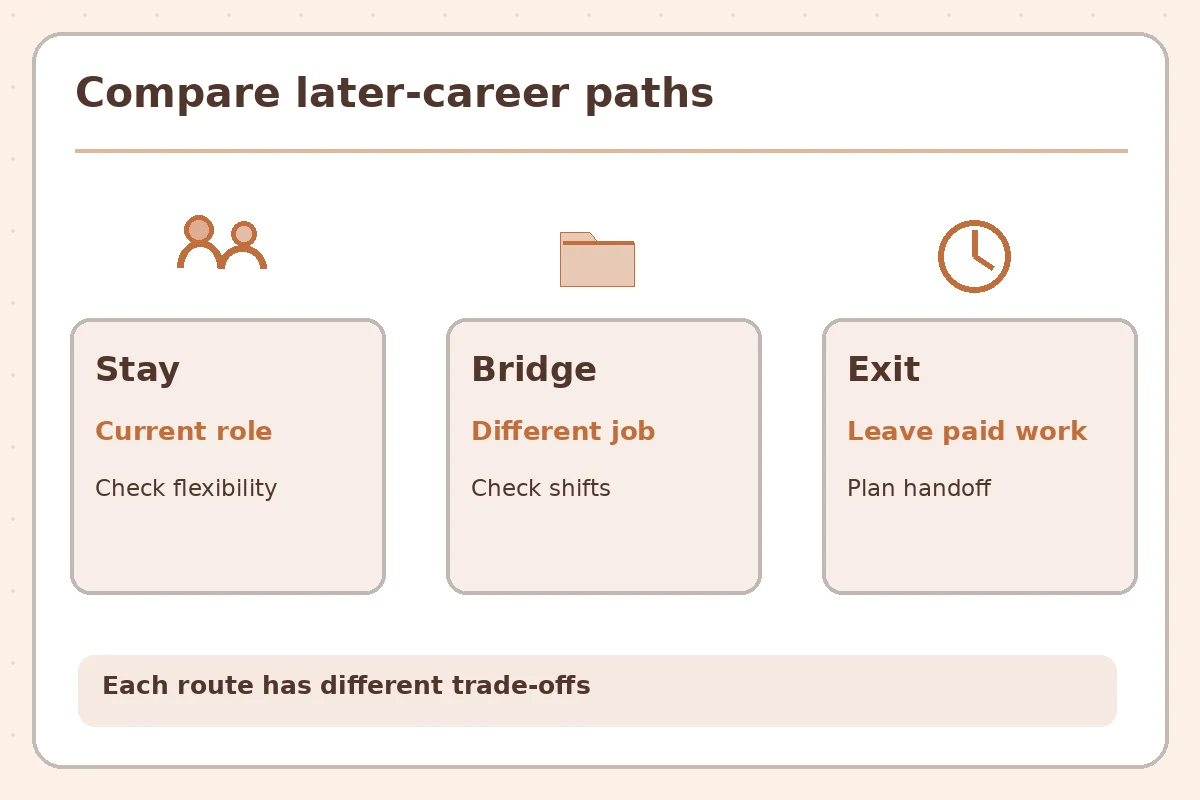
A phased arrangement means gradually changing workload with an employer if such an arrangement can be negotiated and approved. A bridge role is a different job—possibly with another organization—that better matches your priorities. A full exit ends your paid employment and may still leave room for volunteering or learning. Compare the routes for duties, hours, continuity, organizational needs and the certainty of each option.
Do not announce a reduced schedule to colleagues before discussing it with the authorized manager or HR contact. Your employer may have no phased option, or an informal proposal may conflict with benefits or staffing requirements. Likewise, a bridge job is not automatically easier; its shifts, training and workplace expectations need research. Keep a fallback route when the preferred option is not offered.
Identify work worth retaining and work to hand over
List the functions you enjoy and perform well, especially those that are hard for others to learn from a written manual. Maybe you like coaching new staff, answering complex client questions or reviewing quality documentation. Then identify responsibilities that require continuous ownership, such as approvals, vendor sign-off or emergency response. A sustainable arrangement cannot simply leave an unattended gap in the operation.
A handoff map should name the process, the designated receiving person or team, the authorized documentation location, and any open issues. Do not copy confidential files into your private archive as a leaving-work keepsake. Where records belong to the employer, organize them within approved systems and ask who will maintain them after your transition.
Prepare an employer conversation about a flexible role
Propose a workable business arrangement, not a personal entitlement: ‘I am exploring whether a reduced schedule could support mentoring and documentation while another colleague takes over daily approvals. Is there a formal process to discuss options and benefit effects?’ This leaves the decision to the employer. Have a draft schedule and list of tasks, but be ready to change them based on actual staffing requirements.
Ask precise questions: would duties and reporting lines change; who approves the schedule; what happens to health and retirement benefits; how will time off work; and are there return-to-work restrictions? Do not accept verbal assurances about eligibility as a substitute for plan documents. Record agreed details in the appropriate workplace channel after the conversation.

Test a bridge job against daily reality
If a different job looks appealing, compare its real working conditions rather than its title. A part-time visitor-services role may involve weekends and standing; an advisory assignment may have project deadlines; consulting work may require independent client acquisition. Use the job posting and an informational conversation to check hours, travel, required training and what tasks you would actually perform.
Avoid assuming years of experience remove the need for role-specific training. Write a short learning plan for tools or procedures that have changed since you last used them. If you previously supervised others, be clear about your interest in an individual-contributor role and explain which hands-on skills you can demonstrate now. No employer is obligated to offer a different arrangement just because it suits your desired timeline.
Build a knowledge-transfer schedule that is usable
A useful handoff includes a list of recurring tasks, critical contact channels, approved instructions, current ownership and escalation rules. Schedule a demonstration only with the receiving employee’s manager’s agreement. Make time for questions and a check that the next person can find records without relying on your personal inbox or memory. Do not claim the transfer is complete merely because you sent a folder.
A sample sequence is: inventory essential processes, identify a responsible replacement, demonstrate one routine cycle, review open work and confirm the receiving team’s acceptance. The actual handoff might take days or months depending on the role. Your goal is continuity without keeping unofficial responsibility for decisions after you leave or reduce hours.

Leave room to revise the timeline
Choose an initial review date for your options, such as after speaking with HR and comparing two possible roles. Keep a record of what is confirmed, still tentative or unavailable. If reduced hours are declined, update the plan without describing a future departure as already approved. A career plan is a decision aid, not a contract or a benefits determination.
Consider whether you want to preserve mentoring relationships, learn a new skill or contribute through occasional projects after full-time work. Those goals may be meaningful even without a promotion or title change. Keep the next step small and reversible whenever possible, especially when important employment and benefits details remain unsettled.
How We Research and Verify the Guidance
We reviewed role-specific source guidance, compared the intended reader decision with previously prepared JobAsk topics, and distinguish illustrative scenarios from official employer or institutional policy. Source references checked on 2026-11-10: AARP: Phased Retirement (AARP discusses phased work, reduced hours, role handoffs, and employer-specific arrangements.) AARP: Workplace Flexibility (AARP distinguishes flexible options such as job sharing, part-time work, and phased retirement.) UC Berkeley: Informational Interviews (Berkeley separates informational interviews for learning from job interviews and offers preparation and follow-up steps.) We do not imply that training completion guarantees authority, hiring or a workplace benefit.
This page is independent informational guidance, not a statement of any employer’s policy or a paid endorsement. Review the affiliate disclosure and verify local policies, job qualifications, and any individual benefit or licensing details before acting.
Explore Related Career Guides
No. Availability depends on employer policy, role requirements and individual arrangements. Ask HR what is offered and request written explanations of any benefits impact.
It is work taken between a main career and full retirement, sometimes with a different employer or schedule. Evaluate the actual duties and conditions rather than assuming it is low stress.
Yes. Goals can prioritize mentoring, technical contribution, service or a manageable schedule; a promotion is not the only valid measure of career development.
Share availability and relevant facts as required, but do not claim an uncertain retirement date is fixed. Consider the actual application question and employment rules.
They might. The result depends on your plan and circumstances. Review official documents with HR and qualified benefits or financial advisers.