
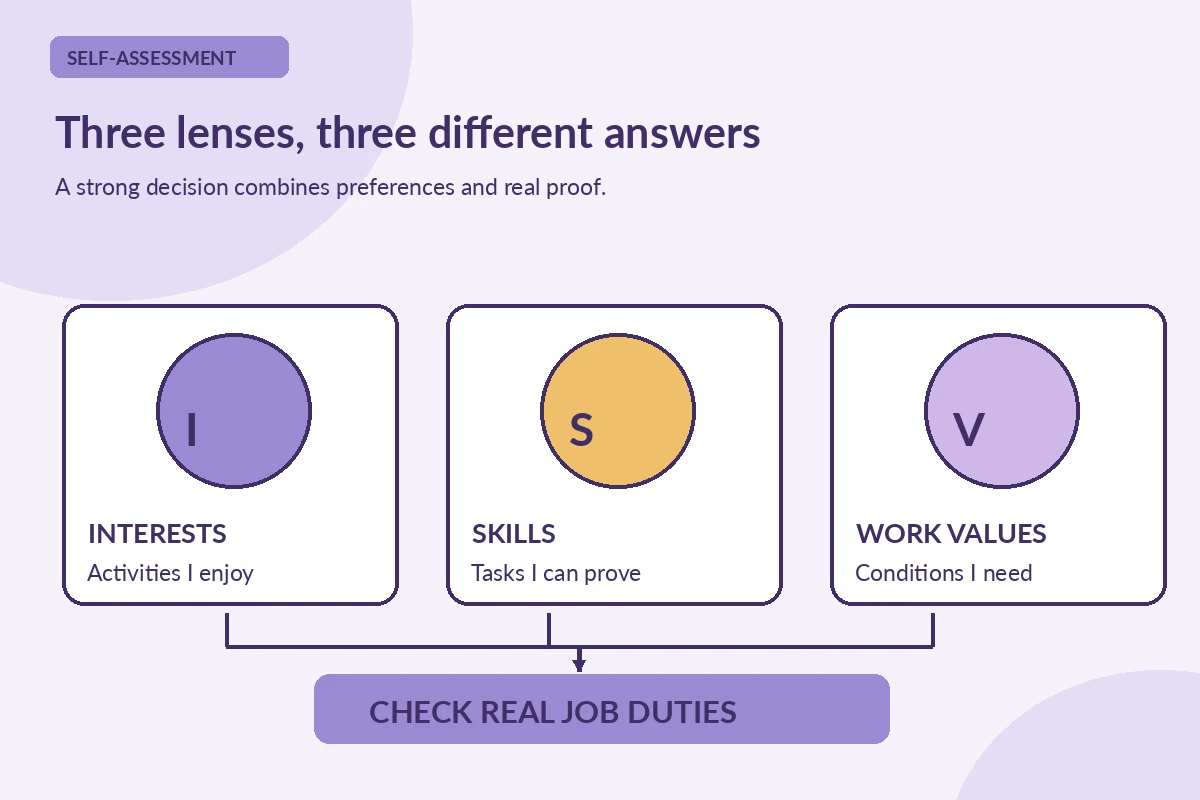
Career self-assessment is not a test that assigns you one perfect occupation. Use three separate questions: What work activities interest you? Which skills can you actually demonstrate? What conditions and values matter in your daily work? Tools such as the O*NET Interest Profiler and CareerOneStop Work Values Matcher help explore answers, but occupational matches are starting points for research. Compare those suggestions with real job duties, training requirements and your current evidence. A high interest score is not a license, a qualification or a prediction of hiring.
Separate interests from abilities and personal priorities
Interests describe activities that attract your attention: analyzing patterns, persuading people, making things or helping others. Skills describe capabilities backed by experience, training or observable work. Values describe conditions such as autonomy, supportive management, service or stability. Someone may enjoy analyzing data without yet knowing spreadsheet tools. Another person may be skilled at selling but dislike the schedule or working conditions of a particular sales job. Blurring these categories can make an attractive-sounding occupation a poor practical fit.
Draw three columns and record specifics from your own life. For interests, note tasks you repeatedly choose; for skills, name a class project, volunteer duty or paid responsibility; for values, describe a condition you would not willingly trade away. Do not score yourself as an expert based on one easy experience. This exercise differs from a résumé inventory because its purpose is to test choices before committing to education, applications or costly training.
Use the O*NET Interest Profiler as a question generator
The US Department of Labor-supported O*NET Interest Profiler examines six types of vocational interests: Realistic, Investigative, Artistic, Social, Enterprising and Conventional. Its results can link to occupation profiles on My Next Move. Record your highest activity interests, then inspect the actual tasks of several suggested roles. Do not translate a letter code into a fixed identity. The result is useful as a conversation starter, particularly when you have little work experience, but should not override meaningful lived evidence.
A hypothetical student might discover that investigative activities are appealing but find that the suggested jobs vary widely in required mathematics, schedules, or professional licenses. That does not invalidate the interest; it shows the need to compare conditions and entry requirements. If you dislike a suggested occupation, ask which particular tasks prompted the match. You might find those activities in another industry with a more realistic training pathway or safer working conditions.
Gather skill evidence instead of rating your confidence
Write examples of tasks you performed, who supervised them, tools you used appropriately and the standard you were expected to meet. NACE identifies career and self-development among career-readiness competencies and includes self-awareness and feedback-seeking as observable behaviors. A real sample project may support a skill claim better than “I am excellent at leadership.” Revisit feedback without copying confidential material or using a private performance review in a public portfolio.
Use categories such as demonstrated, practiced with support and not yet practiced. Suppose you helped organize a school event and handled attendee questions while a staff member managed payments. You can document communication and scheduling support; you cannot claim you independently audited accounts. This distinction matters because an assessment should help you plan learning, not encourage you to embellish qualifications. If evidence is weak, treat that as a prompt for a safe practice opportunity.
Clarify your work values without judging other people
CareerOneStop’s Work Values Matcher asks users to sort 20 statements about their work preferences and groups results into six values. It is a tool for naming priorities, not diagnosing personality. You might prioritize predictable hours, freedom to choose methods or service-oriented work. Two people with similar skills may reasonably select different occupations because their preferred conditions differ. Be precise: “Need a consistent evening schedule” is more actionable than “Want a good culture.”
Values also apply to individual employers within the same occupation. A job title rarely tells you how closely a supervisor reviews work or what the actual shifts will be. Use job ads, credible employer materials and suitable informational conversations to test those details. Do not infer that every workplace in a field is supportive or that a particular employer will accommodate a preference. Note which conditions are essential, which are negotiable and which remain unknown.
Compare several occupations against the three lenses
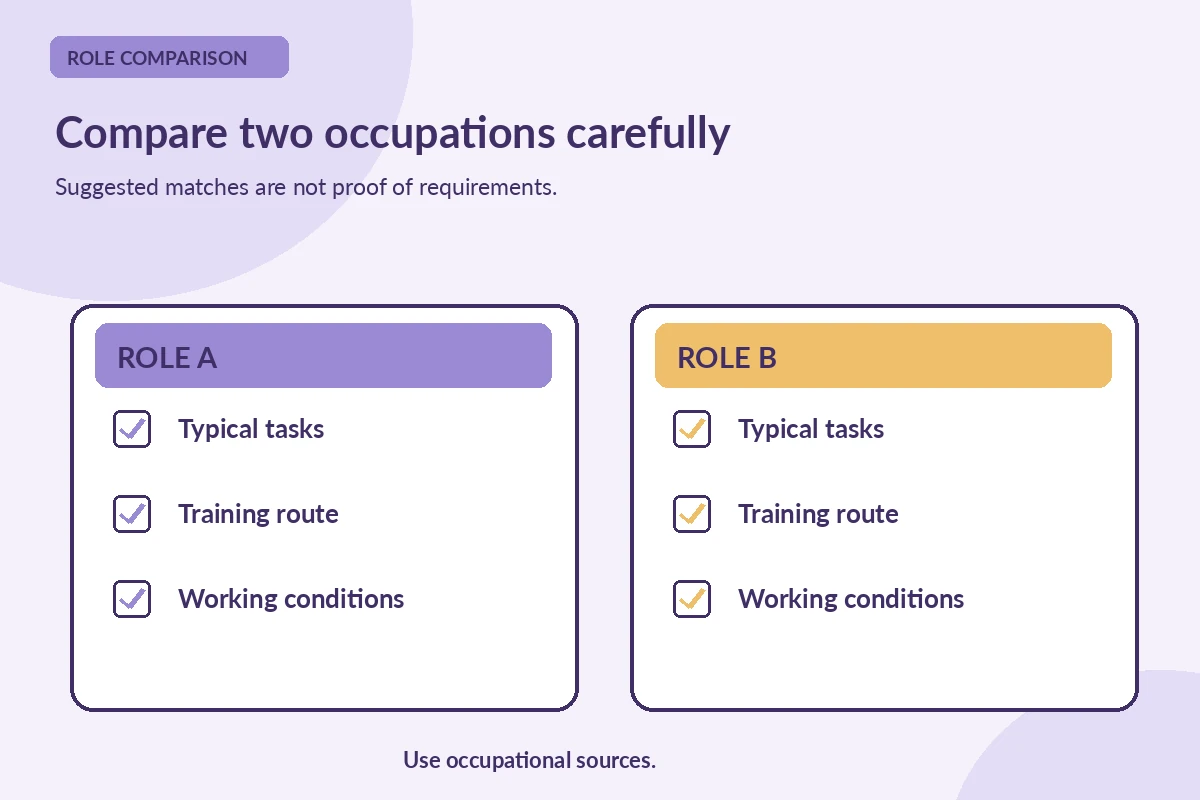
Choose two or three occupations to research rather than treating the first match as the answer. My Next Move and the Bureau of Labor Statistics Occupational Outlook Handbook describe typical work tasks and entry requirements. Record the differences between occupational information and a specific employer’s posting. Look for skills you can demonstrate, skills requiring education or supervised practice, and licensing or credential requirements you cannot skip simply by showing interest.
A hypothetical comparison might pit an administrative coordinator role against a technical support role. Both could involve organized records and helpful communication, but one might demand different systems knowledge or schedules. Label each row supported, unknown or needs training. Do not insert made-up salary numbers or assume a national career profile reflects wages in your local area. A comparison is only as trustworthy as the dates and sources you record.
Run a small reality test before making a large commitment
Use low-risk experiments: complete a public practice exercise, observe a role with permission, interview someone who describes their typical tasks, or review a starter curriculum. Do not request access to client data, regulated duties or sensitive systems for the sake of exploration. If a trial requires equipment, supervision or credentials, ask for the approved route first. Track which parts you enjoyed and which you could actually do, instead of relying on enthusiasm alone.
After the experiment, write one observation about interest, one about skill and one about working conditions. An uncomfortable task may be a learnable gap rather than proof that the whole field is wrong. Conversely, a fun introductory video is not proof that you enjoy the role’s routine work. Revise your list of options as you gather evidence. A career direction can remain provisional while you investigate training costs and time commitments.

Protect your agency when interpreting assessment results
An assessment does not give an employer authority to reject you from a role or tell you which credential you already possess. Do not share personal test results with recruiters unless you have a legitimate reason and understand the request. Avoid services that promise certainty, guaranteed placement or immediate fees for a supposedly exclusive match. Trusted public tools are available for exploring interests and occupations without purchasing an expensive personality report.
Close your worksheet with a next action rather than a permanent label: compare two occupation descriptions, ask a career counselor about a training requirement, or test one skill with public data. Your experiences and constraints can change. Returning to the same assessment later may spark different questions, but the evidence from real tasks, actual conditions and reliable occupational sources should remain central to your decision.
Use this practical comparison worksheet
This table uses illustrative examples rather than actual candidate results or employer promises. Adapt its fields to legitimate requirements, your own work history, and the support or permission available in your setting.
| Self-assessment lens | Evidence to record | Mistake to avoid |
|---|---|---|
| Interests | Activities you choose repeatedly | One test result is destiny |
| Skills | Real task, tool, level of support | Confidence equals mastery |
| Work values | Must-have conditions | A job title reveals culture |
| Reality check | Verified duties and requirements | A profile promises a job |
How We Research Career Planning
JobAsk compared this topic with the user-provided WordPress article inventory and reviewed public search results, US career research resources and primary occupational guidance on November 6, 2026. Examples are hypothetical, not verified testimonials or hiring outcomes. Any role-specific authorization, educational program or employer policy must be confirmed separately. See our affiliate disclosure.
Sources checked November 6, 2026: www.onetcenter.org — O*NET Interest Profiler identifies six occupational interest areas and offers career-starter materials; scores are exploration leads, not hiring credentials.; www.mynextmove.org — My Next Move shows typical tasks, skills, training and career information for occupations and links to interest exploration.; cloudfront.careeronestop.org — CareerOneStop Work Values Matcher is a 20-statement work-preference card sort identifying six work value dimensions.; www.naceweb.org — NACE names career and self-development alongside communication, critical thinking and other career-readiness competencies and observable behaviors.; www.bls.gov — BLS Occupational Outlook Handbook profiles describe occupation duties, working conditions, typical training, wages and outlook, not personal hiring guarantees..
Explore Related Career Guides
Different tools explore interests, work values or skills. Do not combine their scores into an invented hiring-readiness grade.
No. It explores work-activity interests and related occupations; it does not certify skills or authorize regulated work.
Treat the difference as useful information. Look for related roles or a realistic supervised learning route.
Their importance depends on your needs. Compare schedules, support and other conditions alongside actual compensation information.
Yes. Career exploration is iterative; update the options when real duties, skill practice or life constraints change.