
A problem-solving self-assessment is strongest when it shows how you identified a work problem, checked its constraints, selected a permitted action, and verified what happened next. You do not need to claim that you solved a company-wide problem or saved a made-up amount of money. Write one short example from the review period and separate your own actions from the decisions of a supervisor, specialist, or team. The hypothetical examples here illustrate structure; replace every detail with your own records and use your employer’s actual evaluation questions and standards.
Define the problem in operational terms
Begin with a concrete work obstacle rather than a trait such as “excellent problem solver.” Explain which task was blocked, what the expected process required, and how you became aware of the issue. An administrative employee might notice two versions of a request form in a shared folder. That is a verifiable discrepancy; it does not prove negligence by the document owner or justify editing a controlled form without permission.
A good opening can be as narrow as: “While preparing weekly intake records, I found inconsistent field labels between the request sheet and the published instructions.” State whether you encountered this once or repeatedly only when records support the frequency. Your self-review should enable a reader who was not present to understand the setting without seeing confidential customer, personnel, or patient information.
Show the options you considered and discarded
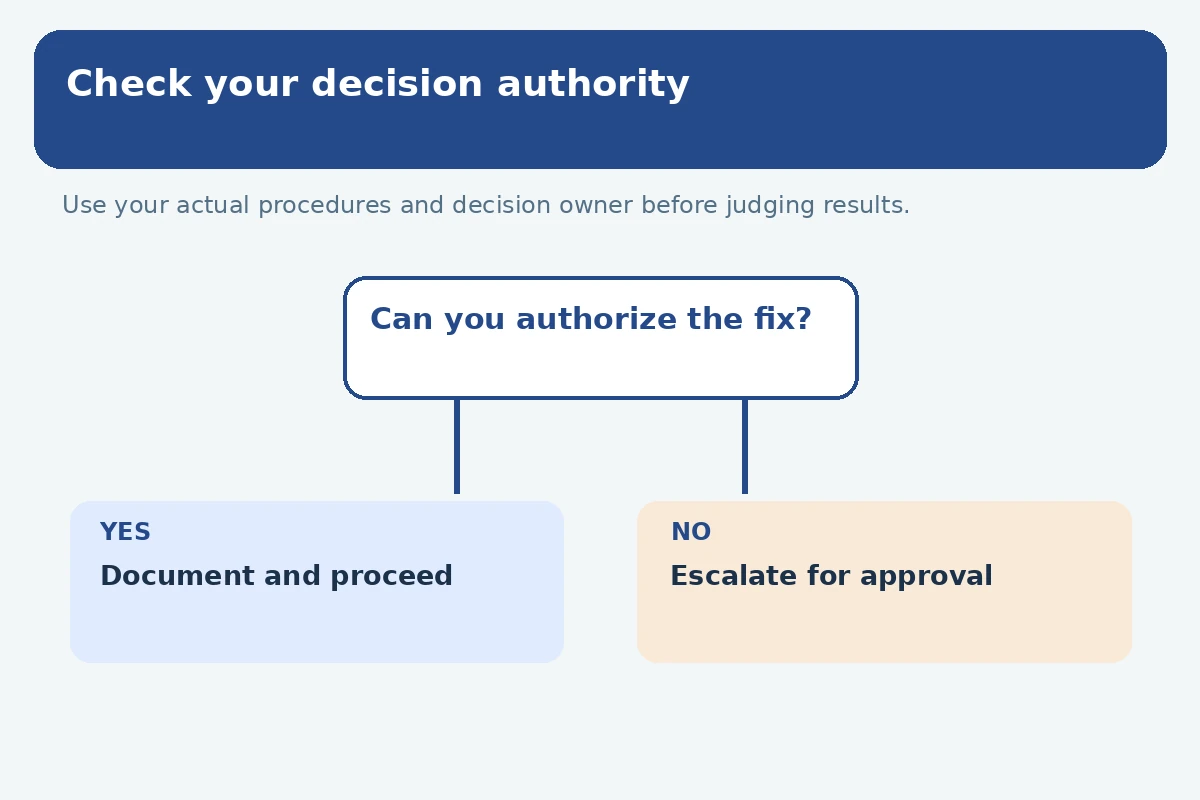
Problem-solving includes recognizing why an apparently fast fix may be risky. If a system field looks wrong, you might compare it with approved instructions, ask the process owner for clarification, or hold the affected transaction for review. Do not claim that you personally changed access rights, policy text, or financial records if the work required someone else’s authorization.
Your self-assessment can name two reasonable options and explain why you chose one. Example: “I considered submitting the request using the old field name, but the mismatch could have sent it to the wrong team. I asked the process owner to confirm the current format before continuing.” This is evidence of judgment, even if the employee did not control the underlying software.

Explain your contribution and the approval boundary
Use verbs that identify what you did: checked, compared, documented, proposed, tested under guidance, or escalated. Reserve verbs like approved, implemented, certified, and resolved for decisions you truly owned. A project may succeed because several roles contributed; the self-assessment should credit collaborators and distinguish your piece of work from the final approval.
If the issue was safety-sensitive, stop the affected activity and follow the established reporting process rather than improvise outside training. A self-review is not a reason to describe an unauthorized workaround as initiative. The best examples often show restraint: recognizing a limit and involving the person responsible for the higher-risk decision.
Write a before-and-after result without inventions
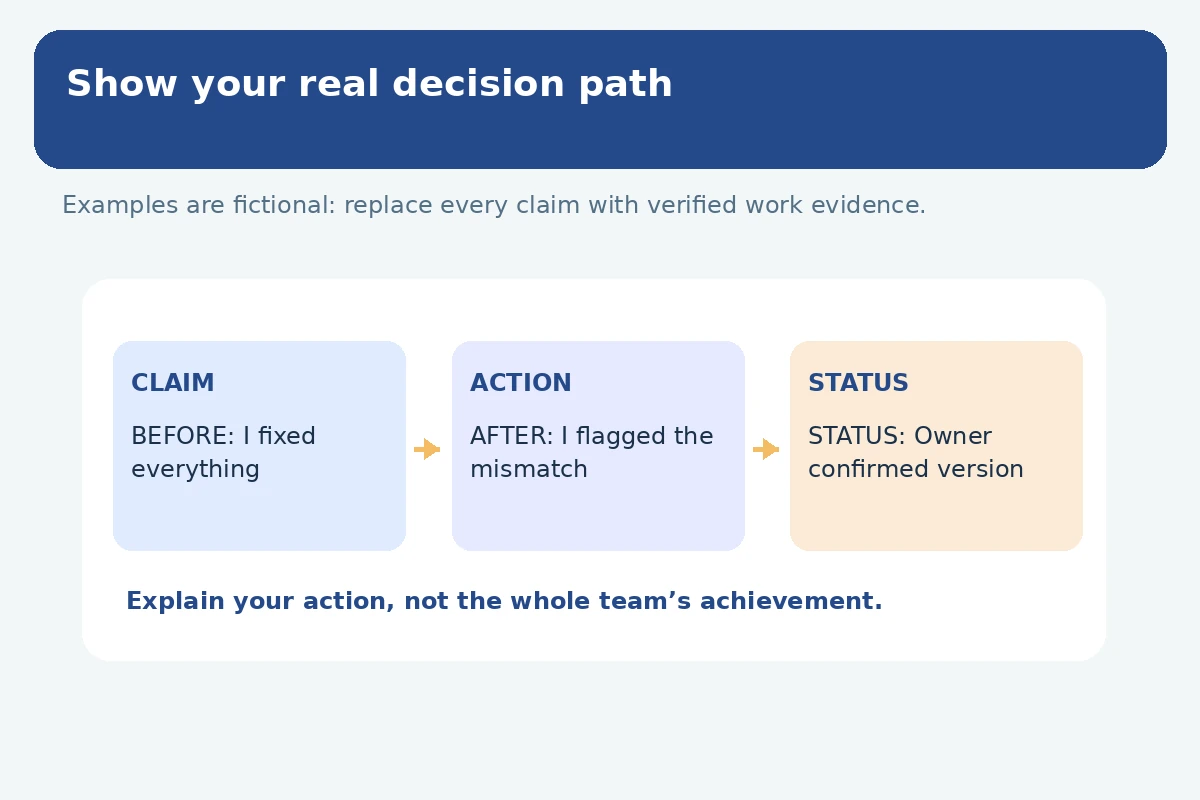
A result can be modest: the correct owner received the discrepancy, the current template was identified, or a handoff was documented more clearly. Use a number only when you can verify it from records the organization permits you to use. A draft that says “eliminated all errors” needs unusually strong evidence; most work situations support a narrower description.
A fictional sample answer is: “I compared the two intake instructions, listed the conflicting fields, and sent them to the document owner. After the owner confirmed the correct version, I used it for the next request and shared the approved link with my team.” Here the employee did not claim authorship of the policy or ownership of the entire improvement.
Handle an unresolved issue honestly
Some problems are not fully solved by the end of the performance cycle. State the status plainly and identify the next decision owner. For example: “I documented the mismatched routing rules and raised them in the weekly meeting; the systems team is still reviewing a permanent update.” That is more useful than presenting an open issue as a completed project.
Where you attempted an approach that did not work, explain the learning step without turning the story into a confession or blaming others. Describe which assumption proved wrong, how you corrected your understanding, and what you will check earlier next time. The goal is to help the reviewer understand decision quality, not to disguise setbacks.
| Review focus | Example evidence | Important limit |
|---|---|---|
| Problem | Two versions of one intake instruction | Do not infer who caused it |
| Options | Compare instructions or ask owner | No unapproved edits |
| Action | Documented mismatch and escalated | Manager confirmed current version |
Choose evidence appropriate to your job
For office coordination, relevant evidence could be a version comparison, decision note, or approved handoff. For customer support, it might be the sequence of ticket questions and an escalation record. For technical work, it might be a reproducible test and a reviewed change request. In each setting, protect data and state whether the artifact is a personal contribution or a team document.
If the organization measures quality or timeliness, connect the example to those agreed standards. If it does not, avoid inventing a score. You can still describe a useful verified outcome, such as a missing attachment found before submission or a conflicting instruction clarified before a customer response was sent.
Turn the review into a next-step commitment
A good development step targets the exact part of the decision process that needs strengthening. You might practice documenting alternatives more consistently, learn the approved escalation channel, or ask for feedback on issue summaries before sending them. The action should match responsibilities you can actually hold within the coming cycle.
Before submitting, check that a manager can see the problem, evidence, your role, status, and requested support. Remove invented results and any private details unrelated to the review. The most convincing problem-solving self-assessment reads like a small, accurate case study rather than a collection of impressive adjectives.
How We Research Fair Performance Reviews
We compared the U.S. Office of Personnel Management’s guidance on clear, verifiable standards and continuous performance conversations with the EEOC’s advice on consistent, factual evaluations. University of Wisconsin–Madison’s HR writing guide provides a useful model for observable behavior and balanced comments; it is institutional guidance rather than a rule for every employer. Each scenario on this page is hypothetical and must be adapted to verified facts and applicable workplace policies. We do not claim any particular rating, pay result, promotion, or legal outcome. For our website disclosure see affiliate disclosure.
Research sources: OPM performance standards; OPM supervisor roadmap; EEOC evaluations; UW–Madison writing guide. Review employment standards, confidentiality rules, and the actual task ownership with your employer before reusing any example.
Frequently Asked Questions About This Review
Explore Related Career Guides
Yes. Describe what you verified, your response, current status, and the person responsible for the remaining decision.
No. Use reliable measures when available, otherwise describe a specific confirmed work outcome without inventing a percentage.
Not when escalation was the appropriate authorized action. Explain why the decision required specialist or supervisor review.
Credit your own actions accurately and name other decision owners where relevant. Do not present a shared result as solely yours.
State the constraint you missed, how you corrected course, and what you changed in your process. Avoid hiding material facts.