
Use a short case interview thank-you email that acknowledges a specific exchange without sending a new solution, revealing proprietary case details, or claiming that you solved it perfectly. Start with the actual interview format, the correct recipient and one detail you can verify from the conversation. Use the examples below as hypothetical models, not ready-made claims about your experience or the employer. A thank-you should reinforce professionalism, not imply a guaranteed offer.
Decide what the message must accomplish
A case interview thank-you email should acknowledge a real conversation, renew your interest, and show professional judgment. It should not become a second case submission. The interviewer may have assessed how you structured the problem, asked clarifying questions, used evidence and adapted when challenged. A note cannot change the original exercise, and claiming it can would create an unrealistic expectation. Choose one discussion point that is safe to mention and say why you found it useful.
Before drafting, separate facts from impressions. Write down the interviewer’s name, the correct role and office, an ordinary topic you discussed, and one genuine reason the work fits your experience. If you cannot remember details confidently, use a truthful broad reference to collaborative problem solving rather than inventing a memorable remark. Keep case facts out of the note if they belong to a client, a proprietary assessment or a confidential prompt.
Choose one case-specific callback without disclosing the case
A productive callback might be that the interviewer encouraged you to test an assumption before recommending an action, or asked how you would validate a rough estimate. That captures a thinking habit, not a secret answer. A weak callback would reproduce the entire market-sizing prompt or claim you found the perfect profitability solution after the interview. The thank-you letter is likely to be read by a busy person and should remain understandable without the case workbook.

If the case was public or fictional, that does not automatically make every detail of the interviewer’s version public. Firms may reuse prompts, data sets, or evaluation rubrics. When in doubt, describe the method generally: “I appreciated discussing how to check the assumptions behind a recommendation.” Avoid identifying a supposed client, attaching your case scratch paper, or distributing a case diagram to multiple people. Professional discretion itself is a relevant consulting skill.
Use a concise example that can be personalized
The following fictional template is an illustration, not a real candidate message: “Subject: Thank you — Associate Consultant interview. Hi Jordan, thank you for speaking with me today about the Associate Consultant position. I appreciated our conversation about testing an initial assumption before drawing a recommendation. That exchange reinforced my interest in the team’s analytical and collaborative work. Thank you again for your time and consideration. Best, Avery.” Replace each detail with something that actually happened.
Notice what the example does not do. It does not praise a firm’s culture without evidence, declare victory in the case, speculate about the hiring decision, or send follow-up calculations. It names the position, acknowledges a specific intellectual exchange and closes courteously. If the interviewer shared a verifiable detail about team practice, you may reference that instead. Do not use an invented statistic about the firm, a client or expected performance to sound more impressive.
Handle a difficult case without a long apology
A case can feel difficult even when the interviewer saw worthwhile thinking. If you got stuck, do not send three paragraphs explaining why you misunderstood the prompt or blaming the assessment format. A note that says you valued the discussion around evaluating alternatives can be sincere even after an imperfect performance. If you need to correct a factual statement that you made about your own employment eligibility or credentials, that is a separate, brief correction and should be accurate.
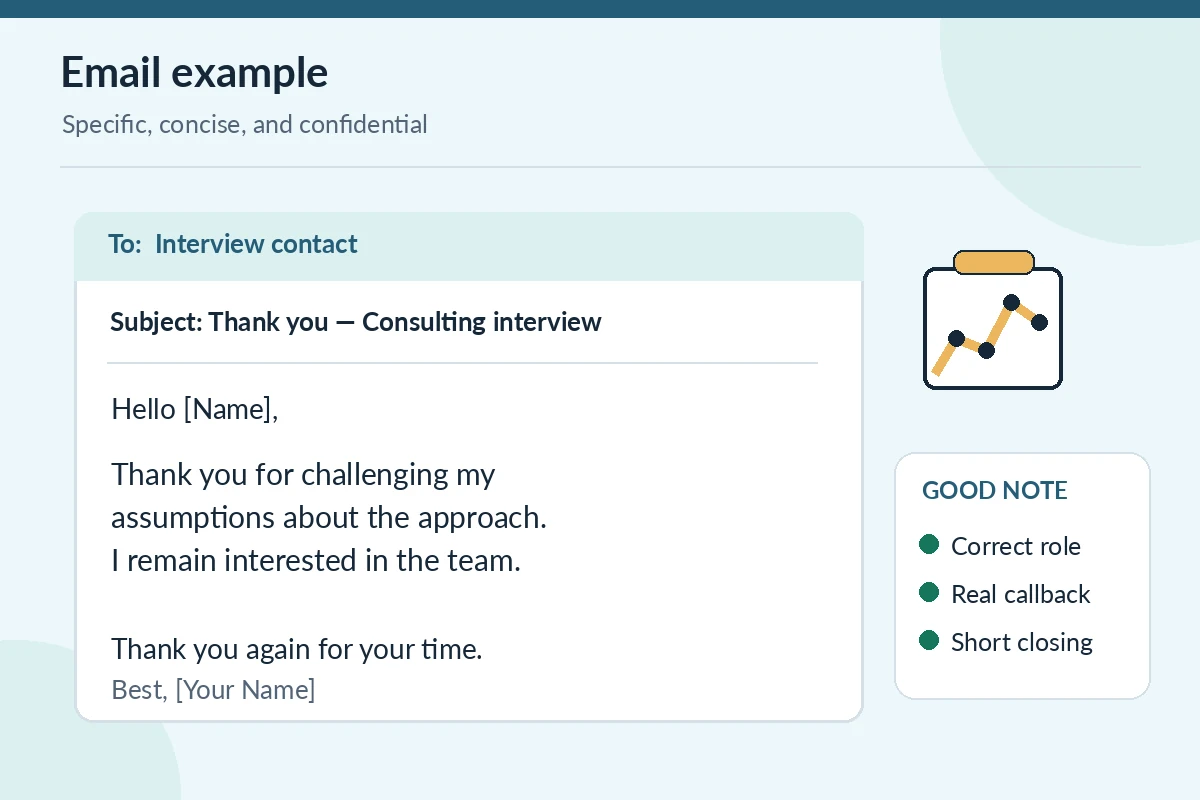
Compare two hypothetical openings. Weak: “Sorry I failed the last section; please disregard everything after the graph.” Better: “Thank you for the discussion and for challenging me to examine the trade-offs before recommending an approach.” The second avoids an unsupported diagnosis of performance. It also respects that the interviewer is responsible for assessment, not the candidate’s post-hoc interpretation of a scoring rubric.
Send the note to the right person in the right format
If you met two interviewers in separate rounds, send an individual message only when their contact details were legitimately provided. Reference the part each person actually discussed. If the recruiting coordinator manages all communication, follow the instructions and ask whether they can forward a short note if needed. Do not infer an email address pattern, scrape personal contact details or mass-message firm partners who were not involved.
Make the subject line easy to place: “Thank you — [Role] interview” is sufficient. A general thank-you note should be brief, readable on a phone and free of attachments unless requested. UC Davis and Penn career guidance both emphasize specificity and brevity. The goal is professional closure and a reminder of fit, not to manufacture influence over an already established selection process.
Keep your evidence proportionate to what you discussed
You can briefly connect the interviewer’s question to a true experience, such as helping a project team compare possible suppliers or checking a data-quality assumption. Do not claim that this experience proves you could lead an entire client engagement. If your own project involved confidential materials, refer to the general method and results only where disclosure is authorized. A single concrete sentence is more credible than a list of impressive but unverified achievements.
If the interviewer explicitly requested a resume update, public work sample or additional information, respond with the requested item through the approved channel and label it clearly. That is different from spontaneously emailing a revised case solution. Read any employer instructions about permitted follow-up before including links. A simple note with no attachment can be fully adequate even after a complicated assessment.
Separate appreciation from later hiring-status follow-up
Thank-you emails and status checks solve different problems. Send the initial note soon after the discussion if appropriate; then honor the timeline the recruiter gave you. A message three hours later asking whether you passed undermines a courteous close. If the firm said decisions would come the following week, record that date and make a separate short inquiry only after the reasonable check-in window.

Do not interpret an unanswered thank-you as evidence of rejection. Individual interviewers may have limited involvement in communicating decisions or may not respond to every note. Keep your application tracker updated, and continue the rest of your search. A thoughtful thank-you should not become a thread of repeated messages or a demand for private evaluation notes.
Run a final discretion and accuracy check
Before pressing Send, read the message as though it could be forwarded to a client or another hiring team member. Confirm the employer name, job title, spelling of the recipient, the specific callback, and the absence of confidential case prompts. Remove exaggerated emotion, complex formatting, links to unauthorized material and any claim that a result or offer is certain. Verify that the greeting and subject fit the actual recipient.
For a final test, ask: “Could I explain this sentence from memory if the interviewer replied?” If the answer is no, replace it. The strongest note is not the longest or most elaborate one; it is a small, honest record of professional attention and interest. You can save a private copy with your application notes so that future follow-up is consistent rather than repetitive.
How We Research case interview thank-you email guidance
We reviewed guidance from university career centers about writing brief interview thank-you messages that refer to real conversations. The scenario-specific recommendations above are editorial applications of those general principles, not claims that a university endorses any particular template. Sources consulted on 2026-11-04: careercenter.ucdavis.edu career guidance (Recommends brief, conversation-specific thank-you emails after interviews.). careerservices.smumn.edu career guidance (Discusses acknowledgments of case or skills-based interview work without writing a long corrective argument.). careerservices.upenn.edu career guidance (Recommends concise, prompt and personalized post-interview follow-up.). Examples are fictional and should be adapted only to your actual experience. See the affiliate disclosure.
More Interview Preparation Guides
Usually no. A thank-you email is not an additional exam submission. A brief reflection may be appropriate if it naturally references the discussion; send a revised solution only when the firm expressly requests it.
You may refer generally to a topic discussed with the interviewer, provided it is not confidential. Avoid revealing case data, client identities, interview prompts or proprietary materials.
Thank the interviewer and mention a genuine learning point, not a long apology or unsupported claim that your conclusion was correct. You can demonstrate calm professional reflection without reopening the test.
Tailor a short note for each person with whom you had a substantive conversation. If you only have one legitimate coordinator contact, use it respectfully rather than guessing addresses.
Sending a brief, accurate message within roughly a day is common career-center advice. Follow the firm’s directions and prioritize correctness over a rushed, generic note.