
Send a concise thank-you email after an interview with a CEO or founder by referencing a genuine business priority, your actual contribution, and the boundaries of what was discussed. Start with the actual interview format, the correct recipient and one detail you can verify from the conversation. Use the examples below as hypothetical models, not ready-made claims about your experience or the employer. A thank-you should reinforce professionalism, not imply a guaranteed offer.
Write to the person, not the title on the org chart
A thank-you email after a CEO interview should be specific and calm. A senior executive might discuss business priorities, customer pressures, hiring decisions, or the first year of the role. Your message should reflect what was genuinely said rather than a generic tribute to “visionary leadership.” The CEO’s title does not require a grander note; it makes accuracy and discretion especially important because the message may be forwarded to the hiring manager or leadership team.
Choose one point from the conversation that relates to the job you applied for. If the executive discussed a service launch, for example, you could mention the importance of cross-team handoffs. Avoid claiming that you were invited to own the launch unless the role’s responsibilities explicitly include that authority. Record the actual business context separately in your private notes so that the email remains concise.
Connect one priority to one real capability
A simple grid prevents flattery. In the first column, note a concrete priority the CEO raised; in the second, note the actual skill or experience you can discuss; in the third, describe an appropriate contribution within the advertised role. An operations candidate might connect the priority of reliable handoffs to experience documenting escalation procedures. That is more credible than promising to “transform the organization” after a brief conversation.

If your experience comes from a small project, label it accurately. A candidate who coordinated volunteers should not claim to have run a large corporate operations function. Instead, describe the relevant action and level of responsibility: tracking tasks, clarifying owners, reporting exceptions or drafting procedures under review. A CEO may appreciate good operational judgment without expecting you to sound like an executive already.
Use an executive-level thank-you example without overclaiming
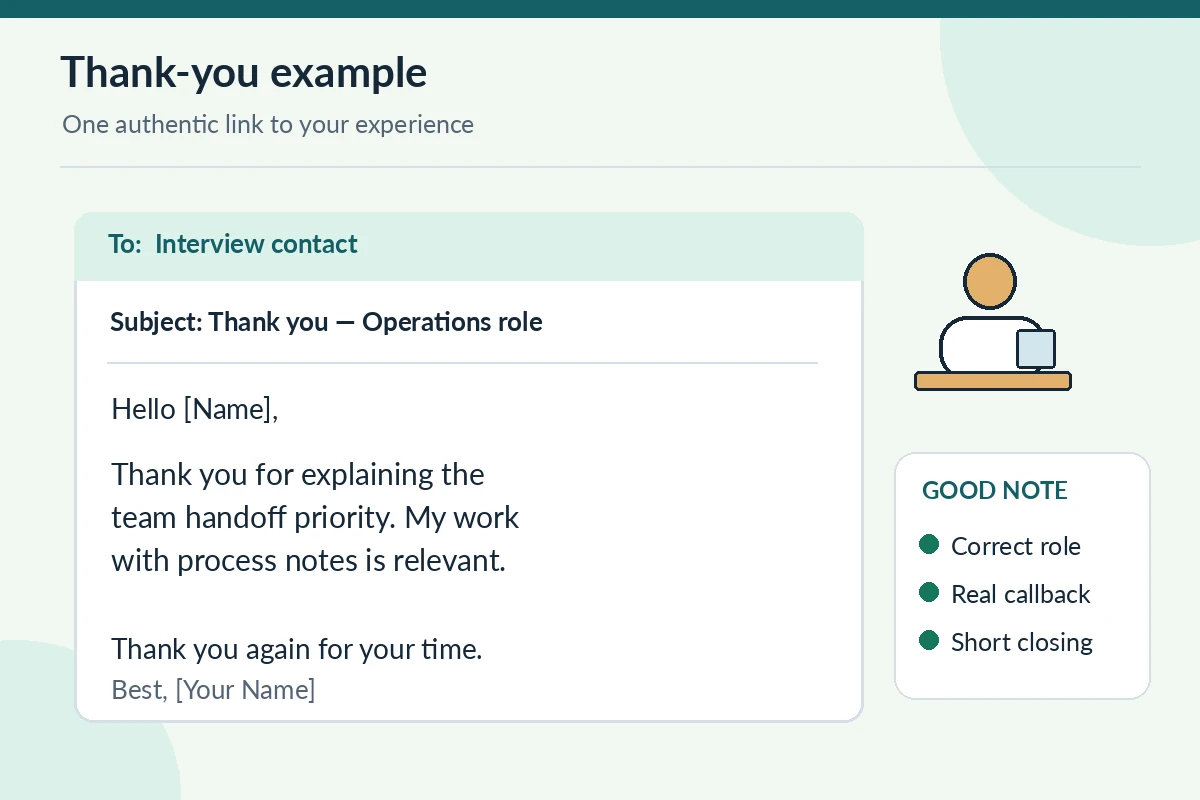
The following is hypothetical: “Subject: Thank you — Operations Lead interview. Dear Casey, thank you for speaking with me about the Operations Lead role. I appreciated hearing how the organization is thinking about smoother handoffs as the service team grows. That discussion connected with my experience documenting recurring process issues and coordinating follow-up with cross-functional colleagues. I remain interested in the opportunity and appreciate your time. Kind regards, Riley.”
The note makes three defensible moves: it identifies the role, refers to a priority discussed, and connects to a genuine contribution. It does not claim the CEO endorsed the candidate’s plan, assign a revenue figure to the prospective work, or imply a contract exists. Change the generic scenario to match your actual interview, or remove the reference if you do not remember it accurately.
Avoid confidential details and invented alignment
Senior leaders may share preliminary ideas, sensitive operational constraints, or information about strategic options. Not everything heard in an interview belongs in a follow-up email. A safe note can refer to “the importance of clear handoffs” without quoting unpublished acquisition plans, customer names or revenue targets. If someone explicitly described information as confidential, leave it out entirely.
Do not write “We agreed I will lead the expansion” when the discussion only explored what the role might involve. You may communicate sincere interest without treating exploratory conversation as an offer. Similarly, avoid telling the CEO that you “fully support the plan” if you have only heard a short summary. Honest attention to the problem is more persuasive than pretending to have comprehensive inside knowledge.
Decide when to include a work sample or extra idea
A CEO may ask about your past projects, but that does not automatically authorize you to send client documents or strategic recommendations afterward. If they requested a specific public portfolio item, share the approved link through the appropriate contact and explain its relevance in one sentence. Do not attach sensitive financial projections, internal reports or screenshots simply to appear proactive.
If a question remained unanswered in the interview, it may be better to note it for a later conversation than force it into the thank-you. A follow-up should not become a shadow consulting project or a claim of ownership before employment begins. The strongest addition is usually a concrete, verifiable example of work you have already done, offered only if relevant and permitted.
Respect the hiring team's communication chain
Even when the CEO interviewed you personally, recruiting staff may manage scheduling, decisions and compensation. Use the contact method provided during the process. If the CEO gave you a direct work address, a brief thank-you is generally appropriate, but do not copy unrelated executives or bypass explicit instructions. If the coordinator asked you to send all correspondence through them, follow that request.
Address the recipient in the manner the conversation supports. Proofread their name and the exact opening before sending. A subject such as “Thank you — [Role] discussion” is clearer than a dramatic statement of commitment. A readable message with ordinary formatting and no attachment works well on mobile devices and does not require a specialized letterhead.
Keep genuine interest separate from negotiation
The CEO may have discussed compensation philosophy, location, travel or reporting structure. An email of appreciation can say that the role sounds aligned with your interests, but should not pretend you accepted terms that have not been provided. If the employer’s stated scope raises serious questions, those belong in a distinct, appropriate conversation with the hiring contact or in a later offer review.

Do not use your thank-you to request an immediate answer or to pressure the executive with a competing-offer deadline. If there is a real time-sensitive fact, communicate it clearly and respectfully through recruiting. The career-center sources recommend prompt thank-you messages, not treating them as a substitute for a thoughtful negotiation or status-check process.
Check every sentence against the real interview
Before sending, underline the one sentence that refers to the CEO’s actual remarks and the one that references your evidence. If either is not true or cannot be explained, revise it. Remove clichés such as “world-changing vision,” claims about guaranteed business impact, invented metrics and promises to accept any terms. Confirm that no confidential detail appears in the email or its subject.
Make sure the note is not a clone of your thank-you to the recruiter. Each person has a different perspective, and a note to the CEO may legitimately reference strategy while a note to the hiring manager references day-to-day work. Maintain a private record of what you sent and the employer’s stated timeline; then let the process proceed without repeated, increasingly flattering messages.
How We Research thank-you email after CEO interview guidance
We reviewed guidance from university career centers about writing brief interview thank-you messages that refer to real conversations. The scenario-specific recommendations above are editorial applications of those general principles, not claims that a university endorses any particular template. Sources consulted on 2026-11-04: www.career.berkeley.edu career guidance (Recommends following up with specifics about the interview and relevant qualifications.). careercenter.umich.edu career guidance (Recommends a role-specific thank-you message after interviews and separating later status follow-up.). careerservices.upenn.edu career guidance (Encourages a personal, specific message that reflects the actual conversation.). Examples are fictional and should be adapted only to your actual experience. See the affiliate disclosure.
More Interview Preparation Guides
Use the form of address they used or the employer’s professional communication norm. When unsure, a respectful name and greeting are preferable to invented familiarity.
Refer to a concrete priority that the executive actually discussed. Explain a relevant skill or interest without claiming access to confidential plans or authority you have not been offered.
A thank-you is normally for appreciation and interest. Direct compensation or contract questions through the designated hiring contact and appropriate stage, unless the executive specifically invited that discussion.
Usually not unless requested. Sending unasked-for strategy proposals can cross information boundaries and shift focus away from the genuine discussion.
The email can still be short. Thank them, mention one real point and express continued interest. Do not presume an offer or try to pressure them for an immediate answer.