
A clinical research coordinator resume summary should lead with the type of study work you can substantiate, not a generic promise that you ‘manage clinical trials.’ Identify the study setting, protocol-related responsibilities, participant scheduling or document work, and the people who reviewed or authorized your activities. O*NET describes clinical research coordinators as planning and coordinating research projects and maintaining compliance documentation, but individual jobs vary considerably. A convincing summary makes a clear line between coordination duties and activities reserved for trained, delegated personnel, investigators, ethics oversight, or clinical professionals.
Identify the study tasks you truly owned
Begin with the actual nature of your work: academic research office, clinical study site, sponsor-support team, or another accurate setting. Create a short inventory of subject visit calendars, protocol version logs, regulatory-binder maintenance, query tracking, participant communication, and data entry tasks. Each item needs a real example. ‘Coordinated appointment windows under a study protocol’ has a clearer meaning than ‘ran all clinical operations.’ If a project involved multiple studies, you can identify the number only if your records support it and disclosure is permitted.
Do not confuse a job title with authorization. A clinical research assistant may schedule visits and organize documentation without independently making eligibility, consent, safety, or clinical decisions. Conversely, someone with delegated training may perform specified activities as directed by an approved protocol. Your summary must be based on the study’s actual delegation and supervision arrangements. Never infer that participating in a research team makes you a principal investigator or licensed healthcare practitioner.
Respect consent, protocols, and reviewer boundaries
HHS Office for Human Research Protections provides guidance on informed consent and investigator responsibilities. That material is not permission for an applicant to claim they independently obtained consent, determined eligibility, or handled adverse events when those responsibilities were assigned to others. Describe what you did: prepared approved study materials, coordinated appointments, maintained document versions, or routed participant questions to the authorized staff member. If you were specifically delegated to conduct an approved consent discussion, say so precisely and only if verifiable.
A hypothetical applicant might write ‘supported informed-consent appointment preparation and maintained version-controlled participant packets under study procedures.’ This is distinct from ‘approved consent forms’ or ‘authorized enrollment.’ Avoid listing named participants, identifiable health records, unpublished study findings, or sponsor-confidential materials. When describing systems, use platform names only if you actually used them and are permitted to discuss that experience. Confidentiality remains part of professional credibility, not a detail to hide in fine print.

| Evidence area | What can be said | Boundary to verify |
|---|---|---|
| Participant visit calendar | Coordinator may schedule and confirm | Protocol timing and assigned review |
| Consent packet | Prepare or route approved materials | Qualified/delegated person handles consent |
| Regulatory files | Track current document versions | Investigator and ethics oversight remain separate |
Draft a summary from protocol evidence
Try this hypothetical example for an experienced support coordinator: ‘Clinical research coordinator supporting outpatient study visits, protocol calendars, and regulatory document tracking. Coordinated schedule changes with investigators and maintained study records for review. Experienced in escalation of participant questions through authorized study staff.’ It does not claim regulatory approval, clinical decision making, or guaranteed research outcomes. Adjust the study type and tasks, and confirm each phrase is supported by a genuine work-history bullet.
For a graduate with research practicum experience, write something more limited: ‘Research assistant with supervised experience organizing visit materials, checking data-entry completeness, and maintaining study logs. Seeking clinical research coordination work with defined training and review procedures.’ Do not substitute ‘clinical research coordinator’ as your past title if you were a student assistant. If you hold research training, say ‘completed [actual training title]’ rather than inventing a GCP certificate or assuming that a course establishes authority to conduct study activities.
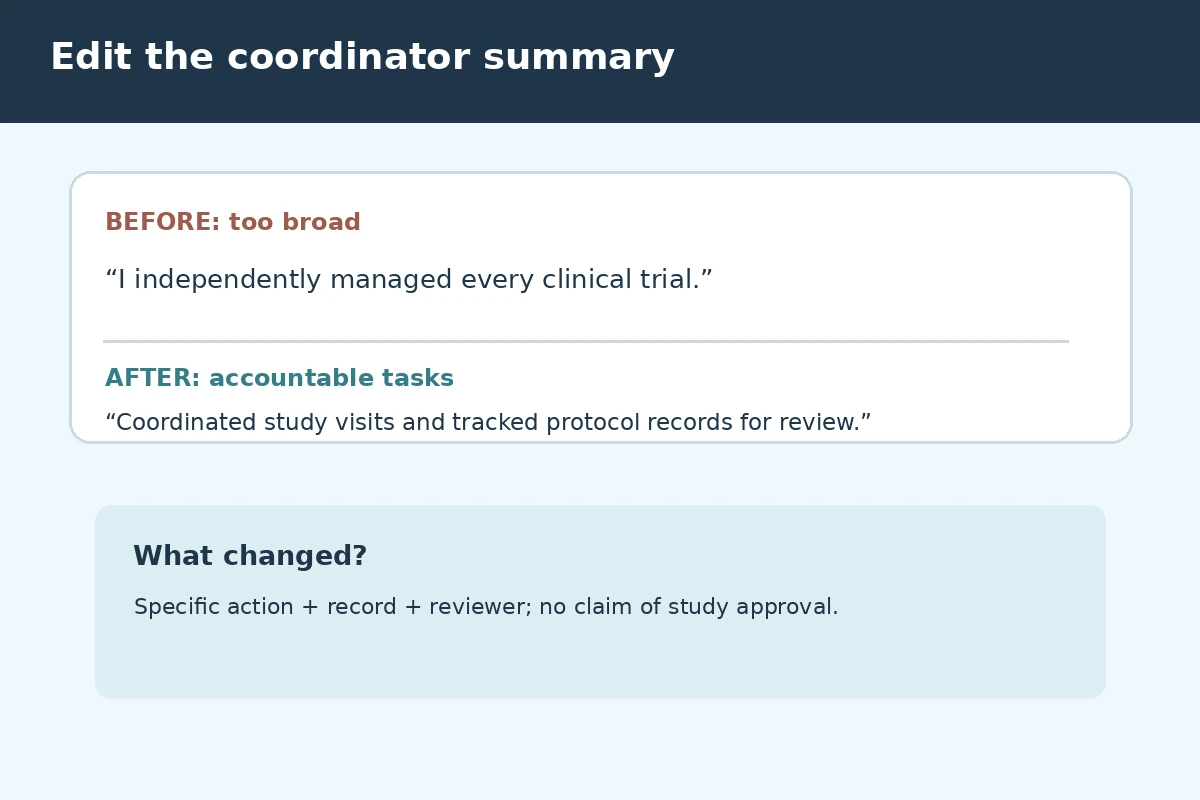
Distinguish a study visit from a study decision
A schedule confirmation, complete document packet, or reconciled data query can be legitimate coordination evidence. A participant’s medical suitability, safety assessment, or regulatory approval is a different responsibility. In your notes, make columns for work you prepared, work you performed under documented delegation, and work another person approved. This helps you write concise statements that survive technical follow-up questions. It also prevents overstating a project in which you observed rather than completed the clinical component.
Treat quality measures carefully. You might know how often you reviewed calendar discrepancies or followed up on missing forms, but should not infer a safety outcome from those numbers. Do not claim that a trial ‘passed an audit’ because you filed paperwork, unless your employer documented the outcome and your contribution is clear. A summary should highlight control of records, accuracy, communication, and protocol awareness, not imply personal authority over the entire study lifecycle.
Match the role description without copying duties
A study coordinator job may prioritize recruitment scheduling, data queries, visit preparation, document control, or working with monitors and site teams. Highlight the closest actual experience instead of stuffing every technical term into the summary. If the posting asks for particular electronic systems, list only those you used, and clarify whether your access was data entry, review, query resolution, or administration. A tool name alone does not show what you did. Use your work bullets to connect the system to a legitimate action and reviewer.
When the opening requires research-related credentials or clinical qualifications, check the specific employer and study-site requirements. O*NET provides an occupation-wide description, not a license or training waiver. If the role seems to require work beyond your expertise, consider an assistant or document-control position with supervised training instead. Make honest distinctions between human-subject research, laboratory research, and routine administrative scheduling: employers may value transferable records skills, but they are not interchangeable without context.

Run a five-minute ethics and consistency audit
Look at every verb. ‘Scheduled,’ ‘logged,’ ‘prepared,’ and ‘routed’ suggest different ownership from ‘approved,’ ‘diagnosed,’ or ‘authorized.’ The latter should appear only if your documented role permits them. Check titles, dates, protocol descriptions, sponsor references, and credentials against information you can safely disclose. Remove participant identifiers and internal material from portfolio screenshots; even a page with redacted names may expose confidential project details. Use a general process example instead if permission is uncertain.
Read the finished summary aloud and ask whether a study manager could verify the implied responsibility. It should explain the study setting, your task area, and the review or protocol boundary within roughly three sentences. If it instead promises ‘100% compliance’ or ‘flawless trials,’ replace that language with specific recordkeeping actions. Finally, review the full resume and exported PDF so your evidence bullets, dates, and summary do not contradict one another.
How We Research This Resume Guide
For the occupational descriptions and the specific boundaries discussed here, we checked these official and occupation-based sources on November 16, 2026: O*NET describes research coordination, scheduling and regulatory documentation tasks.. OHRP provides research consent guidance that makes accurate authorization and role descriptions important.. OHRP explains investigator responsibilities for human-subject research.. We compared candidate topics with the supplied WordPress list of drafts and published posts, and searched for overlapping public resume-summary intent. The examples are hypothetical writing models, not a claim that any person or employer achieved the stated results. Real credentials, license or training requirements, employer procedures and confidential information must be independently verified. We do not recommend paid products on this page; see the JobAsk affiliate disclosure.
More Resume and Cover Letter Guides
Only if your formal duties and evidence support that scope. Most summaries are stronger when they name specific scheduling, document, communication, or protocol tasks.
Describe the exact approved and delegated activity. Preparing packets is not the same as conducting a consent discussion or determining eligibility.
Not necessarily. A broad but accurate study setting may be enough; respect sponsor restrictions, participant privacy, and employer confidentiality.
Yes, but state the real job title and supervised tasks; do not rename a practicum or assistantship as coordinator employment.
Only when relevant and actually completed. Give the genuine training name and date or status elsewhere on the resume if the opening asks for it.