
A research assistant resume summary works when it identifies the kind of research you supported, the methods you used, and the quality checks you personally performed. A social science assistant who coded surveys has different evidence from a laboratory technician who prepared samples or an academic assistant who screened articles for a review. Start with your actual project and output, not a broad claim that you “conducted independent research.” If you worked under a principal investigator, protocol, or course instructor, accurately name that relationship. Your summary should help a reader see your contribution without overstating methodological authority or access to sensitive participant information.
Map research methods to outputs, not impressive labels
Research experience includes literature screening, citation tracking, interviews under approved procedures, data cleaning, laboratory records, coding, chart preparation, and report support. O*NET describes many activities for social science research assistants, but a candidate should not copy the entire occupation profile into a summary. Instead, make a short matrix: method used, material handled, deliverable produced, supervisor or protocol. A candidate who standardized spreadsheet entries may fairly describe data quality work, while “designed the study” requires actual involvement in study design.
Research domain matters. A psychology survey project might focus on codebooks and participant scheduling; a public policy project might focus on source logs and research memos; a biomedical bench placement might require procedures, training, and supervision that cannot be inferred from coursework alone. Use the project’s real terminology only when you can explain it in an interview. Do not include unpublished findings, confidential datasets, proprietary methods, or participant identifiers. Your résumé does not need to prove competence by exposing the underlying records.
Create different summaries for training and paid research
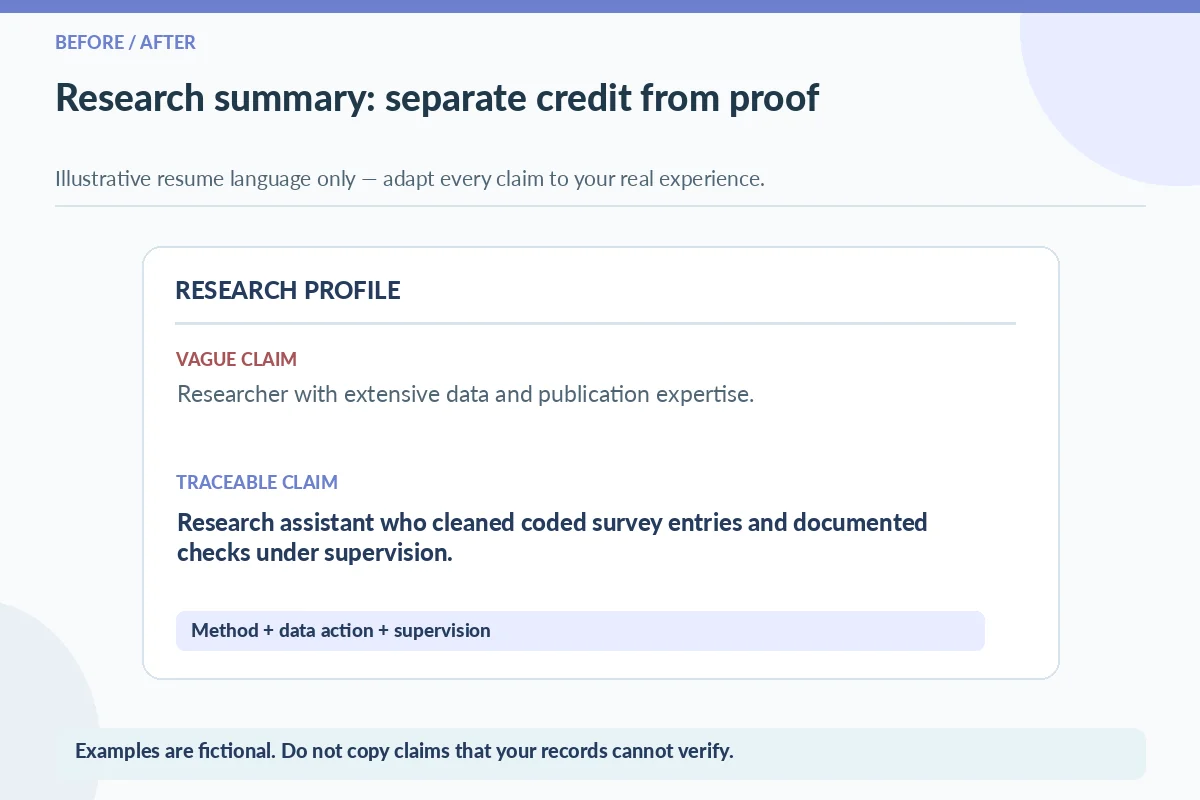
Illustrative student example: “Undergraduate research assistant with supervised coursework in survey data cleaning, source documentation, and chart preparation. Uses a defined codebook to check inconsistent entries and record questions for the project lead.” This is appropriate only if those methods were performed. It does not claim publication, advanced statistics, or permission to contact research participants. A course project can be useful evidence, but it should be labeled academic rather than presented as a job at a research institute.
Illustrative employed example: “Research assistant supporting social science projects through literature screening, reproducible data checks, and documented report preparation. Maintains source trails and escalates protocol questions to the research lead.” An experienced candidate can replace general terms with the actual technique, software, research setting, and approved deliverable. A laboratory research assistant should not borrow social-science wording if their work centered on sample logs or instrument maintenance; use a domain-appropriate method and describe the trained scope of that work.
Select real data-quality and literature evidence
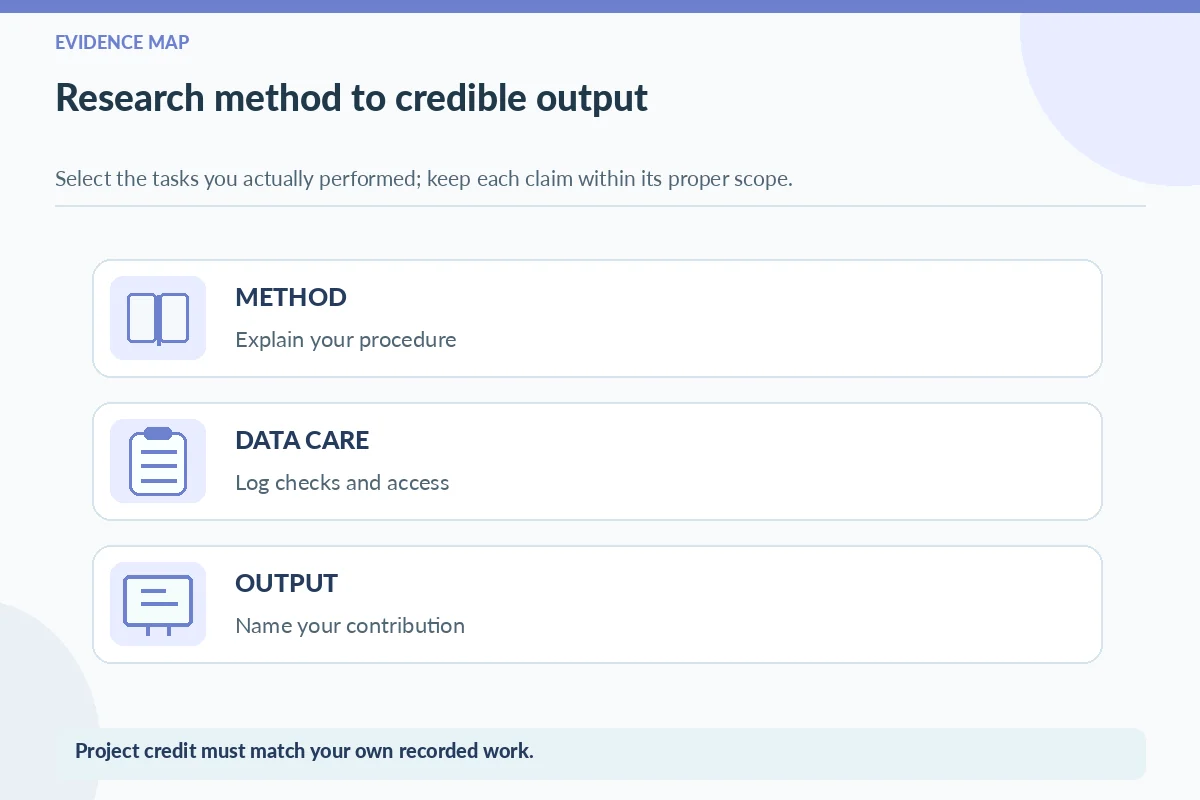
Make each word in the summary traceable to an experience bullet. “Data cleaning” should lead to a bullet about the type of records checked, the rule for identifying errors, and whether corrections were approved or logged. “Literature research” should lead to database searches, screening criteria, notes, or citation management that you actually maintained. “Analysis” should identify whether you ran a prescribed script, prepared tables, or interpreted results under review. It is acceptable to say you supported an analysis instead of claiming sole authorship.
If you used statistical software, name it only when you could independently discuss the functions you ran. Observing a teammate’s R code is not equivalent to writing and validating scripts. A plausible artifact might be an anonymized codebook or a toy dataset created solely for a portfolio exercise; clearly label it as simulated. Do not make real institution records public. When an employer asks for a work sample, first confirm project permission, intellectual-property ownership, and any confidentiality restrictions before sharing even a redacted graphic.
Protect participant privacy and research oversight
A summary should not say “managed human-subject research” just because you sent scheduling emails. Work involving consent, recruitment, screening, or participant contact may be governed by protocols and institutional oversight. HHS OHRP provides guidance about human-subjects protections; whether a project requires particular review depends on its setting and details. A research assistant should describe the exact approved assignment—such as scheduling visits under a protocol—without turning that assignment into the claim that they designed consent procedures or authorized enrollment.
If your project relied on controlled datasets, focus on your process: “checked coded records for completeness within approved access controls” can be more accurate than “owned confidential participant database.” For sensitive topics, avoid granular demographic information, health details, or quotations that could identify people. A summary is not the place for participant-level detail. Describe the research question at a broad level and explain that the lead investigator or supervisor made decisions about protocol deviations and access. This precision protects both credibility and participant confidentiality.
Turn academic experience into a focused employer match
Read the job advertisement for methods first. Some postings request survey operations, qualitative coding, transcript quality checks, bibliographic screening, wet-lab techniques, or specialized data analysis. Identify one method you know, one type of output you have delivered, and one quality step you follow. A candidate for a literature-review assistant role should probably emphasize source screening over unrelated lab equipment. A candidate for a survey operations role should emphasize structured records, participant communication within authorized instructions, and documentation.
New graduates can use capstones, supervised projects, and internships as evidence if they identify what they actually did. For example, “prepared a reproducible search log for a course literature review” is accurate where “published systematic reviews” may not be. Use graduation details in education rather than forcing an extended coursework list into the summary. If the employer expects formal ethics training or research-specific credentials, state only those completed. A short summary that states one real method is better than a long list of prospective skills.
Review the final summary for reproducibility and honest attribution
Check every verb: collected, coded, cleaned, analyzed, authored, reviewed, recruited, and supervised imply different responsibilities. If you and a team produced a report, identify the component you handled rather than claiming the team’s entire result. If you did not work with human participants, leave consent and IRB terminology out. If you analyzed synthetic data in a course, do not describe it as a live clinical dataset. Your summary should not promise an experiment worked or a model achieved accuracy that your records do not support.
Finally, confirm that the work experience section contains concrete evidence for each method in the summary, that no research data or unpublished information is exposed, and that the job title and dates are consistent. Have a supervisor or trusted collaborator review technical wording when permitted. A precise summary should make it easy for the interviewer to ask, “What did you check, with which method, and who reviewed it?” The candidate should be able to answer those questions clearly without revealing restricted information.

How We Research Role-Specific Resume Summaries
We reviewed occupational profiles, official career guidance, and relevant professional or safety sources from onetonline.org; hhs.gov; ori.hhs.gov on November 4, 2026. Each sample summary here is fictional and must be adapted to actual skills, official role titles, and the employer’s requirements. No source endorses a particular candidate, and no hiring outcome, credential, metric, or ATS result is guaranteed. We do not claim a paid relationship with the sources. Read our affiliate disclosure.
More Resume and Cover Letter Guides
Yes. Identify it as coursework and describe the real method, your own contribution, and the output. Do not label course work as an employed research position.
Only when that name is accurate, relevant, and permissible to share. The summary can identify supervised research without disclosing confidential project participants or unpublished findings.
Describe the specific supervised task you performed rather than claiming broad proficiency. The summary should match a skill you can explain and demonstrate.
Only if you actually performed an approved participant-related task. Distinguish scheduling or scripted communication from consent decisions, screening approvals, or independent protocol design.
No. Research contributions include documented data checks, literature screening, protocol-compliant support, coding, and report preparation. Do not claim authorship without an actual authorship record.