
For a collaboration interview question, tell a story about work that genuinely depended on another person or team. Explain the common objective, what each party owned, and the specific information or decision that had to cross a boundary. Your contribution must be visible without taking credit for the other team’s work. A strong answer ends with a confirmed handoff or shared result, not merely a pleasant meeting.
Behavioral interviewers can follow up by asking exactly what you personally did. Prepare one example that survives that question. The University of Massachusetts Amherst lists teamwork prompts that ask about role division, compromises, and adapting to coworkers. A cross-team version is most useful when an unclear responsibility could have disrupted the outcome.
What the interviewer needs to hear in your story
The core question is: Tell me about a time you collaborated with people from another team. Prepare one example in which your own behavior is observable, not just a description of what a team generally does. Keep the setting short enough that the listener can follow it. The most useful material is often the decision you considered, the action you personally completed, and the specific part of the outcome you can substantiate.
The STAR structure is a useful editing tool, not a script you must recite. Give brief context and your responsibility, spend the largest share of your response on actions, and close with result plus reflection. If you were a student or volunteer, name the context accurately. Do not quietly upgrade a group project into professional employment or invent a title to make the story impressive.
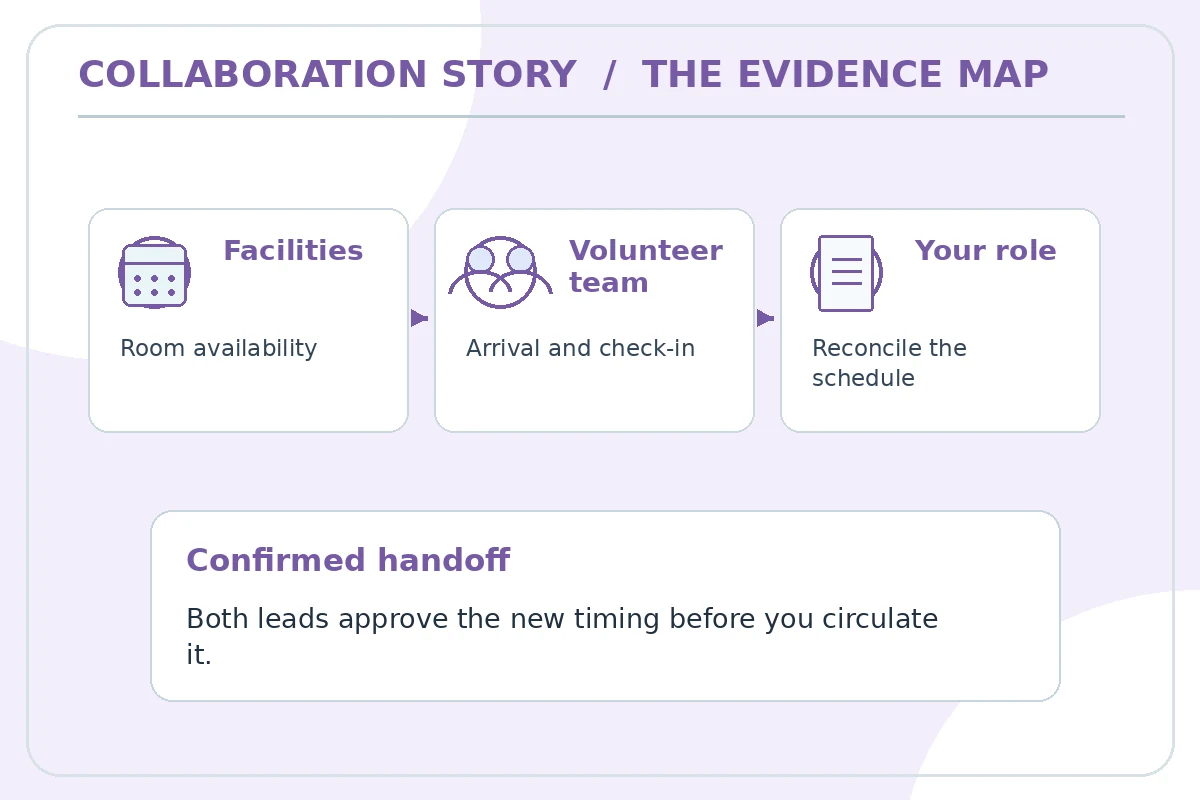
Four decisions that make your example credible
Define the shared goal and separate ownership. Start with the real deliverable: for example, an approved event schedule, corrected customer handoff, or usable project brief. State which team provided inputs, which team made decisions, and which parts you handled. Do not blur a partner’s approval, professional sign-off, or technical work into your own achievements.
Identify the handoff that could fail. Instead of saying “we collaborated smoothly,” identify a file, question, status, or deadline that one group needed from another. If information arrived in incompatible formats, describe the check you introduced. If a dependency was missing, show the question you asked and how you recorded the answer.
Show how you handled a mismatch. Collaboration is not proof that everyone agreed at first. You might have summarized conflicting requests, clarified a term, requested a joint review, or documented what was still unknown. Explain how you listened and what you changed. The point is an observable action that improved shared understanding, not a claim to have “managed personalities.”
Credit the outcome accurately. Say what was delivered and which responsibilities remained with others. “I reconciled the two lists and sent a version for manager approval” is stronger and safer than “I personally launched the program” when approval or launch belonged to another group. If a handoff slipped, acknowledge the correction and the revised checkpoint.
A worked example with clear individual responsibility
Illustrative example only: A student organization hosted an open-house event. The facilities group controlled room availability while the volunteer team handled registration. The applicant created a single list of room times and expected volunteer arrivals, found a mismatch between setup and check-in, and asked each lead to confirm the needed times. The leads approved a revised schedule and the applicant sent a dated copy to both groups.
In the answer, the applicant should say “I created and reconciled the shared schedule”; the facilities lead still approved access and the registration lead still directed volunteers. If the event later ran well, do not imply a precise attendance improvement without records. The valuable detail is the verified cross-team handoff and who signed off on the new plan.

Replace vague claims with observable actions
Too vague: “My team did an amazing launch.” More credible, if true: “I gathered facilities and volunteer schedules, highlighted one conflict, and obtained both leads’ confirmation of the revised handoff.” Notice that the revised wording does not promise success by itself. It identifies something an interviewer could ask you to explain or verify.
Too vague: “I persuaded everyone to follow my plan.” More credible, if true: “I presented the conflicting requirements, recorded the agreed decision, and distributed the confirmed version.” Notice that the revised wording does not promise success by itself. It identifies something an interviewer could ask you to explain or verify.
When you write your own version, replace the illustrative case with an event you can discuss truthfully. Write the actual date or relative period for your private notes if it helps memory, but do not bring sensitive work files to the interview. You need a coherent account of what happened, not documents that you lack permission to disclose.
Avoid these common answer failures
Watch for 1. A story about being friendly is not necessarily collaboration. Pick a task where another person’s input changed what you needed to deliver.
Watch for 2. Avoid converting a team outcome into an individual achievement. Use “we” for a shared result and “I” for your genuine task.
Watch for 3. Do not reveal client names, private personnel information, or proprietary designs to make the story sound specific. Describe the workflow without exposing protected content.

Rehearse a concise and defensible STAR answer
Create a private four-line note, then practice without reading it aloud. The goal is to remember the sequence of decisions, not exact sentences. Ask a friend to interrupt with “Which part did you personally do?” and “How do you know that was the result?” If you cannot answer, revise the story until the ownership and evidence are clear. A normal interview may also probe what you would do differently now.
Rehearsal point 1: Draw a line between your work and the other team’s decision rights. Add a concrete phrase from your authentic experience and remove any details you cannot support. Keep the result proportionate to your role and record exactly which decisions belonged to a supervisor or other owner.
Rehearsal point 2: Name one handoff, document, or dependency you checked. Add a concrete phrase from your authentic experience and remove any details you cannot support. Keep the result proportionate to your role and record exactly which decisions belonged to a supervisor or other owner.
Rehearsal point 3: Explain one misunderstanding and the practical step that resolved it. Add a concrete phrase from your authentic experience and remove any details you cannot support. Keep the result proportionate to your role and record exactly which decisions belonged to a supervisor or other owner.
Rehearsal point 4: End with a verifiable deliverable and proper credit. Add a concrete phrase from your authentic experience and remove any details you cannot support. Keep the result proportionate to your role and record exactly which decisions belonged to a supervisor or other owner.
Finish with a short reflection linked to the target job. For example, if the vacancy requires coordination, explain what this event taught you about reliable handoffs; if it requires independent judgment, describe the limit of your authority and how you knew when to request a decision. Do not end with a generic slogan about passion or being a perfectionist.
How We Research these interview examples
This guide uses guidance from an academic career or HR center and the University of Michigan career center’s STAR interview preparation resources. The sources describe how behavioral questions elicit specific past examples and how candidates can organize evidence into a response. The illustrative story in this article is fictional; it is a writing exercise, not a verified employer event. Source pages were checked on 2026-11-02.
Interview standards and procedures differ by organization and role. Any answer about compliance, confidential information, approvals, or safety must reflect the rules that actually applied in the applicant’s setting. JobAsk may describe services or tools elsewhere; review our affiliate disclosure for how we handle commercial links. No partner endorsement, guaranteed hiring result, or recruiter scoring claim is made here.
Frequently asked questions about this answer
More Interview Preparation Guides
Yes. State the setting and your assigned responsibility. Group coursework or volunteering can demonstrate a real handoff.
Explain the follow-up method, escalation or workaround you actually used, without speculation about colleagues’ motives.
Claim the action and deliverable you owned. Explicitly attribute approvals, technical work and shared results to the people responsible.
Yes. Center the ongoing dependency, coordinated workflow and transfer of information, even if a disagreement occurred along the way.
Describe the incomplete outcome, what you learned about ownership or handoffs, and the specific change made afterward.