
An integrity interview answer should describe a specific choice in which convenience, pressure, or uncertainty conflicted with a clear responsibility. Tell the interviewer what you actually knew, which rule or expectation applied, what action was within your authority, and how you documented or reported the issue. Protect people’s privacy while describing the decision. An ethical story does not require dramatic accusations or a claim that you personally investigated misconduct.
UMass Amherst includes integrity prompts about pressure to compromise honesty and protecting confidential information. UConn career guidance likewise recommends a specific instance with your task, actions, and result while avoiding private details. Use those principles to choose a proportionate story: perhaps correcting an inaccurate record, declining unauthorized access, or asking a supervisor about an unclear request.
What the interviewer needs to hear in your story
The core question is: Describe a time you had to act with integrity at work or school. Prepare one example in which your own behavior is observable, not just a description of what a team generally does. Keep the setting short enough that the listener can follow it. The most useful material is often the decision you considered, the action you personally completed, and the specific part of the outcome you can substantiate.
The STAR structure is a useful editing tool, not a script you must recite. Give brief context and your responsibility, spend the largest share of your response on actions, and close with result plus reflection. If you were a student or volunteer, name the context accurately. Do not quietly upgrade a group project into professional employment or invent a title to make the story impressive.
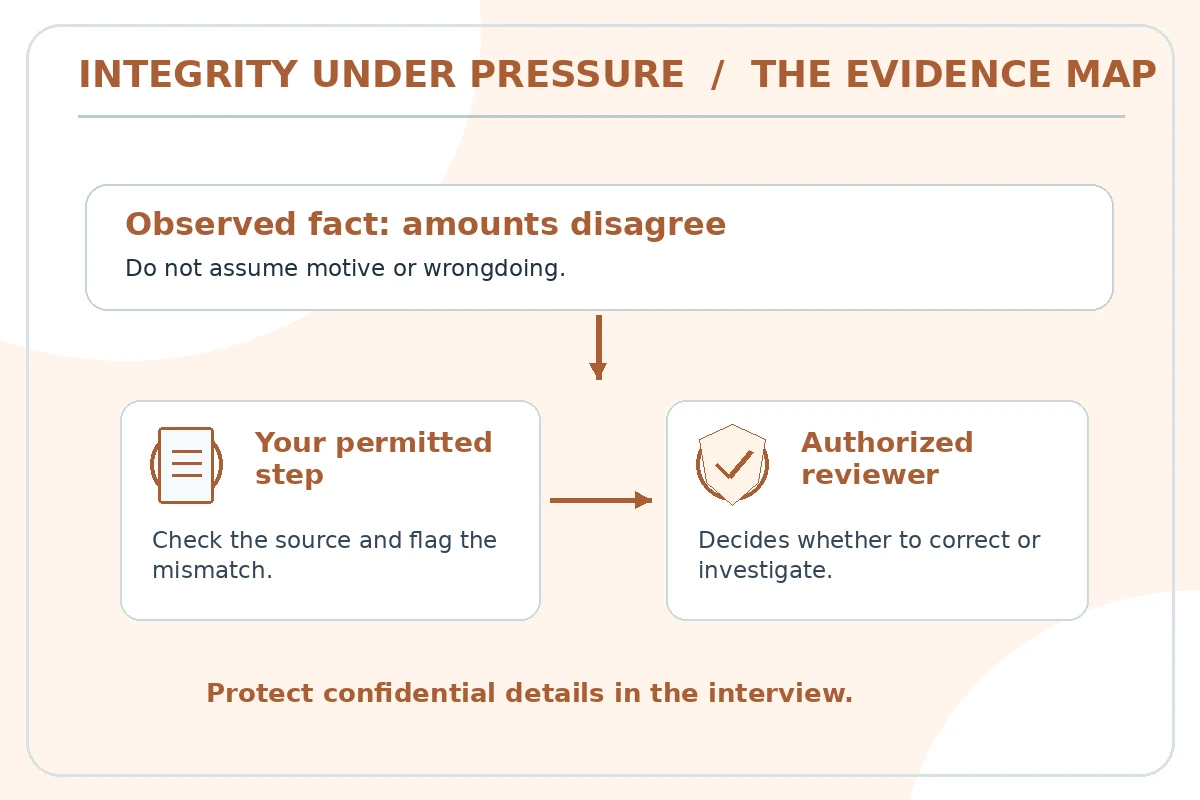
Four decisions that make your example credible
Distinguish what you saw from what you inferred. Say “the numbers in two versions did not match” rather than “someone falsified the report” unless there was a verified finding you may appropriately disclose. Specific factual observations demonstrate judgment. Speculation about another person’s motives can undermine your answer and create unnecessary confidentiality risks.
Identify the real duty and the rule. Name the ordinary expectation that guided you: accurate records, handling private information through approved systems, or obtaining the proper sign-off. Avoid inventing a universal legal obligation or claiming to know a former employer’s internal policy better than you did at the time. When relevant, say you asked where to find the current procedure.
Explain the response within your authority. You might have paused a submission, requested clarification, corrected your own entry, or alerted the proper supervisor. A front-line worker cannot automatically approve an exception, inspect someone else’s account, or make an official finding. Show that you preserved the record and used a legitimate reporting route rather than escalating publicly.
Give an honest, bounded result. The outcome may be simply that the responsible person reviewed a discrepancy, the file was corrected, or the request was handled through the approved channel. You do not need to assert that an investigation found wrongdoing or that you protected an entire company. State what you know and what remained outside your view.
A worked example with clear individual responsibility
Illustrative example only: A volunteer helping prepare event reimbursements noticed that one receipt amount in a draft spreadsheet differed from the receipt image. Before sending the summary, the volunteer checked the source against the entry, marked the disputed line, and asked the coordinator to review it. The coordinator corrected the amount before approving the summary. The volunteer did not accuse anyone of dishonesty or claim authority to approve reimbursements.
The STAR answer focuses on a genuine check and a decision not to ignore a discrepancy. If your own experience involved confidential records, describe the nature of the workflow rather than quoting names, account information, patient details, or screenshots. Your response should show why you were careful without revealing the material you were protecting.
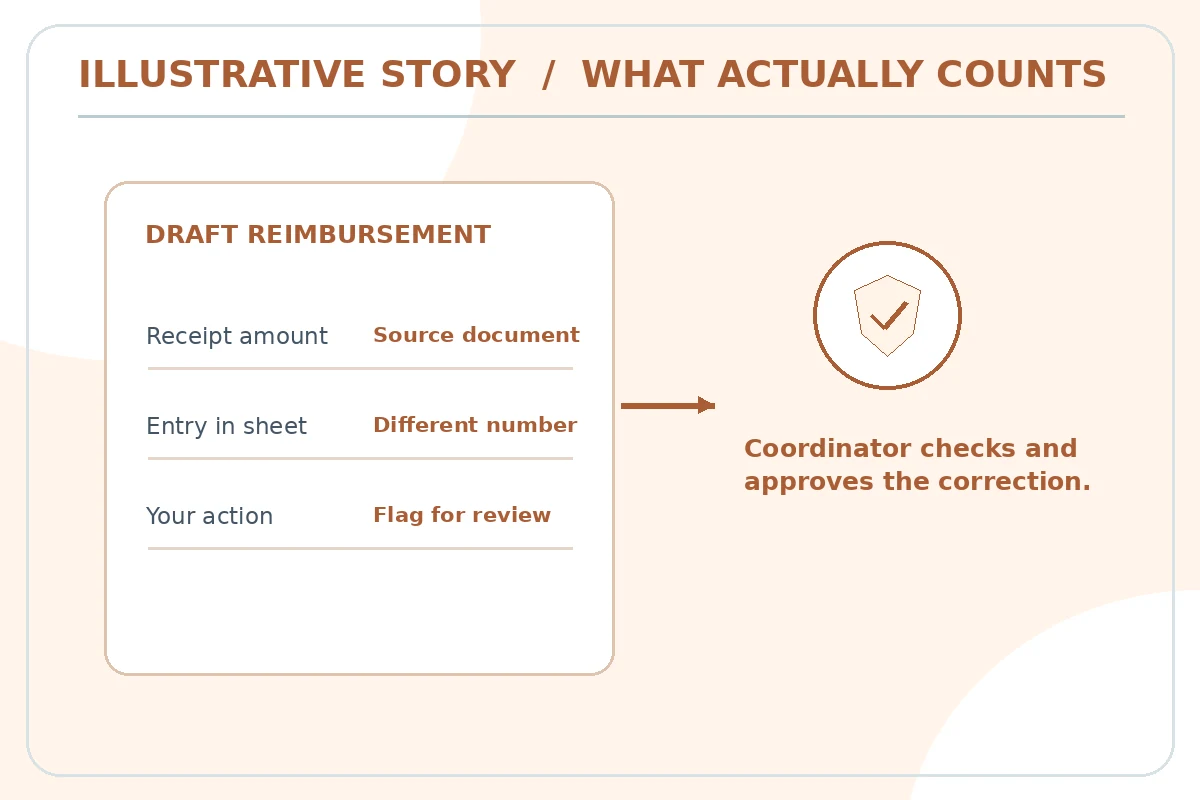
Replace vague claims with observable actions
Too vague: “I caught a dishonest coworker and saved the organization.” More credible, if true: “I found a mismatch between a source document and the draft, flagged it, and asked the authorized reviewer to confirm the correction.” Notice that the revised wording does not promise success by itself. It identifies something an interviewer could ask you to explain or verify.
Too vague: “I always do what is right, even if others do not.” More credible, if true: “I checked the procedure, declined to bypass the control, and brought the unresolved request to the designated approver.” Notice that the revised wording does not promise success by itself. It identifies something an interviewer could ask you to explain or verify.
When you write your own version, replace the illustrative case with an event you can discuss truthfully. Write the actual date or relative period for your private notes if it helps memory, but do not bring sensitive work files to the interview. You need a coherent account of what happened, not documents that you lack permission to disclose.
Avoid these common answer failures
Watch for 1. Do not use a story that requires sharing a patient, customer, employee or student’s private information. A useful level of detail is the type of record and your action.
Watch for 2. Avoid converting disagreement over a preference into a major ethics complaint. Show a concrete accuracy, fairness or confidentiality issue instead.
Watch for 3. Do not imply that refusing an unsafe or unauthorized act always ends with praise. If the outcome is unknown, say the issue was passed to the correct owner.
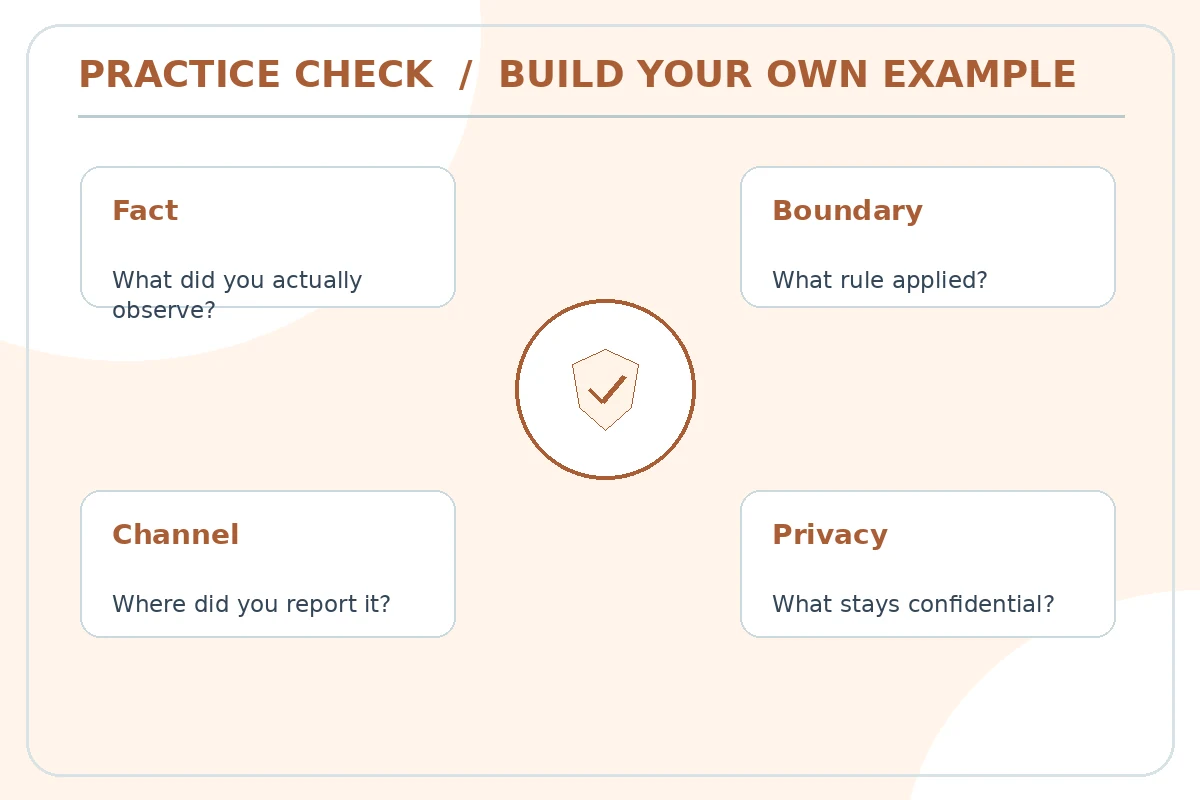
Rehearse a concise and defensible STAR answer
Create a private four-line note, then practice without reading it aloud. The goal is to remember the sequence of decisions, not exact sentences. Ask a friend to interrupt with “Which part did you personally do?” and “How do you know that was the result?” If you cannot answer, revise the story until the ownership and evidence are clear. A normal interview may also probe what you would do differently now.
Rehearsal point 1: State the observable issue without attributing motives. Add a concrete phrase from your authentic experience and remove any details you cannot support. Keep the result proportionate to your role and record exactly which decisions belonged to a supervisor or other owner.
Rehearsal point 2: Name the boundary or procedure you relied on. Add a concrete phrase from your authentic experience and remove any details you cannot support. Keep the result proportionate to your role and record exactly which decisions belonged to a supervisor or other owner.
Rehearsal point 3: Identify the person or approved channel you involved. Add a concrete phrase from your authentic experience and remove any details you cannot support. Keep the result proportionate to your role and record exactly which decisions belonged to a supervisor or other owner.
Rehearsal point 4: Report only the result you could verify. Add a concrete phrase from your authentic experience and remove any details you cannot support. Keep the result proportionate to your role and record exactly which decisions belonged to a supervisor or other owner.
Finish with a short reflection linked to the target job. For example, if the vacancy requires coordination, explain what this event taught you about reliable handoffs; if it requires independent judgment, describe the limit of your authority and how you knew when to request a decision. Do not end with a generic slogan about passion or being a perfectionist.
How We Research these interview examples
This guide uses guidance from an academic career or HR center and the University of Michigan career center’s STAR interview preparation resources. The sources describe how behavioral questions elicit specific past examples and how candidates can organize evidence into a response. The illustrative story in this article is fictional; it is a writing exercise, not a verified employer event. Source pages were checked on 2026-11-02.
Interview standards and procedures differ by organization and role. Any answer about compliance, confidential information, approvals, or safety must reflect the rules that actually applied in the applicant’s setting. JobAsk may describe services or tools elsewhere; review our affiliate disclosure for how we handle commercial links. No partner endorsement, guaranteed hiring result, or recruiter scoring claim is made here.
Frequently asked questions about this answer
More Interview Preparation Guides
Only at a high level that protects people and proprietary information. Use a different example if you cannot describe it safely.
No. Integrity can be demonstrated by correcting your own work, checking an anomaly or declining unauthorized access.
Yes. Proper attribution, accurate reporting or an honest correction can work if the choice and your actions are specific.
Describe the escalation route you actually used and what happened, without making unsupported legal or policy claims.
State what you personally did and what part of the process was handed to an authorized reviewer; do not invent a resolution.