
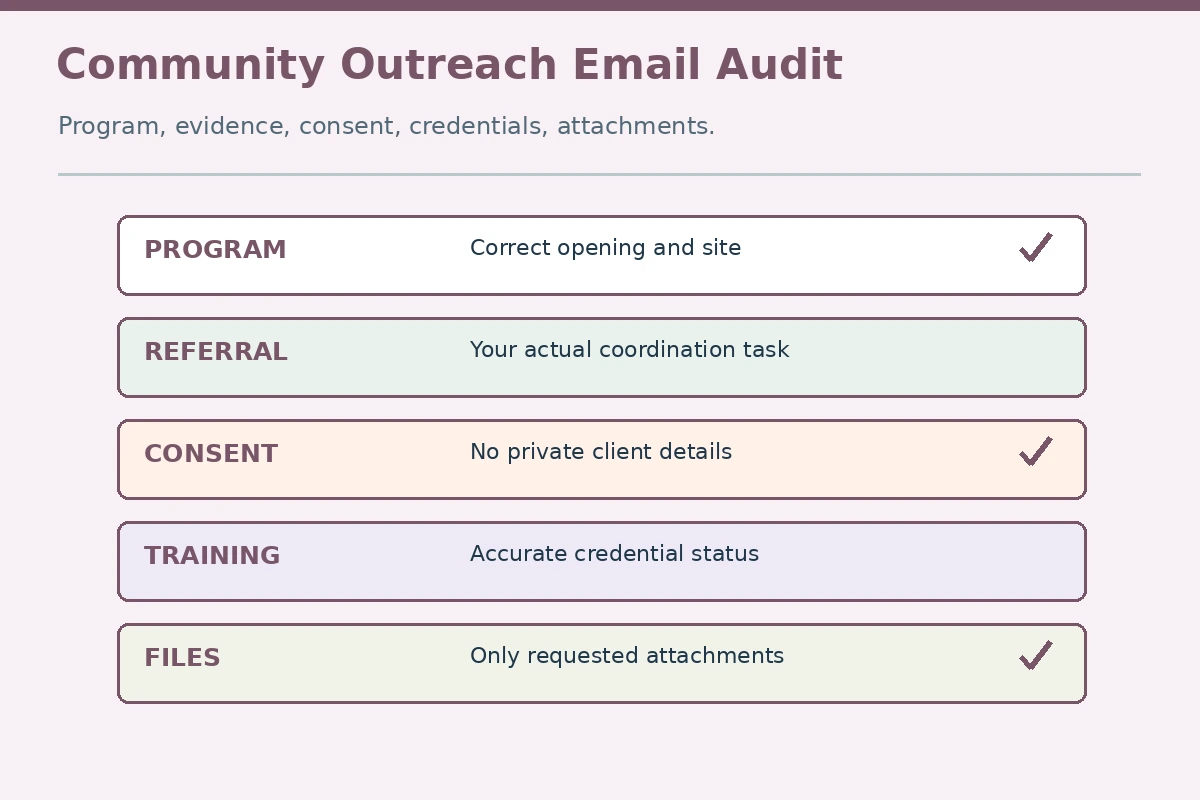
A community health outreach application email should identify the program and role, describe one real example of explaining resources, supporting an event or coordinating a referral, and distinguish outreach from clinical judgment. State any required training or credential status accurately. You can show empathy and organization without disclosing a client’s condition or suggesting you can diagnose, prescribe or independently decide eligibility for services.
O*NET describes community health roles that may include sharing health information, maintaining records, connecting people with resources and following up. The authorized scope depends on training, employer rules and the specific position. A useful email makes your part of a service workflow visible while protecting people’s privacy and avoiding unsupported promises about services or outcomes.
Read the Program Scope Before Choosing a Writing Example
Identify whether the opening concerns resource navigation, appointment coordination, education, community events or another defined function. Check the actual employer, work area, required language skills, schedule and credential expectations. Some outreach positions may require certifications or experience; others focus on administrative and community engagement tasks. Do not infer that a program name authorizes you to offer clinical advice. Follow the submission route and reference code shown on the official vacancy.
A subject such as “Community Outreach Assistant Application – [Your Name]” should mirror the posted job, not a more senior title you wish to hold. If the role requires a credential you have not earned, do not claim that you hold it or that it will automatically be granted later. The email can express interest in employer-approved training, but not imply that interest is equivalent to a current qualification.
Select One Outreach or Referral Task You Can Explain
Pick a real task such as organizing a health-information table, explaining how to contact a local program, tracking follow-up appointments under policy or distributing approved multilingual materials. Describe the information you provided, how you confirmed it and when you sought staff review. A hypothetical evidence line is “During a supervised community event, I helped visitors find program contact information and directed complex eligibility questions to the coordinator.” That sentence does not promise enrollment or medical outcomes.
Do not tell stories containing names, addresses, clinical histories or case numbers. Even when identifying details are changed, a recognizable combination of facts may violate trust. A program can evaluate your communication skills from a category of task and a clear handoff. Avoid claiming that a referral resulted in treatment unless you were authorized to know and disclose that outcome. Your example should reflect the actual evidence available to you.
| Outreach activity | Evidence in email | Leave to authorized staff |
|---|---|---|
| Program information | Shared approved resources | Eligibility decision |
| Referral handoff | Directed request correctly | Clinical judgment |
| Record keeping | Used approved process | Unapproved disclosure |
| Bilingual help | Named actual language tasks | Specialized interpretation claim |

Build a Respectful Outreach Email With a Specific Ask
Hypothetical email: “Subject: Community Outreach Assistant – [Your Name]. Dear Hiring Team, I am applying for the outreach opening posted by your organization. In a supervised community event, I provided visitors with approved resource information, checked referral instructions and directed complex questions to the program coordinator. I would welcome the opportunity to support accurate, respectful community communication. I have attached my resume as requested. Thank you for your consideration. [Name] [Contact information].” Edit the activity to match your real background.
Avoid writing as though a generic interest in public health is enough to meet the posting. One concrete experience is more persuasive than claiming that you can solve community health disparities. If you are changing careers, use a transferable example from service coordination or outreach organizing, label it accurately, and say what you would need to learn. The hiring manager should be able to identify your real contribution and the boundary between information and decision-making.
Separate Resource Navigation From Clinical or Eligibility Decisions
Helping someone locate a clinic, schedule an appointment or understand a public program brochure is different from diagnosing a condition, promising insurance eligibility or deciding what treatment is appropriate. Such decisions require specific authorized staff and procedures. Write “referred the question to the qualified team” rather than “approved medical services” unless your real duties and professional status justify a stronger claim.
Community health workers may perform a broad range of functions, but an occupation description does not create a license for any one applicant. If the vacancy includes screening, home visits or specialized language work, identify what training and oversight the employer requires. Do not claim to be a certified interpreter, nurse, health educator or case manager solely because you volunteered at an event. Safe, accurate boundaries can themselves demonstrate readiness to work on a team.

Handle Language, Consent, and Confidential Materials Carefully
If your experience involves a second language, describe actual communication tasks and the level of support you gave. Avoid asserting authority for clinical interpretation without training. If the job includes records or outreach calls, the message can show that you use approved consent and information-handling processes. Never attach client intake forms, screenshots from a case management system or a directory containing private individual details.
The FTC warns that fake recruiters may use official-looking correspondence to obtain sensitive data. Verify an employer through its own website and contact channels before providing documents beyond a normal job application. An early request for a bank account or payment deserves caution. It is possible to explain your outreach capabilities in an email and resume without transmitting a person’s confidential health information or your own financial details.
Review Credential Claims, Attachments, and the Final Email
Compare each term in the email with your experience: coordinator versus volunteer, supervised versus independent, referral versus approval, language assistance versus certified interpretation. State completed training only when it is complete, and label coursework clearly. Remove invented numbers about clients helped, visits completed or community outcomes. If the posting requests references or evidence of certification at a later stage, follow its documented process instead of sending unrelated confidential documents.
Check the subject, official destination, program title, requested attachments and your contact details. Preview the resume and remove any case information. Save a copy of the job posting, the final email and the date sent. After submission, respect the employer’s communication instructions and avoid repeated contact. If you discover an inaccurate credential or employment claim, send a prompt concise correction to the verified contact.
How We Research Application Emails for This Role
Checked on 2026-11-14: O*NET: Community Health Workers — O*NET describes community health workers providing outreach, resource connections, records and referrals with duties varying by role.; Harvard Career Success: Resumes and Cover Letters — Harvard advises applicants to name the position, tailor a short message to the employer and give specific evidence rather than repeating the resume.; FTC: Job Scammers Are Looking to Hire You — FTC describes risks from fake job recruiters requesting money or sensitive data before legitimate hiring steps.; UC Berkeley Career Center: Cover Letters — UC Berkeley advises connecting relevant experience to the job description and using an employer-specific, proofread introduction.. We compared this role-specific email intent against the supplied JobAsk WordPress title exports and the previous local draft batches. All sample messages and diagrams are hypothetical, not claims about actual applicants or current job openings. Employer-specific submission instructions always take priority over general examples; confirm the posting, credentials and authorized duties yourself. No hiring, response or ATS outcome is guaranteed, and no affiliation with cited organizations is claimed. Read our affiliate disclosure.
Related Job Search Guides
Yes if the job accepts transferable experience. Name the volunteer context, tasks and supervision rather than implying paid clinical work.
Avoid identifying or recognizable health details. Describe the service process and authorized referral path instead.
State only completed, valid credentials relevant to the posting, and identify coursework or in-progress training separately.
No. A second language alone does not establish training or authorization for specialized clinical interpretation.
Follow the verified employer instructions. Normally send requested application documents, not client records or personal banking information.