
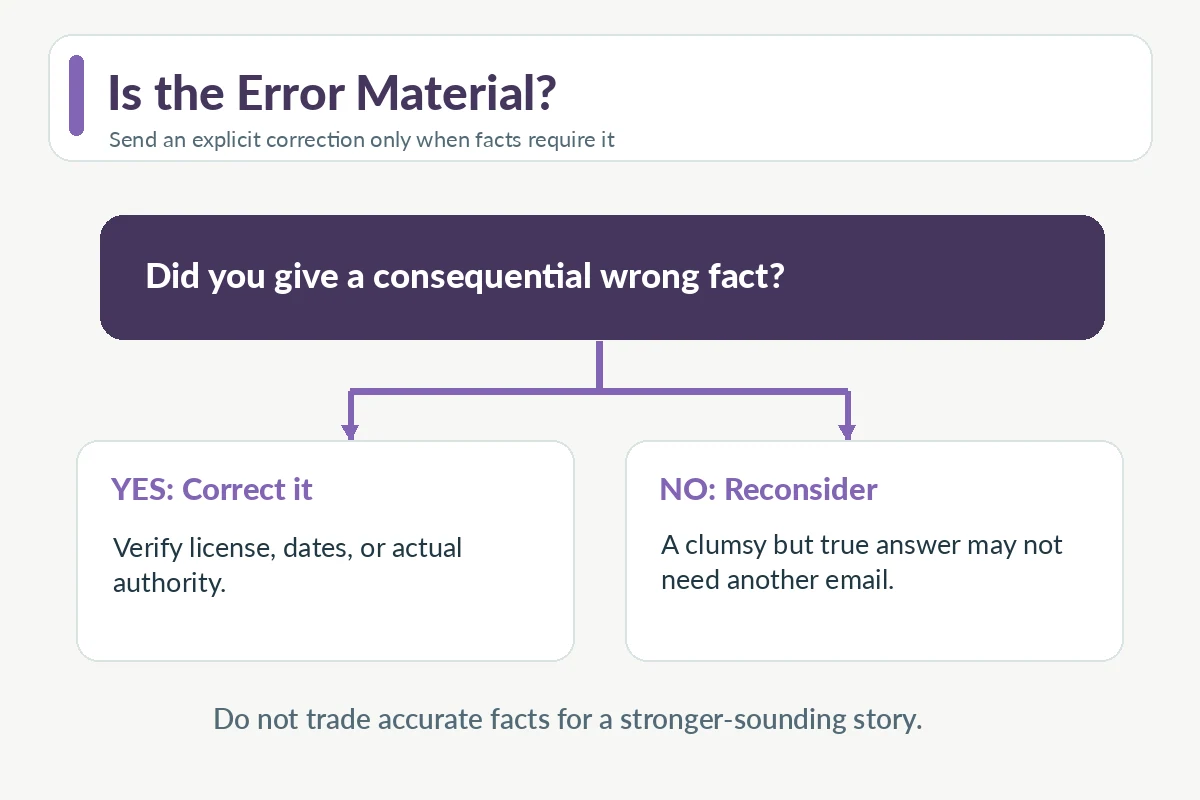
If you realize after a job interview that you gave materially incorrect information, correct the fact through an appropriate contact promptly and briefly. An incorrect credential status, employment date, project ownership statement or permission claim matters more than an awkward phrase. Identify exactly what you said, the verified correction and whether it affects a hiring requirement. For a minor answer that could simply have been clearer, you can add one short relevant point in a regular thank-you note—or leave it alone. Do not write a long second interview by email.
Use a Materiality Test Before You Hit Send
Ask three questions: was a statement factually wrong, could the error affect how the employer assesses qualifications, and can you verify the corrected version? Misstating that you hold a license, signed off a safety procedure, earned a degree, managed a team or worked particular dates warrants correction. Saying ‘I meant Friday’ when the conversational detail is irrelevant might not. Nervousness is not evidence of wrongdoing, and overcorrecting every filler word can bury genuinely important information.
The University of Virginia’s interview guidance allows a concise improved response when an answer felt inadequate. The University of Alabama also suggests using a follow-up to add relevant information omitted in the interview. Those are different situations from correcting an actual false fact. A truthful correction should be explicit rather than buried in an elegant rephrasing. If the error relates to a regulated credential or safety qualification, verify the issuer’s current record before stating a status.
Write the Original Claim and the Verified Fact Side by Side
Draft a private two-column note. For example: ‘I said I personally approved vendor payments’ versus ‘I prepared invoice exceptions for a supervisor who approved payments.’ Or ‘I said my certificate is active’ versus ‘I completed training but have not received the credential.’ The second column must reflect the facts you can support, not the description you wish you had used. Keep project names and confidential employer details out of any unsolicited email.
If the interviewer’s question involved proprietary information, correct the scope without forwarding company records. A fictional candidate might write: ‘I want to correct my description of the reporting workflow. I compiled and checked the weekly dashboard; the finance lead approved the published totals.’ That gives the interviewer a defensible fact and clarifies authority. It does not require attaching an internal dashboard or naming individual customers.

Send a Short Correction on an Approved Channel
Use the recruiter, hiring contact or original interview thread that has already been provided. Include job title and interview date so the message is easy to place. Lead with the correction, not a long confession about nerves. A sample is: ‘Subject: Clarification from our interview — Billing Coordinator. Thank you for speaking with me about the role today. I want to correct one detail in my answer: I reconciled invoice discrepancies and prepared them for manager review; I did not authorize payments. I appreciate the chance to clarify the scope of my experience.’ This is fictional sample wording.
Do not characterize a serious credential misstatement as a ‘tiny typo.’ Conversely, do not make an extended apology about a minor phrasing issue. Match the tone to the fact. If the correction changes a mandatory qualification, state the accurate status and let the employer decide whether it affects eligibility. Avoid asking the interviewer to promise that the correction will not affect their evaluation.
| Answer issue | Follow-up choice | Evidence to check |
|---|---|---|
| Wrong license or credential status | Correct clearly | Issuer record |
| Inflated job duty or authority | Correct clearly | Actual task scope |
| Clumsy but accurate example | Optional one-sentence addition | Your own project notes |
Distinguish Clarification From a Second Attempt at the Question
An incomplete but truthful answer may benefit from one additional example in a thank-you note. You can say, ‘I also wanted to mention that our project included a weekly quality review,’ only if that fact is real and relevant. That is not the same as contradicting a previous claim. Never supply a fully revised case solution, technical test, or confidential attachment without permission; an assessment may have a defined submission process.
Suppose you were asked about a conflict, described your action accurately, but forgot the follow-up check. It may be reasonable to mention the check in one sentence. If instead you said you were the team leader but were a contributor, that needs a clear factual correction. Keep the difference visible to the reader so the email does not appear to revise the meaning while concealing the original error.

Handle Timing and Additional Requests Proportionately
A material factual error should be corrected once you verify the truth, rather than waiting weeks for an arbitrary status date. Use the employer’s chosen communications channel and do not repeatedly forward the same correction. A routine hiring-status follow-up is a separate step governed by the decision timeline. If you already sent a thank-you note, a standalone short correction may still be necessary for a consequential false claim, while a trivial wording adjustment may not deserve another message.
If the recruiter asks for supporting documentation, use only the secure, authorized method. Do not send identity documents, account passwords or employer-confidential records in an ordinary email. Confirm with the official organization if a request appears suspicious. The correction should improve the accuracy of the hiring record without increasing exposure of sensitive personal or workplace information.
Review Your Resume and Future Interview Story
Compare the corrected statement with your resume, application fields, portfolio and references. If another document repeats the error, ask how to update it using the employer’s official process; do not create contradictory versions without explanation. Keep a private note that you sent a correction and preserve the exact wording. In a later round, use the accurate version consistently and explain your actual contribution without converting team outcomes into personal achievements.
The aim is not to look flawless but to make sure the evaluator has the correct facts. There is no guarantee that clarification will change a decision or be read before a decision is made. There is also no sound reason to invent a better story to compensate. Trust is better served by limited, specific corrections and accurate boundaries about what you really did.
How We Research and Verify Interview Guidance
This U.S.-focused guide was checked on 2026-11-13 against career-center and consumer-protection guidance: career.virginia.edu; career.sa.ua.edu; www.bc.edu. The sources support general professional communication and the specific boundaries identified above; they do not predict an individual employer’s response. Every sample message, job title, personal anecdote, requisition number and person in this article is an illustrative fictional example, not a documented real hiring exchange. Always follow the instructions in your own interview invitation and verify a recruiter through an official company channel. See our affiliate disclosure; this page does not claim a paid employer or service partnership.
More Interview Preparation Guides
Yes if it is consequential. Send one concise factual correction through the established contact route.
You may add one relevant true detail in a thank-you note, but avoid sending a complete second interview.
Verify the issuer record and correct your status explicitly; do not imply pending credentials are awarded.
No. A brief acknowledgment and exact correction are more useful than repeated apologies.
There is no guarantee. Its purpose is ensuring the employer has accurate information.