
A data analyst interview thank-you email can make a useful point about analytical judgment without repeating a technical assessment. Choose one genuine discussion about metric definitions, source quality, dashboard users or validation. Thank the interviewer and connect that topic to a factual project action: defining the denominator, checking missing records, validating a join or explaining a chart to a nontechnical audience. Avoid claiming that your model caused business growth, sending confidential data or relitigating a case exercise. This guide includes a reusable note and a simple evidence check.
Find the Metric or Data-Quality Question Worth Remembering
The most specific follow-up usually starts with a question the interviewer asked about how metrics are defined or checked. Was “active customer” defined differently across teams? Did a dashboard combine several data sources? Did a business partner need an explanation of what a chart meant? O*NET describes business intelligence analysts as producing reports, maintaining dashboards, documenting requirements and testing information against defined needs. These are relevant reference points, but not proof of the exact work at a particular employer. Use the topic the interviewer actually raised and keep it brief.
If they discussed reporting consistency, you could write, “I appreciated hearing how your team checks metric definitions before sharing dashboards.” That is precise and does not suggest you know their confidential measures. Avoid mimicking a technical exam answer in the thank-you; the interviewer already saw your reasoning. If you interviewed for an operations reporting role rather than machine learning, do not suddenly claim deep predictive modeling because you found a template online. A strong note shows the habit of matching analysis to the question being answered.
Adapt a Data Analyst Interview Thank-You Email Template
Hypothetical email: “Subject: Thank you — Data Analyst interview. Hello [Name], Thank you for speaking with me about the Data Analyst position. I enjoyed discussing how the team defines reporting metrics and validates source data. In a [real project or role], I checked data definitions and compared records before presenting a summary, and I would value the chance to apply that careful approach to your reporting work. I remain interested in the position and appreciate your time. Best, [Your name].” Replace every bracketed phrase with a true fact.
If your example came from coursework, say so; do not pretend it was a production dashboard used by executives. If you wrote the SQL query but another person designed the metric, credit the division of work. A short thank-you is not the place for an unsolicited code repository, notebook attachment or new model prediction. The recipient should be able to identify the interview and the role without parsing a technical report. A note that reflects data discipline and clear communication is stronger than one full of tool names with no connection to the conversation.
Show the Difference Between a Calculation and a Validated Finding
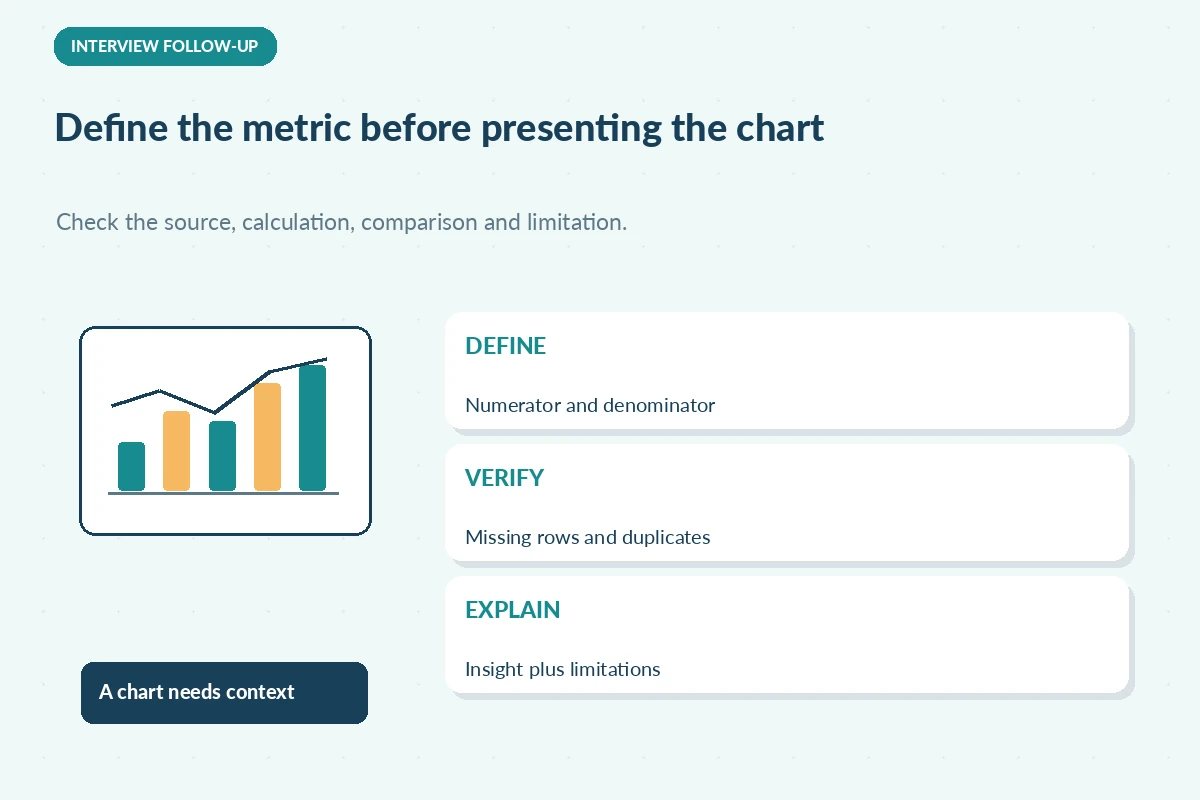
A data analyst might calculate a rate correctly while using the wrong business definition. That is why the process matters: identify the metric owner, write the intended numerator and denominator, check missing or duplicate records, validate the query against a small trusted sample and state limitations before presenting a conclusion. You need not list every step in the thank-you, but one true action can be informative. For example, “I compared the dashboard total with an independently filtered sample and escalated a definition mismatch” has a clear scope when that is what you did.
Avoid writing “my analysis increased profit by 30%” if the number is not verified, causality is unclear or another team made the decision. If the interviewer asked about A/B tests, do not claim statistical significance merely because one variant looked higher. Use words such as “reviewed,” “tested,” “noted a discrepancy” or “communicated assumptions” according to the evidence. The interviewer may be trying to learn whether you distinguish observations from conclusions. Show that discipline through restrained, accurate language rather than grand claims.
| Analysis discussion | Evidence you may mention | What to avoid |
|---|---|---|
| Metric definition | Checked denominator and scope | Invented target or KPI |
| Data quality | Found duplicate or missing rows | Unsupported accuracy score |
| Dashboard report | Explained a limitation | Private dashboard screenshot |
| Decision support | Clarified assumptions | Guaranteed business outcome |

Do Not Attach Confidential Dashboards or Interview Materials
A previous employer's customer-level dataset, internal dashboard, SQL credentials or proprietary model output should not appear in a recruiting email. A coding exercise provided by the prospective employer may also be subject to their sharing instructions. Even when you are proud of the work, you should not forward it to third parties or post a screenshot from a private tool. Describe the method rather than the identifiers: “I tested how duplicate rows affected totals and documented the limitation” is normally plenty for a note.
If the interviewer asked for a portfolio, send a public project you are authorized to share or an intentionally fictional dataset, clearly labeled. Check notebook outputs, chart tooltips, metadata and embedded files for private information. The FTC's data-protection guidance supports responsible limits on sensitive data access; specific employer agreements and privacy rules may create additional obligations. Do not assert that removing names automatically anonymizes data. A concise email protects everyone's information and lets the discussion remain about your reasoning.
Address the Right Interviewer and Preserve the Hiring Timeline
An analyst interview may involve a recruiter, hiring manager, data engineer, stakeholder or a mixed panel. Different people may have focused on different issues. If you have appropriate contact information for multiple interviewers, reference the detail each person discussed rather than sending identical messages that claim everyone asked about the same metric. If the recruiter was the sole contact, use that channel and avoid guessing employees' personal addresses. University career centers recommend prompt, personal thanks with a specific conversation detail and renewed interest; they do not promise that the note changes the hiring outcome.
Choose a clear subject such as “Thank you — Data Analyst interview” or reply to the invitation thread when it reaches the person you met. If the employer said a decision would follow the team's review next week, do not pressure them for results in the immediate note. Record the timeline separately. If you need to correct a material factual answer from the interview, clarify briefly and accurately; do not attach pages of revised case analysis without being invited to do so.

Run a Final Data-Integrity Check on the Email Itself
Use the same approach you would apply to a dashboard. Validate the role name against the invitation, check the interviewer's name and title, confirm that the cited discussion really happened, verify that every claimed action is yours, and remove any confidential metrics or links. Look for wording that changes the scale of your contribution: “built the analysis” can be inaccurate if you only reviewed a chart. Make the boundary explicit when necessary. Read the message as a nontechnical hiring manager might, and replace jargon that does not add meaning.
A final draft needs one specific meeting reference and one truthful evidence sentence. It should not try to persuade with invented performance figures. Ask whether the note reinforces the job's actual analytical work—definitions, checks, communication—or merely lists Python, Excel and SQL. If you catch a typo before sending, correct it. If you are uncertain whether an example is sharable, use a safer general description. Accurate, modest evidence is fully compatible with professional confidence.
How We Research and Maintain This Guide
This guide was checked against the linked career center, occupation and privacy resources on 2026-11-13: University of Pennsylvania Career Services University of Michigan Career Center O*NET OnLine (U.S. Department of Labor) Federal Trade Commission. The email, scenario and decision table are illustrative, not a reported employer interview or an offer guarantee. Roles, approval paths and application instructions depend on the actual organization. For relationship information, read the affiliate disclosure. JobAsk does not claim source endorsement.
More Interview Preparation Guides
Usually no. A concise reference to the data problem and the method you discussed is enough unless the employer requested code.
Describe the analytical approach without sharing internal screenshots, metrics, customer data or access links.
Label the example as coursework and explain your actual verification step or communication decision.
Only if the number is true, supported, relevant and permissible to share. Avoid implying causation without evidence.
A brief factual clarification may be appropriate. Do not send a lengthy unsolicited rework of an assessment.