
A bookkeeper interview thank-you email should remind the interviewer how you approach accurate records, not suggest you can authorize transactions just because you can find an error. Mention one subject actually raised—reconciliations, invoice entry, month-end close or discrepancy review—and connect it to genuine work, coursework or supervised practice. Thank the person, express interest and finish without attaching confidential financial records. The sample email and review map below distinguish careful checking from formal approval so the note stays credible.
Choose a Reconciliation or Recordkeeping Detail From the Interview
The strongest subject is something the interviewer said that helps you understand the work. Perhaps the role requires matching invoices to purchase orders, noting unmatched bank transactions, keeping supporting documents organized or preparing work for a reviewer. O*NET lists activities such as checking entries and documents for correct codes, verifying calculations and identifying discrepancies. Which tasks the position includes depends on the actual job description and employer's process. Write down the single most relevant task you discussed; the thank-you should not read as a list copied from the occupational database.
An accurate reference might be “I appreciated your explanation of how the team handles exceptions before a record is finalized.” That shows you listened to a review boundary. Do not say, “I will independently approve every adjustment,” unless the job explicitly includes approved authority and you genuinely possess that responsibility. In bookkeeping, a candidate can show skill by describing the controls they respect. Your email may be the first example the interviewer sees of your ability to use precise language about financial processes.
Use a Concise Bookkeeper Thank-You Email Example
Hypothetical message: “Subject: Thank you — Bookkeeper interview. Hello [Name], Thank you for speaking with me about the Bookkeeper position. I appreciated learning how your team documents reconciliation differences before review. In [my work, class project, or supervised practice], I checked records against their supporting documents and flagged mismatches for the appropriate reviewer. I would welcome the opportunity to bring that careful approach to your team and remain interested in the role. Best regards, [Your name].” Replace the experience clause with a true, specific example.
Do not claim a system, certification, volume of invoices or financial outcome you have not verified. If you only practiced reconciliation in a simulated worksheet, say “coursework” or “practice exercise”; that can still be a useful signal for an entry-level role. Avoid adding invented percentages such as “reduced errors by 40%” to make the note more impressive. Keep the paragraph focused on an evidence-backed action and the job conversation, rather than reciting a full accounting resume. The subject line should match the role title used in your interview invitation.
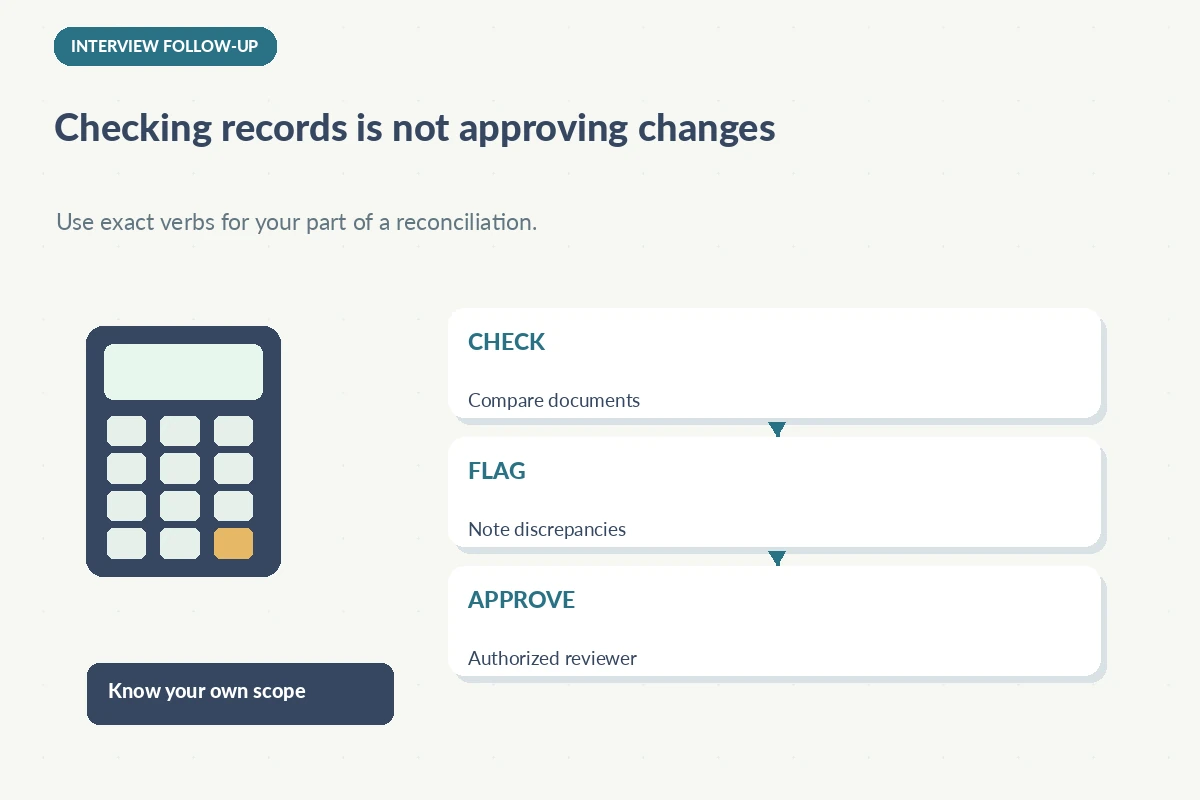
Distinguish Prepared, Reviewed and Approved Accounting Work
A common overclaim is treating an identified discrepancy as though it has already been corrected and authorized. These are different steps. You might prepare an exception list, a senior colleague might investigate the source, and an authorized person might approve a correction. In your thank-you, use verbs that reflect what you actually did: “checked,” “compared,” “recorded,” “flagged,” or “prepared for review.” Reserve “authorized,” “posted final adjustments,” and “signed off” for real responsibilities you have evidence for.
A useful hypothetical comparison: weak—“I fixed all bank account discrepancies”; accurate—“I compared a sample ledger to a practice bank statement and documented the unmatched entries for review.” The second sentence makes scope and evidence visible. If the interviewer emphasized separation of duties, referencing it briefly can show you understand the team's control environment. Do not invent a universal bookkeeping authorization hierarchy; actual controls vary. A small scope-accurate sentence builds trust better than a large claim with no work record behind it.
| Accounting step | Candidate-safe wording | Approval boundary |
|---|---|---|
| Compare records | Checked invoice and ledger fields | No final authorization implied |
| Flag mismatch | Recorded an unmatched entry | Reviewer assesses correction |
| Prepare report | Organized exception notes | Manager approves change |
| Maintain privacy | Used a fictional example | No client statements attached |

Keep Internal Numbers and Financial Documents Confidential
Never paste actual client account numbers, payroll data, vendor bank details, proprietary invoice images or internal ledger reports into recruiting correspondence. Even if you think a screenshot proves an achievement, sharing it may violate the previous employer's rules or the expectations of the people whose data appear. Instead, describe the type of task in generic terms. For example, “I checked invoice fields for consistency and routed exceptions to my supervisor,” is usually enough for a thank-you email. The interviewer can request an appropriate demonstration or anonymized practice exercise later.
The Federal Trade Commission recommends limiting access to personal information and protecting it through appropriate security controls. That is not a license for a candidate to improvise a secure transfer method. If the employer requests an accounting sample, ask whether a self-created demonstration using fictional figures is acceptable. Never promise that a sample data set came from an actual business when it did not. Avoid sending a spreadsheet that still has hidden worksheets, metadata or pasted original identifiers. In most cases no attachment is needed for a short thank-you.
Reference the Interviewer and Its Next Step Correctly
If a controller described how bookkeeping staff communicate with accounts payable or purchasing, mention that real detail without implying you will manage the whole department. If a recruiter rather than the hiring manager conducted the interview, thank the recruiter for the screening discussion rather than pretending they explained detailed month-end controls. The USC Career Center encourages a concise, personalized note that expresses interest and checks spelling and punctuation. Send it using the contact route the employer actually provided; a courteous message in the right thread is preferable to searching for someone's private email.
Many career centers advise sending shortly after the interview, often within a day. This is professional practice rather than a guaranteed benefit. If the interview ended late on Friday, you can write promptly and check the content calmly before sending. A subject such as “Thank you — Accounting Clerk interview” helps the recipient locate the conversation. Do not accidentally call the position “senior accountant” because you searched for an example. If there were multiple interviewers, tailor one appropriate detail per person where contact information is available.

Review the Email With an Accounting-Accuracy Checklist
Before sending, read each claim as if it were a journal entry that another employee must be able to trace. Does the message refer to a real task, and does its verb match your actual authority? Is the interviewer name and job title correct? Does it contain invented dollar totals, customer names or confidential files? Could you explain the example in an interview without reversing your claim? The note is a low-stakes communication, but those checks reflect the accuracy and discretion the job requires.
Keep a separate record of the employer's timeline if the interviewer offered one. The thank-you email does not need to pressure the hiring manager for a response or include a second full statement of qualifications. If you missed a material factual point, such as your actual software experience, you may clarify it briefly and accurately, but avoid a long after-the-fact defense. A useful final note has a true conversation detail, a plausible role-related skill and an appropriate close. Your resume and interview provide the fuller story.
How We Research and Maintain This Guide
This guide was checked against the linked career center, occupation and privacy resources on 2026-11-13: University of Michigan Career Center USC Career Center O*NET OnLine (U.S. Department of Labor) Federal Trade Commission. The email, scenario and decision table are illustrative, not a reported employer interview or an offer guarantee. Roles, approval paths and application instructions depend on the actual organization. For relationship information, read the affiliate disclosure. JobAsk does not claim source endorsement.
More Interview Preparation Guides
Yes. Describe it as a class or practice exercise; do not present it as paid employment or approved company work.
Generally no. Do not share confidential transaction or client information. Ask whether a self-created sample is appropriate if requested.
Use verbs that match your true work, such as checked, matched, flagged, documented or prepared for review.
No. Credit yourself for your contribution and explain the authorization boundary accurately.
Keep the appreciation email focused on the conversation; address compensation in the employer’s designated process or a separate relevant message.