
A career change resume summary should explain the bridge to your next role, not apologize for your earlier career. Start with a true description of the work you have done, name one or two transferable capabilities relevant to the target opening, and show where that evidence appears later in the resume. A different industry label alone does not make your experience irrelevant.
Keep the opening short enough to scan and specific enough to be tested. The University of Texas at Dallas career center discusses transferable skills as a way to present capabilities gained in work and other settings. Use that idea carefully: transferable means applicable to the new role, not automatically equivalent to years of specialist experience.
Identify the Work You Are Moving Toward
Read one specific vacancy and underline its repeated tasks: resolving customer issues, coordinating schedules, checking financial records, writing reports, or maintaining reliable processes. Separate tasks from broad adjectives such as dynamic or motivated. The summary should anticipate the work the reader wants performed, rather than list every responsibility in the candidate’s previous industry.
For example, someone moving from hospitality to office coordination could use records accuracy, appointment management, and customer communication if those duties were actually part of the prior job. They should not label themselves an experienced office administrator just because a hotel role included paperwork. Write a simple match table: target duty, related activity, and where the proof appears in your resume.
Choose Transferable Evidence, Not a New Title
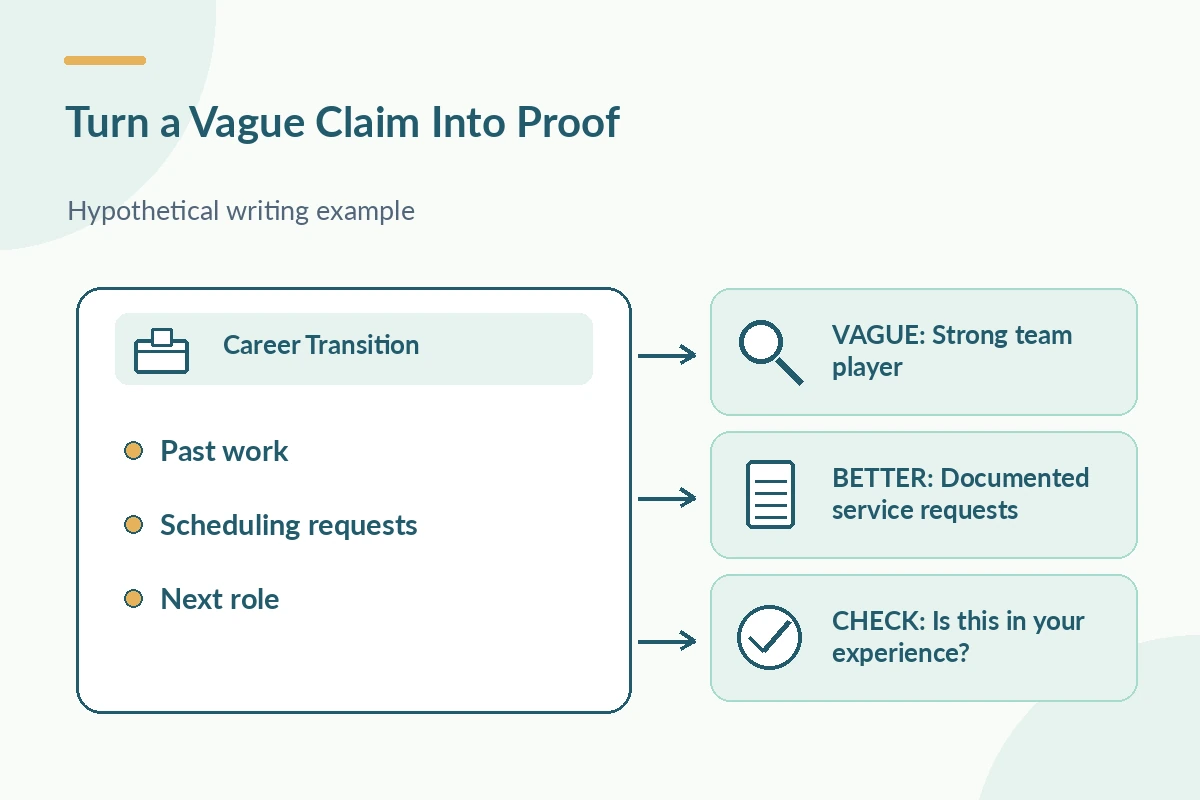
Useful transfer evidence describes an action with a recognizable work output. “Handled questions and documented follow-up requests” communicates more than “excellent people skills.” If the new role values documentation, the second half of that action matters as much as the interaction. The University of Montana resume guide recommends relevant, accurate accomplishments rather than filling space with unsupported strengths.
Do not claim expertise in the target occupation simply because two jobs share a skill label. Managing store inventory is not the same as professional financial auditing; helping coworkers troubleshoot a printer is not a qualification as a network engineer. Choose a modest, accurate level of specificity and show how the prior skill could apply without crossing that boundary.

Build a Three-Part Career Bridge
A clear pattern is previous work context → proven transferable action → target-role contribution. Each part can be a short phrase; not every candidate needs three full sentences. Use the work context to establish credibility, the action to show evidence, and the target phrase to show deliberate alignment. Do not include personal reasons for leaving an industry unless they directly clarify professional fit.
Hypothetical example: “Customer-facing operations assistant with experience coordinating schedules, documenting service requests, and following up with multiple teams. Seeking office support work that uses accurate records and calm communication.” This example is invented for instruction, not a real candidate. Replace every element with your own experience, and remove any claim your detailed history cannot demonstrate.
Compare Vague and Evidence-Based Wording
Weak hypothetical draft: “Passionate professional changing careers and eager to bring amazing skills to your company.” It tells a recruiter almost nothing about which tasks this candidate can do. A more useful version identifies the actual experience: “Retail shift associate experienced in reconciling daily handoff notes and explaining service options; transitioning toward scheduling and administrative support.”
The revision is still only a hypothetical illustration. It does not state that the person has already held an administrative job. If the detailed work history shows only merchandising rather than handoff notes or service options, the revised summary must change. A credible opening is a compressed map of the evidence below it, never a substitute for that evidence. Our career change resume guide goes into more detail.

Decide When a Summary Is Worth the Space
A summary adds value when a recruiter might otherwise misunderstand why your prior experience fits a different role. If the transition is obvious from your most recent job title and first few bullets, the section may be unnecessary. A resume does not become invalid without a summary, and there is no official three-line rule that guarantees an interview.
Prioritize the strongest relevant work first. If the summary repeats generic language from a skills section, delete the repeated phrases and let the evidence carry the page. Review the UC San Diego resume guide for its emphasis on individual contributions rather than duty lists; apply the same principle to what you feature in the opening paragraph.
Avoid Inflated Experience and Invented Metrics
Do not convert one informal project into several years of industry experience. If you completed a short analytics course while working in sales, describe completed coursework or the specific project, not a data analyst job you never held. Do not imply you supervised employees when your contribution was mentoring a new coworker on a single task.
Numbers should come from actual records or reliable personal knowledge. “Improved efficiency by 40%” may look impressive but is inappropriate when no baseline or measurement exists. A specific nonnumeric result can be stronger: “Updated weekly tracking records and resolved discrepancies with a supervisor.” You may explain the process without manufacturing quantified success.
Tailor the Summary Without Keyword Stuffing
After writing a truthful base summary, compare its words to the exact job description. Include a natural occupation term or relevant tool only if you can explain and use it. If the role expects Microsoft Excel but you have used it only for simple tables, describe that level accurately in the skills section rather than claiming advanced modeling.
Avoid copying every phrase from the posting into the opening. Recruiters must be able to match your statement to dated experience and actual activities. No adviser or tool can honestly promise that a particular wording will pass an employer’s applicant tracking system. Readability, relevance, and consistency are more defensible goals.
Run the Two-Way Evidence Audit
First, read the summary alone: does it identify a plausible target job and a relevant past contribution? Next, read every summary claim beside the employment, project, volunteer, or education evidence. Add a detail to the resume if the evidence is real but hidden; otherwise remove the claim from the summary. The two readings must tell the same story. Our administrative assistant resume summary guide goes into more detail.
Finish by reading the target posting again and checking whether the summary actually solves a reader’s question about the transition. If it remains a list of personal traits, rewrite it around a task. If it overexplains the switch, shorten it. A restrained bridge is more useful than a dramatic declaration about reinventing your career.
How We Research Resume Summaries
The sources reviewed on 2026-10-22 are university career guidance, university career guidance, university career guidance. We compared their actual occupational descriptions or career-center guidance with the limited claims made above. These references do not verify any hypothetical candidate, guarantee a hiring outcome, or establish an applicant tracking system ranking. All examples labeled hypothetical are invented teaching cases.
Earlier generic resume-summary pages cover broad principles; this guide addresses a specific applicant context. No affiliate partnership is asserted; see the affiliate disclosure.
Related Guides
- Career Change Cover Letter: Prove Transferable Skills for a New Role
- Career Change Resume Objective: Explain the New Direction With Real Evidence
- Career Change Cover Letter: Bridge Your Experience to a New Role
- Tell Me About Yourself for a Career Change: Explain Transferable Skills
- Career Change Job Search: Target Roles and Prove Transferable Skills
Usually use the summary to show relevant capabilities, not personal reasons. Explain the career motivation only if it helps clarify your fit.
Do not present an unearned title as past experience. You can name the target role as a goal while describing prior work accurately.
One or two well-evidenced skills are often enough for a short opening; avoid a long list of adjectives.
Use the form that makes the transition clearest and does not duplicate other sections. Neither is universally required.
Only if the numbers are true and supported. Clear nonnumeric actions are better than invented metrics.