
An engineering co-op student resume should answer two employer questions immediately: when you can work and what technical work you can already substantiate. State the degree, actual co-op or internship eligibility if required, available work term and concrete project evidence. Separate classroom prototypes from employer-approved designs, and never turn participation in a supervised lab into a claim that you authorized a production release. Check your own co-op program’s document rules before copying someone else’s template.
Show Co-op Status and Availability Precisely
Some formal co-op programs specify enrollment status, dates, completed work terms, and the semester for which a student is seeking employment. The University of Alberta’s engineering co-op guidance offers an example of program-specific mandatory fields, but that is a rule for its participants, not a standard for every U.S. school. Start with your university’s actual co-op office guidance and the employer’s posting. State only the work term you can genuinely accept, considering course schedules, authorization and school approval. Do not infer a guaranteed co-op placement from admission to an academic program.
A concise top line could be “Mechanical Engineering, BS in progress; seeking [verified summer term] co-op,” if that matches your record. If a program requires a completed-term count or particular academic data, include it using your current transcript and co-op portal. Otherwise, do not clutter the header with administrative details unrelated to the target role. Verify whether the employer needs a one-semester internship, a multiyear alternating schedule or a specific minimum period. Co-op and internship are not interchangeable when the timing and agreements differ.
Map Technical Projects to the Actual Job
Read the job posting and pull out its real tasks: CAD model changes, test preparation, wiring documentation, manufacturing process observations, quality records or basic scripting. Then choose class, team, competition or lab projects that demonstrate those actions. University of Kentucky’s engineering co-op sample includes student experience, co-op work and leadership as sources of relevant evidence. You do not need to pretend each project was a paid employment assignment. Label “Course Project,” “Senior Design,” or “Student Engineering Team” as appropriate, including genuine dates and your role.
A strong project entry makes the artifact visible: “Created and revised a bracket model in CAD based on the class team’s dimensional review,” if accurate. An inflated version, “Engineered a production-certified mechanical system,” would imply sign-off that might never have occurred. For software or electronics work, name the exact development environment, version-control contribution, test type and scope. If the work used simulated data or a classroom bench, state that; do not imply it met a regulated product validation requirement. Match the level of detail to what a first co-op supervisor would actually expect.

Separate Team Contribution From Engineering Approval
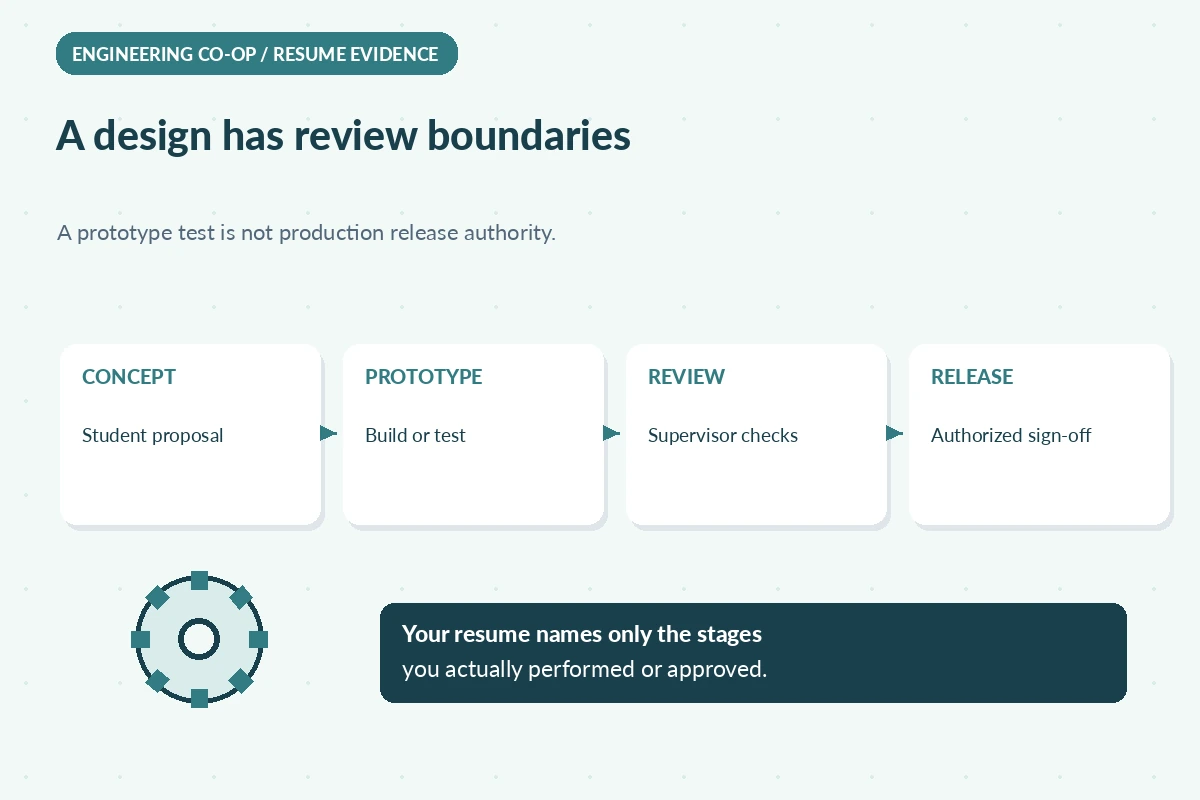
Engineering tasks often move through distinct stages: concept, calculation, prototype, test, review and approval. Your resume should say which stage you performed and who approved the work when that distinction matters. A student may have performed measurements, compared test runs or prepared a draft drawing without authority to release a design, certify a component or sign off safe equipment operation. Use verbs like “drafted,” “assembled under supervision,” “recorded,” “tested in a course lab,” and “submitted for review” where truthful. Reserve “approved,” “certified” and “validated” for their actual documented meanings.
Suppose a student team designed a small mechanism and presented its performance at a campus showcase. An appropriate bullet might state “Modeled the linkage, checked fit against provided dimensions and presented prototype test observations.” That is a hypothetical example, not a measured real-world result. If the team received a grade or award, name it only if it happened and can be verified. Do not claim a safety improvement percentage or warranty outcome from a one-off classroom demonstration. Employer engineers need honest visibility into what you can repeat and where review is required.
Document Tools and Work Standards Without Rating Yourself
Technical skills should be specific enough to support interview questions. “CAD” alone may be vague; specify the tools you actually used and whether your experience was in coursework or employment. A label such as “SolidWorks: sheet-metal lab models” can be more credible than a five-star bar graphic. For coding, mention the language and the kind of script produced; for testing, identify the instrument and the training context. Tools used only in a tutorial belong lower on the list or may be omitted when space is short.
If a posting references quality standards, regulated procedures or hazardous machinery, do not claim independent compliance just because you studied those topics. State any formal, current training you completed using the issuing body and real date where relevant. Do not imply a student project satisfies a product standard unless documented assessment actually occurred. Keep lab and employer proprietary details private: a generic description of test design, version tracking or analysis technique is often enough. In a co-op interview, a clear description of limitations can demonstrate better engineering judgment than a sweeping claim.
Build a Work-Term Entry That Can Be Verified
If you previously completed a co-op term, list the actual employer, role title, location as appropriate and employment dates. Under it, describe owned deliverables, review interfaces and observed results. If you completed only an academic placement and not a formal employer work term, label it accurately. School co-op rules may specify how terms are counted or how to handle waived terms; follow your program records rather than borrowing another institution’s wording. Applicants without previous terms can put projects ahead of unrelated part-time employment when those projects best answer the job description.
Consider this illustrative bullet: “Updated a parts-tracking spreadsheet from technician inspection notes and flagged conflicting entries for supervisor review.” It names a useful deliverable and preserves the approval boundary. Do not embellish it into “Directed plant-wide quality control.” If a supervisor did not confirm a number, leave the number out instead of inventing efficiency gains. If your team participated in a proprietary design program, describe the type of work without disclosing drawings, customer names or internal system identifiers. Your evidence should survive a conversation with someone who knows the workflow.
Check the Co-op Resume Before Sending
Review availability, academic status, employment dates, course-project dates, names of software and actual level of training. Confirm that a listed university affiliation and any program designation are permitted by your school. For example, some institutional templates restrict use of their co-op marks or logos; never paste those marks into an unrelated application. Read the PDF at actual size and avoid dense tables that separate tools from the project where you used them. The resume should remain understandable without colors or a portfolio supplement.
Maintain a separate private project ledger with dates, teammate roles, drafts, review feedback and demonstrable outputs. It will help you defend each bullet during technical interviews, while keeping sensitive originals off public profiles. You can ask a co-op office or campus career center to review the document against local placement requirements. The final test: can the employer see the term you are seeking, the tools you have used, a project you can explain in depth and the boundary between student work and an authorized engineering sign-off?

How We Research Student Resume Examples
This article uses current university career-center materials and the named primary professional or employer sources to explain documentation, role scope and resume writing. Sources are guidance rather than binding rules for every school or employer. All candidate examples are hypothetical and must be changed to match verifiable personal records. No fabricated hiring results, licensing approvals, ATS scores or employment outcomes are implied.
Sources reviewed November 13, 2026: pigmancareers.uky.edu — University of Kentucky engineering provides a co-op/internship resume sample for students.; eng.umd.edu — University of Maryland engineering career center includes sample co-op resumes and project-focused examples.; www.ualberta.ca — University of Alberta shows that formal co-op programs may have specific term and status reporting rules; not a U.S.-wide requirement..
Always review the opportunity’s current application instructions and any relevant university, employer or credential rules. Our sources are cited for education, not endorsed products. See the JobAsk affiliate disclosure for relationship information.
More Resume and Cover Letter Guides
Yes when relevant to the posting or required by your co-op program. Use the actual eligible term and your real schedule.
Yes, label them as course or student projects and specify your deliverables and level of review.
Only if your own program requires and permits it. Another school’s branding rules do not transfer to you.
Use verifiable course projects, lab work and student-team contributions; do not relabel them as employment.
Only if you truly held that authority. Students should distinguish drafts, tests, review and authorized final approval.