
A psychology student resume should translate actual classes, research assignments, campus activities, and work into tasks an employer understands. For a research assistant opening, the strongest section may describe data coding or a supervised study. For a nonresearch position, clear communication, organization, and ethical judgment may matter more. State the specific action and its context; taking a psychology course does not by itself qualify a student to diagnose, counsel, treat, or make decisions reserved for licensed professionals. The strongest draft makes the boundary visible while still demonstrating useful skills.
The following examples are hypothetical writing models, not a record of any actual applicant. Replace tools, roles, dates, outputs, awards, and measurements with evidence from your own coursework or employment. Never use a credential, title, or result that you cannot explain and verify.
Choose between research and general workplace targets
Start with the posting. A university lab may value methods courses, survey administration under supervision, spreadsheet cleaning, research ethics training, and careful notes. A recruiting or support role may emphasize explaining a process, coordinating appointments, summarizing themes, or managing sensitive records appropriately. APA describes transferable skills developed through undergraduate psychology, but a list of abilities is not evidence that you have mastered each one. Select two assignments or roles that demonstrate the particular skill using actions and outputs, not the major name alone.
Make education details accurate and limited
List your official school and degree title, major, and completed or expected graduation date. A selected methods or statistics course can be useful when it directly matches the job; an entire transcript-style course list usually buries the evidence. If a class included research design, be specific about the activity: for example, drafting a hypothetical survey instrument or coding an anonymized class dataset. State the class or course setting. Do not claim accreditation, credentials, research approval, or training outside what your school actually confirmed.

Explain your research contribution without borrowing authority
Research can involve literature review, preparing stimuli, recruitment communication, organizing de-identified responses, data entry, coding, a supervised analysis, or poster preparation. Choose a verb that fits your actual task. A defensible hypothetical bullet is “Coded anonymized class responses using an instructor-provided rubric and compared disputed labels with a project partner.” It would be misleading to replace that with “conducted clinical behavioral assessments.” Even in a genuine faculty lab, approval, research protocol design, and conclusions may belong to the principal investigator or wider team rather than to an undergraduate assistant.
Protect participant information in examples and links
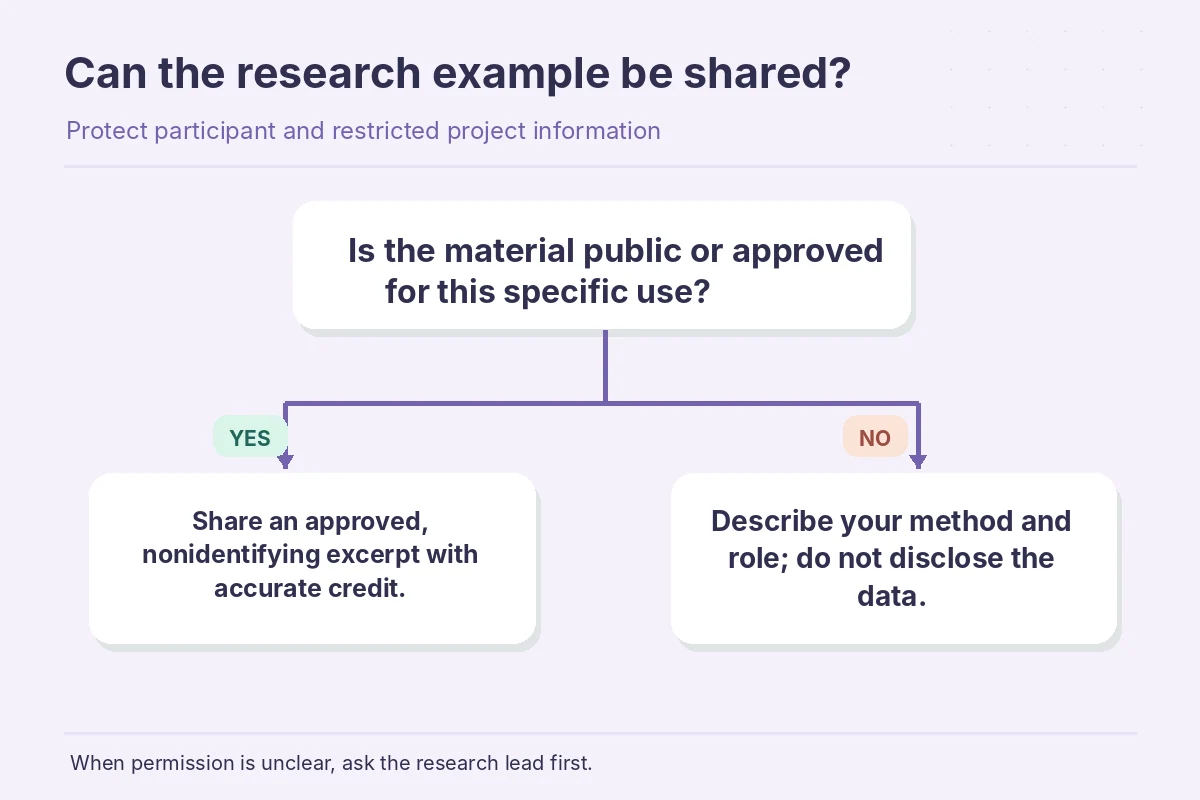
A resume does not need names, individual case histories, private survey answers, or raw restricted datasets to show experience. Describe the kind of records handled and the safeguards your actual role required. If you want to attach a writing sample or poster, confirm it is public or that you have the appropriate permission. A private classroom discussion is not a professional case study. Describe human-subjects training only if completed, with its actual provider and name; do not turn a general ethics lecture into an invented certification.
| Activity | Accurate resume wording | Avoid |
|---|---|---|
| Methods assignment | Coded instructor-provided responses | Led an approved clinical study |
| Peer support volunteering | Shared resources and referred concerns | Provided therapy |
| Course presentation | Presented literature synthesis to class | Published peer-reviewed research |
Translate courses into workplace proof
A class presentation can support the ability to organize evidence and explain findings to a defined audience. A group project can support collaboration if you explain the portion you wrote, checked, or presented. Service work may show how you handled questions and recorded follow-ups. Instead of “strong listener and critical thinker,” try a bounded hypothetical description such as “Summarized peer feedback across draft survey items and documented changes for a course presentation.” Adapt the example to your real experience, using only confirmed tools, dates, and results.
Distinguish volunteer support from professional care
A peer education role, crisis line training, childcare placement, or community volunteer shift has real value but it is not equivalent to licensed therapy or clinical practice. Name the organization and job title as recorded, and explain whether you facilitated activities, followed instructions, directed questions to trained staff, or prepared materials. Avoid intimate details about the people served. If a worksite required escalation for high-risk situations, describe your reporting or referral duty rather than claiming you independently treated or resolved a clinical problem.
Choose a lean section order and working examples
For a psychology research position, consider Education, Research Experience, Research Methods and Tools, then other Experience. For a general entry-level job, lead with a relevant paid or volunteer role if it contains more direct evidence. Skills can include software packages you actually used, not every package mentioned in lectures. APA recommends connecting academic learning to employer needs; use that principle to pick sections, not to inflate the list. Keep the layout consistent, let the strongest bullets breathe, and avoid unsupported statements about candidate personality or guaranteed hiring results.
Two realistic before-and-after bullet examples
These examples illustrate a change in precision, not a claim about any real applicant. Do not paste the improved version unless the action, context, and scope match work you completed.
Before: Skilled in psychological assessment. After: Organized class survey responses and checked coding notes with a faculty-assigned rubric.
Before: Provided mental health treatment to peers. After: Directed student questions to approved campus resources during a supervised outreach shift.

Audit authorship, dates and evidence before submitting
For each bullet, ask whether a professor, supervisor, teammate, or project record could confirm the part you completed. Distinguish an ethics training module from a research project, an observation from data collection, and an internal class presentation from a public conference talk. Review grammar and capitalization, then save the file in the format requested. A well-structured resume lets the employer ask about your work without requiring disclosure of participant identities or private circumstances. Your role and the scope of your training should remain clear even if the recruiter never opens a linked artifact.
How We Research and Verify Examples
We reviewed APA undergraduate career guidance, its recent graduate article, and Penn student resume guidance. Every example is hypothetical and protects professional boundaries and personal information.
Primary sources used in this guide: www.apa.org — APA identifies analysis, research reasoning, ethics, written communication and other transferable undergraduate psychology skills.; www.apa.org — APA suggests using class projects, presentations, internships, volunteering and research to demonstrate relevant experience.; careerservices.upenn.edu — Penn resume guidance supports distinguishing academic projects and employment and writing role-specific evidence.. Source pages were reviewed on November 15, 2026.
JobAsk explains its approach to commercial relationships and reader trust in its affiliate disclosure. This is independent career information, not a placement guarantee or a claim of affiliate approval.
More Resume and Cover Letter Guides
Yes, as coursework or an academic project. Describe the actual assignment and do not portray it as paid research employment.
Only when you completed that specific training and the credential name, dates, and provider are accurate. Do not invent a certification from a class lecture.
Keep any example at an approved, non-identifying level. Do not publish restricted records or personal histories in a resume or portfolio.
Not by itself. Professional practice and protected titles depend on further qualifications and applicable licensing rules.
Use a Volunteer Experience or Relevant Experience section with dates, organization, your actual role, and evidence of your contribution.