
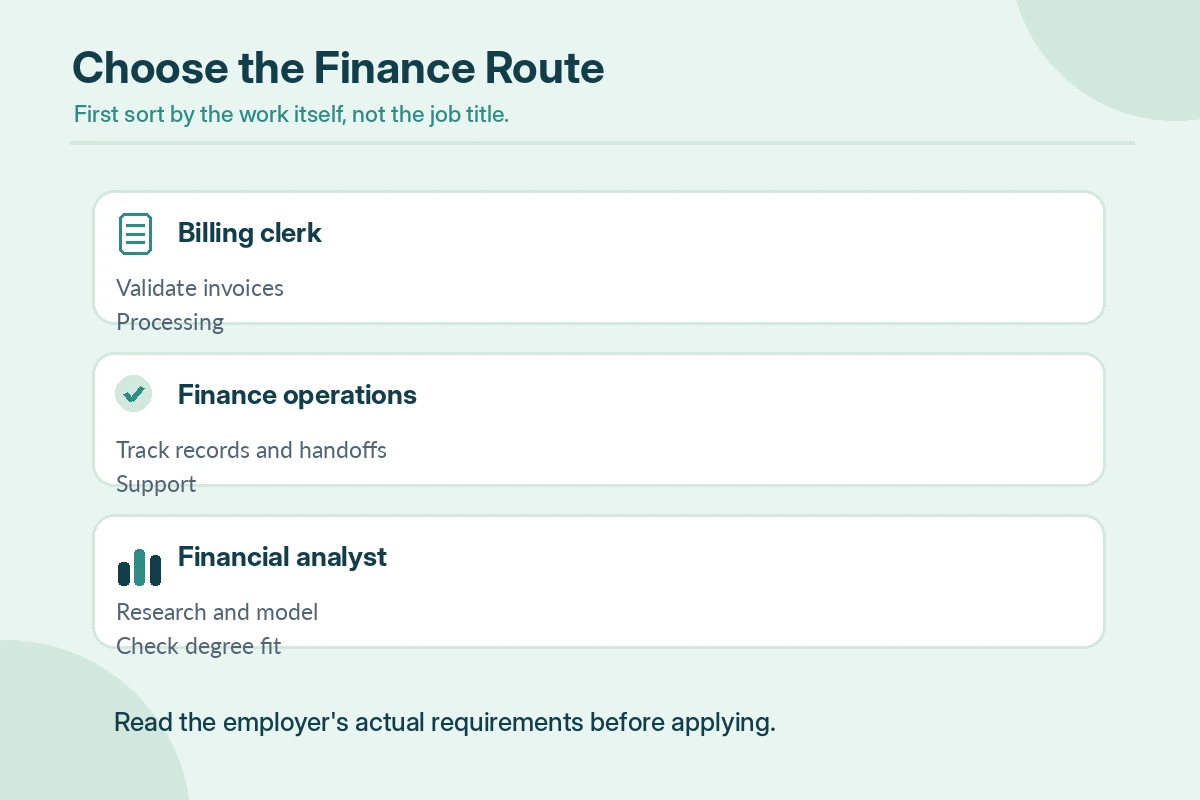
Entry-level finance jobs do not all start with investment analysis. If you are new to the field, compare billing and posting clerk, finance or accounts operations assistant, and junior financial analyst listings by the actual work and qualification threshold, not by the word “finance” in the title. A billing role may focus on validating amounts and documents; an analyst listing may expect a degree and a financial-modeling foundation. Neither is automatically a stepping stone to the other.
This guide is for U.S. jobseekers choosing a realistic first application target. It shows what evidence a candidate can prepare without pretending to have managed a company’s accounts, how to screen employer requirements, and why an appealing analyst title should not distract from a better-fitting operational role. Every candidate example here is hypothetical and must be changed to reflect actual experience.
Distinguish Financial Processing From Analysis Before You Search
The O*NET Billing and Posting Clerks profile lists invoice preparation, recordkeeping and checking billing data as core tasks. An employer might call such work billing assistant, billing coordinator or finance operations associate. Read the description to determine whether the job is predominantly administrative processing, customer communication, basic reconciliation, or policy-driven exception handling. A title that contains “specialist” is not proof that the role involves professional financial analysis.
By contrast, an entry-level analyst posting may ask for budgeting, forecasts, spreadsheets and formal reporting. Do not assume that a general finance search result is available to applicants without a related degree. Put job ads into three piles: document processing, financial operations support and professional analyst work. That simple classification prevents a week of applications to positions with entirely different entry thresholds.
Choose Your Target From a Real Requirement Matrix
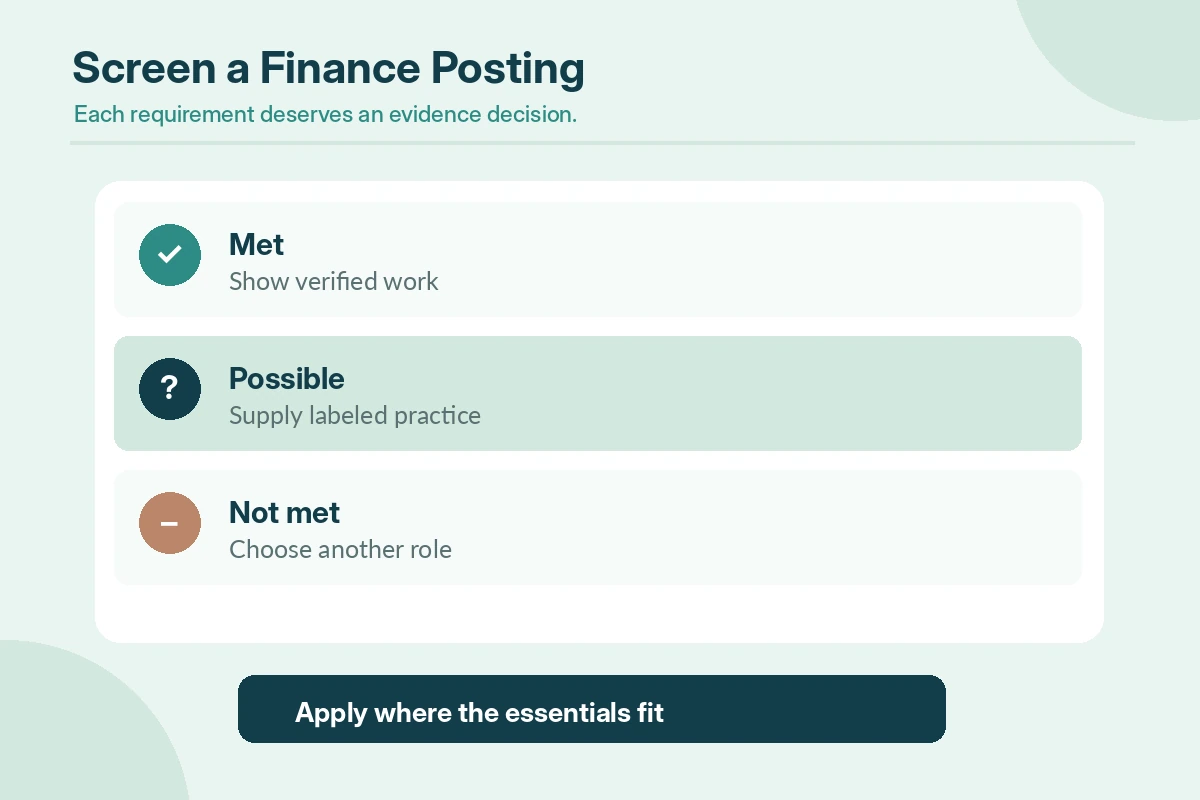
Create a four-column tracker with job title, must-have education, tools and daily responsibilities. Record each employer requirement verbatim, then mark it met, possible with supporting evidence, or not met. An Excel class or personal budget is not equivalent to closing a company ledger; however, a verified project that involved checking transactions can be evidence of care with numbers. Do not assert that one credential is universally needed: the advertisement controls the decision.
Ask whether the role requires independently posting journal entries, handling payments, speaking with clients, escalating discrepancies or supporting licensed professionals. If the posting requires authorization, prior regulated experience or tools you have never used, move it to a later list. Give higher priority to jobs that explicitly train new hires on employer systems and define a supervisor or review path.
Build a Small Accuracy Example Without Inventing Employment
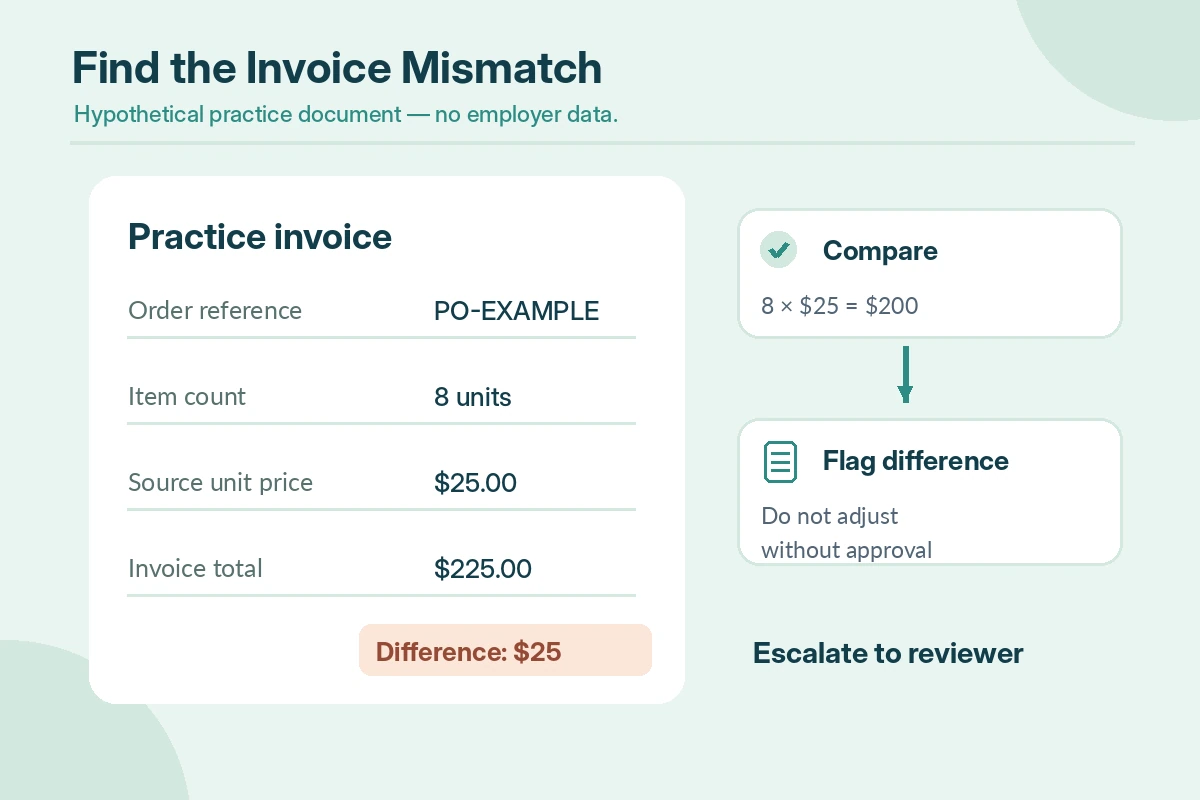
A useful hypothetical practice exercise is to create a sheet of ten fictional invoices and purchase-order amounts, add two deliberate inconsistencies, and document how you found them. In a short write-up, show the source field, the compared value, the exception and who would need to resolve it in a real workplace. Keep the exercise entirely fictional and never label it a former employer result. It demonstrates a method of checking data, not professional authority.
If you have actual cashier, retail, volunteer treasurer or administrative experience, select one truthful example involving totals, records or customer follow-up. Say what you did and who approved the final transaction. A cashier who balanced a drawer did not necessarily prepare financial statements; a student who modeled a budget did not independently assess credit risk. The strongest entry-level story is often the one with the fewest inflated claims.
Read Finance Job Ads for Red Flags and Unclear Scope
Distinguish billing support from jobs advertised as “financial consultant” that primarily involve selling products. Search the employer’s own careers site, confirm the business, then compare whether the day-to-day description matches the title. An ad promising an unusually high return to someone with no skill requirements should prompt verification, not excitement. Ask in the interview how work is reviewed, whether you handle cash or sensitive customer records and what training is provided.
The Federal Trade Commission warns that fraudulent postings may appear on legitimate job boards. Never send money for a promised position or deposit a check and send part of it onward. For any financial role, verify the application domain yourself rather than relying only on a recruiter’s message or document request.
Turn the Shortlist Into Focused Applications
For each promising job, use one resume bullet that proves the specific requirement. A billing role could be supported by an accurate records exercise labeled “hypothetical practice project”; an operations support role might align with scheduling, document review or escalation experience. If a tool was learned in a tutorial, describe it as introductory training rather than paid production experience. Tailor the top of your resume to the employer’s real responsibilities.
After applying, log the date, employer domain, exact role, version of your resume and follow-up method. Judge progress by replies to suitably matched applications, not raw application counts. If every role on your list insists on a credential you lack, change the target job family instead of rewriting the same resume repeatedly. Consider a financial processing role only if you are comfortable with its actual duties; there is no guaranteed promotion ladder.
Questions to Ask About Reviews and Money Handling
Before an interview, draft four questions that distinguish one finance setting from another: who reviews invoice exceptions, what happens when supporting documents do not agree, which systems a new employee may edit, and how corrections are logged. If an employer expects a clerk to independently authorize transactions on the first day, ask what approval policy and training support that responsibility. These questions are not a demand for the employer to reveal confidential controls; they help you understand job scope, supervision and how mistakes are prevented. Record the answers after the interview to compare real opportunities on more than a title.
Create a brief weekly search routine rather than scattering applications. On one day, classify ten real postings into billing, operational support and analyst work. On another, compare essential qualifications and remove posts outside your scope. Use a third session to improve one truthful evidence example and apply through independently verified employer sites. At week’s end, note which requirements appeared repeatedly. If an office skill is missing, choose a learning project that actually addresses it. Never claim the practice exercise led to a paid result or a guaranteed interview.
How We Research This Entry-Level Role
The U.S. Department of Labor O*NET occupation profile supports the billing-clerk tasks described above. The BLS administrative occupations reference provides the neighboring clerical context; it does not establish that analyst vacancies accept any particular qualification. FTC consumer advice informs the fraud checks. Pay, hiring probabilities and employer-specific entry thresholds are intentionally not inferred from occupation averages.
This guide is independent informational content. The examples are explicitly hypothetical and do not represent actual employers, candidates, interviews, or performance results. Check the current official vacancy and confirm important requirements with its hiring team. You can read our affiliate disclosure; no paid placement relationship or hiring guarantee is implied.
Related Job Search Guides
- Entry-Level Bookkeeping Jobs: Compare Clerk Duties and Skill Proof
- Entry-Level Purchasing Assistant Jobs: Compare Quotes and Track Orders
- Entry-Level GIS Jobs: Mapping Technician Routes and Project Proof
- Entry-Level Accounting Jobs: Choose the Right First Role and Prove Your Skills
- Entry-Level Bookkeeping Jobs: Choose Clerical Routes and Show Accuracy
No universal answer fits every listing. Billing and financial clerical support may have different thresholds from analyst positions; verify each employer’s must-have education.
No. Billing clerks generally process and verify transaction records; analysis and forecasting duties differ. The advertisement determines the actual role.
Yes, if it is labeled clearly as a hypothetical or academic project and you describe what you truly calculated and checked.
No. State that you checked receipt totals and explain your scope. Reconciliation has a more specific meaning than general accuracy.
Pressure to send money, move funds, or deposit and return part of a check is a serious warning; verify the employer through its official site.