
To read an entry-level job advertisement, do not assume that the word “entry-level” means no experience, no education, or guaranteed training. First separate nonnegotiable conditions—such as a credential explicitly required for the role—from preferred experience. Then confirm the real tasks, location, work hours, and employer application route. Apply when you can truthfully meet the required conditions, or ask the employer a concise question when the wording is ambiguous. This guide gives you a posting worksheet rather than a promise that an applicant-tracking system will overlook a missing requirement.
Read the job posting as four different kinds of requirements
Copy the requirements into four lanes: eligibility and credentials, work conditions, essential tasks, and preferences. Education or licensure requirements belong in the first lane; location and shift availability in the second; daily duties in the third; “preferred experience with scheduling software” in the fourth unless the employer states otherwise. A single advertisement may blend these categories or contradict itself. Keep the original wording beside your interpretation so you do not mistakenly turn a nice-to-have into a legal requirement, or the reverse. BLS occupation profiles can establish typical entry preparation, but the specific job posting and applicable rules still matter. If a role demands a license you do not hold, do not imply that a school project is a substitute.
Distinguish a true entry route from an aspirational title
Job titles can be broad. A “junior analyst” opening may still ask for a particular degree or prior systems experience; a “trainee coordinator” posting might emphasize supervised practice instead. Look for language describing who trains new hires, how work is reviewed, and what tasks you would handle in the first weeks. Avoid relying only on a search filter that labels a position entry-level. The BLS Occupation Finder separates typical education, related experience, and on-the-job training, which can help you compare occupations before deciding which postings are realistic. Treat those national occupational descriptions as context, not as a promise that any single employer must hire someone with your background.
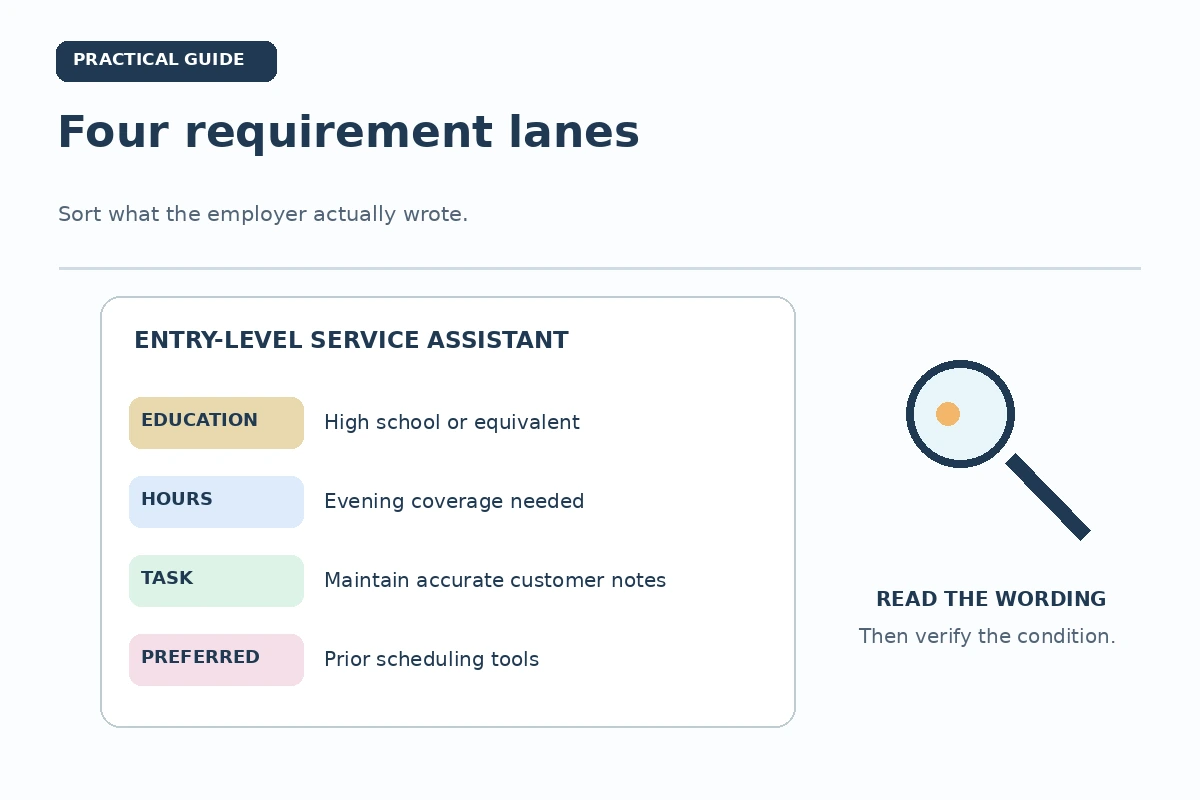
Identify which requirements call for clarification
Flag ambiguous statements such as “experience required,” “flexible hours,” or “certification preferred” when the advertisement never defines them. Instead of writing a long email asking whether you qualify in general, ask one concrete question: “Does the required credential need to be held before the start date, or is the role designed for supervised trainees?” Make no assumptions about the answer. If a credential is required by law, a recruiter cannot simply waive that condition; verify the relevant regulator or official program guidance when appropriate. For ordinary employer preferences, the hiring team decides whether your alternative evidence is suitable. Save their response and date so your application does not depend on memory.
Translate your experience into honest evidence
A lack of paid employment does not mean an absence of useful experience. For each essential task, find one truthful example from coursework, clubs, volunteering, home projects, or previous responsibilities. If a posting asks for accurate records, an actual student club inventory log might show careful data entry, provided you describe it as club activity. If it asks for customer conflict handling, do not invent difficult customers you never served; use a real communication example if you have one. Keep a compact evidence column: requirement, action you really performed, setting, and what can be verified. This can guide both resume bullets and interview answers without falsely presenting education as professional employment.

Use a three-way decision instead of applying blindly
Give each posting one of three provisional labels. APPLY if you meet the stated eligibility conditions and can explain the core duties with credible evidence. VERIFY if one important point is ambiguous and can be asked before investing in a lengthy application. SKIP if there is a clear disqualifying condition or the role is unsuitable for your actual schedule and abilities. A sample decision: “Driver’s license required for daily driving; I do not have one”—skip instead of pretending you can drive. Another: “Spreadsheet experience preferred; I used spreadsheets to track approved class expenses”—consider applying with honest context. These are hypothetical decisions, not employer screening outcomes.
Check the job source before sharing personal details
A professionally formatted posting can still be fraudulent. Confirm the organization’s real website and look for the opening on its careers page when available. Be careful with lookalike domains, recruiters who move you to unofficial channels, and unexpected requests for financial or identity documents. FTC job-scam guidance warns about fake checks and requests for payment to obtain work. Never deposit a supposed equipment check and send money to a vendor on an unverified recruiter’s instructions. If a legitimate application process needs sensitive details later, use the verified employer channel and ask how the information is protected. A posting is not verified simply because a job board lists it.

Turn the posting worksheet into a focused application
Once the role passes your checks, write two or three evidence bullets using the employer’s actual duties, not just its adjectives. If a posting lists stocking, inventory counts, and shift handoffs, discuss a real setting in which you organized supplies or maintained a checkable list, and say clearly if it was volunteer or school work. Do not keyword-stuff a resume with software you have never used. CareerOneStop’s find-a-job guide recommends targeting application materials and tracking where you applied. Keep a dated record of the original posting, employer route, documents submitted, and any clarification obtained. Use that same record to prepare for a specific interview.
Review your decisions after a small batch of applications
After you have screened a manageable set of postings, review the patterns rather than blaming yourself for every nonresponse. Are you repeatedly choosing roles with mandatory credentials you lack? Are your strong examples buried under generic claims? Are you missing a clear shift requirement? Adjust the search terms or training plan accordingly. A lack of response does not prove an automated system rejected you, and it does not justify inventing qualifications. Ask a trusted adviser or an American Job Center career counselor to review one representative advertisement and your evidence matrix. A tighter shortlist can save time and preserve accuracy, even though it cannot guarantee an interview.
A four-column posting worksheet to copy
For each posting write: (1) verbatim requirement, (2) type—credential, schedule, task, or preference, (3) evidence and source of proof, and (4) decision—apply, verify, or skip. Add the job link, date found, employer’s official application URL, and exact question sent for any unresolved point. Example (hypothetical): “Maintain supply logs | core task | school theater prop inventory, volunteer | apply and describe honestly.” Do not enter private references’ contact details into a shared worksheet. Recheck the advertisement before submitting because employers can edit requirements.
How We Research Beginner Job Search Guidance
We review U.S. primary resources about occupation requirements, official job-search services and employer verification, then translate those into a practical worksheet. Sample scenarios are hypothetical; they do not represent actual openings, hiring decisions, employer commitments or universal legal rules. Check the current employer posting and applicable licensing or program requirements before relying on an example.
Sources reviewed November 11, 2026: www.bls.gov — The BLS Occupation Finder compares typical entry education, related experience and on-the-job training by occupation; individual postings may differ.; www.careeronestop.org — CareerOneStop recommends selecting openings, adapting application materials and recording employer contacts.; consumer.ftc.gov — FTC advises verifying employer identity and avoiding payment requests for the promise of a job..
This guide offers general U.S. job-search information, not legal advice, job placement, an employment promise or proof that a particular opening exists. Review the JobAsk affiliate disclosure. The internal category links here are informational, not paid endorsements.
Related Job Search Guides
No. Employers use the term differently. Read the actual requirements and compare typical entry preparation using BLS information.
You can consider applying if the missing skill is genuinely optional and you meet all essential conditions. Describe existing evidence honestly.
It can demonstrate a task or skill when labeled as coursework or a project; it should not be presented as paid professional employment.
Ask when the credential must be held and who sets the requirement. Do not assume a legal or licensed-role condition can be waived.
Verify the company and application route independently, and treat requests to pay for a job or process a supposed equipment check as serious fraud warnings.