
If your first job search must fit around classes, caregiving, medical appointments, or limited transportation, create an honest availability grid before you apply. Record the hours you can reliably work, allow for travel and necessary breaks, and distinguish fixed shifts from changing or on-call schedules. Then screen each real opening against that grid, asking about unclear shifts before you claim you are “fully flexible.” The purpose is to find a workable match, not to guarantee that an employer will adapt every schedule to yours.
Write down genuinely available hours, not wishful hours
Begin with obligations you cannot move: class sessions, caregiving commitments, scheduled appointments and required travel. Mark only the time you can regularly commit to work, using a simple weekly grid. Leave a buffer for getting to and from the job, changing clothes, or predictable obligations after a shift. A hypothetical student may be free from 3:00 p.m. but unable to arrive at a worksite until 4:00 p.m.; “available at 3:00” would be misleading. Do not share private details of family or health circumstances in an application when a simple accurate availability window answers the employer’s scheduling question.
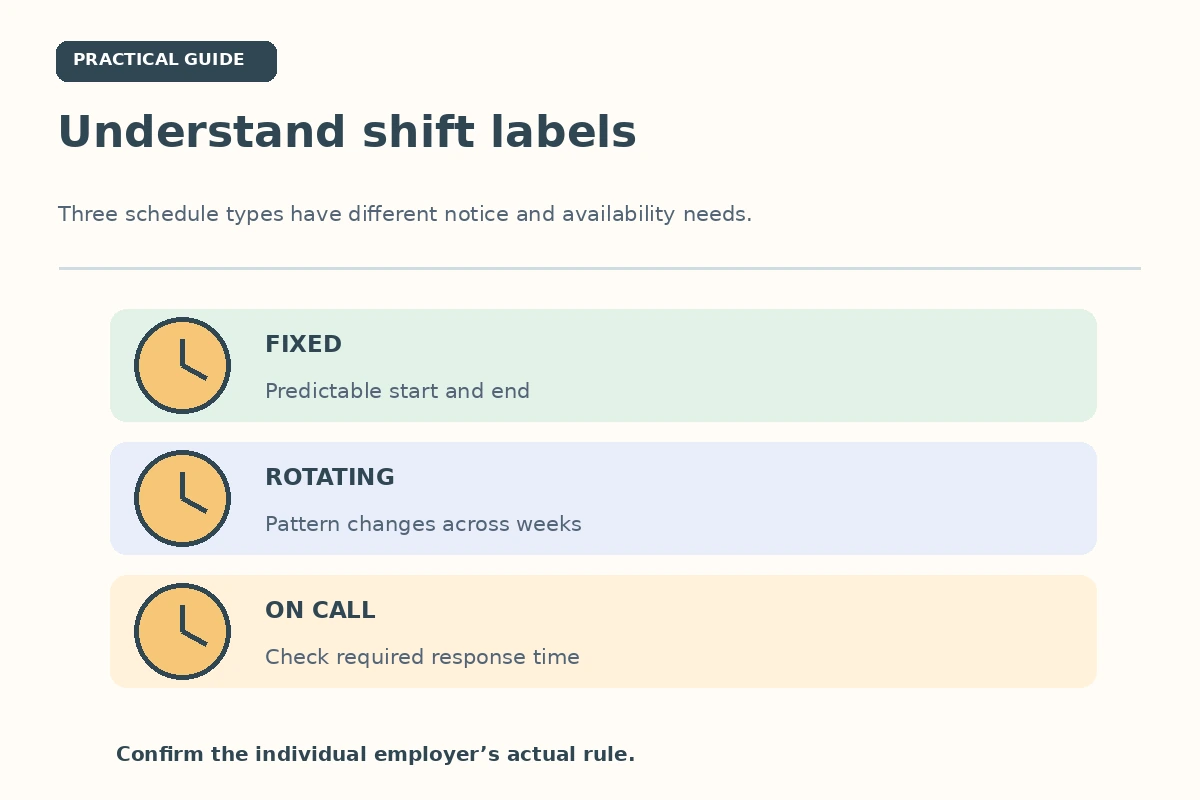
Recognize fixed, rotating, nonfixed, and on-call language
The Bureau of Labor Statistics distinguishes fixed schedules, flexible schedules and nonfixed or rotating arrangements in its work-schedule terminology. A “weekend position” may include early opening, late closing or occasional weekday training. “Flexible” may mean that workers choose hours within employer rules—or that the employer changes shifts, depending on the posting. Ask who sets the schedule, how far ahead it is posted, and whether there is a required minimum availability. Do not assume “part-time” means only a few predictable weekday hours. Treat the individual employer’s current description as decisive for the proposed role.

Screen the whole shift, including opening and closing duties
A retail listing that says “evening shifts” might require arriving before customers enter or completing closing duties after the public store hours. An event job may have load-in and teardown outside its advertised event window. These are hypothetical possibilities, not assertions about a particular employer. Ask for the normal start/end range and whether training schedules differ. Be truthful about how late you can stay and whether you can work weekends. It is better to rule out a mismatch before applying than to agree to coverage you cannot reliably provide. Safety rules and transportation options matter especially when shifts end late.
Test travel rather than assuming a map estimate is enough
Check travel at the hours you would actually commute, including any public-transit schedule, walk, transfer and contingency. If the route depends on a final bus, verify the return journey rather than planning only the trip to work. A map estimate may not reflect peak traffic, weather or local service changes. Choose a realistic buffer and compare the true door-to-door time with your available hours. Do not volunteer for a restricted driving duty or imply a license or vehicle is available when it is not. If the posting lists multiple sites, ask which one is assigned and whether temporary coverage elsewhere is expected.
Use a schedule-fit table to shortlist openings
For each legitimate posting, note advertised work window, number of shifts, training hours, commute, schedule notice and whether availability rules are explicit. Mark FIT if the real conditions appear compatible; ASK if one scheduling fact is missing; SKIP if there is a definite conflict. A hypothetical role requiring weekday mornings conflicts with classes scheduled at those times, even when the job title sounds ideal. A role that advertises Saturday coverage may fit if your Saturday travel is reliable and the employer’s normal hours are clear. This decision table prevents you from collecting applications whose schedules you cannot honor.
Phrase availability precisely without oversharing
When a form asks for availability, give time windows and relevant dates rather than “any time” or a complicated account of personal obligations. You might write, hypothetically: “Available Mondays and Wednesdays after 4 p.m. and Saturdays 9 a.m.–6 p.m.; unavailable Tuesday and Thursday mornings.” Use only what is true for you. If the employer asks whether you can handle occasional changes, distinguish occasional notice-based adjustments from open-ended on-call work. A concise question like “Are training shifts held during the same hours as regular work?” can prevent misunderstandings. Be prepared to discuss how much notice you need to arrange transport.

Keep scheduling claims consistent across the application
Your resume, application form, availability email and interview answer should not contradict one another. If your schedule changes between applying and interviewing, update the employer directly. Do not conceal a known conflict in the hope of fixing it after an offer. Conversely, avoid declaring that every future hour is unavailable because of one unusual week; state the regular pattern and any known short-term exceptions. CareerOneStop recommends targeting applications and tracking employer contacts, which helps when different openings request different shift information. Add a field for the availability statement you actually submitted so you can refer to it later.
Check the terms after an offer, not just in the ad
A real offer may specify hours, shifts, training days, travel between sites or a rotating schedule that differs from your first impression. Ask for the written details and clarify conflicts before accepting. Do not assume an informal interview comment overrides the final terms or workplace scheduling policies. A workplace may have lawful scheduling and accommodation obligations depending on jurisdiction and circumstances, but this article does not provide legal advice or promise a particular arrangement. If the position is incompatible with your nonnegotiable hours, decide based on the real constraints rather than a hypothetical future change. Continue searching for roles whose expectations you can meet reliably.
A weekly availability and shift-fit worksheet
Make seven rows for days and columns for earliest reliable arrival, latest reliable departure, commute mode, travel buffer, and fixed conflicts. Then create one row for each job: normal shift, training hours, rotating or on-call expectation, commute home and status—FIT, ASK or SKIP. For example (hypothetical), “Sunday 12–6 p.m.; last bus home 7 p.m.; ask whether closing duties extend after 6.” Keep private reasons for unavailable hours out of the shared application materials. Review the grid before every new submission.
How We Research Beginner Job Search Guidance
We review U.S. primary resources about occupation requirements, official job-search services and employer verification, then translate those into a practical worksheet. Sample scenarios are hypothetical; they do not represent actual openings, hiring decisions, employer commitments or universal legal rules. Check the current employer posting and applicable licensing or program requirements before relying on an example.
Sources reviewed November 11, 2026: www.bls.gov — BLS describes work schedules, typical work environments and travel information in occupational profiles.; www.bls.gov — BLS distinguishes fixed, flexible, nonfixed and rotating work schedules.; www.careeronestop.org — CareerOneStop recommends targeting openings and keeping records of applications.; consumer.ftc.gov — FTC cautions that fake jobs may promise unrealistic ease or scheduling freedom and seek money or information..
This guide offers general U.S. job-search information, not legal advice, job placement, an employment promise or proof that a particular opening exists. Review the JobAsk affiliate disclosure. The internal category links here are informational, not paid endorsements.
Related Job Search Guides
Only if that is true. Give reliable time windows and known constraints instead of promising hours you cannot work.
No. Shift arrangements vary. Ask whether the schedule is fixed, flexible, rotating, or assigned by the employer.
Ask for the response time, typical notice, coverage expectations and how those conditions fit your real obligations.
Ask the hiring contact whether training occurs during different hours and whether alternatives are available; do not assume they are.
Confirm the actual hours, training schedule, worksite, commute, scheduling notice and any rotating or closing duties in writing.