
Quick answer. Treat logistics as a set of related workflows, not one job title. Shipping and receiving clerks verify goods and documentation; inventory-related workers maintain records; coordination roles may require more planning experience. Start with the exact task set you can support, then check whether the vacancy requires equipment access, special software or shift coverage.
This guide is for a job seeker interested in supply chain work but lacking specialist logistics experience. It helps you compare logistics starting roles and apply honestly; it does not list open jobs or predict hiring. Our guide “Entry-Level Construction Jobs” covers how to compare helper roles and safe starting routes.
Identify the Starting Roles Behind the Job Title
The BLS material recording clerks profile describes recording shipments, checking inventory and preparing materials, with many jobs requiring a high school credential and employer training. O*NET shipping, receiving, and inventory clerks includes checking shipment contents against orders and recording discrepancies. These sources describe occupations, not guaranteed vacancies at any specific company.
Distinguish a record-centered starting role from jobs that supervise shipping lanes, negotiate carrier contracts or operate specialized vehicles. A “logistics assistant” title could be clerical in one business and operations-heavy in another. Read the responsibilities and required tools before deciding that the word “assistant” guarantees beginner eligibility. Our guide “Starting Out in Logistics” goes into more detail.

| Role family | Typical focus | Question to check |
|---|---|---|
| Shipping clerk | Label goods and prepare outgoing records | Ask what documents and tools the role uses |
| Receiving clerk | Compare delivered goods with order records | Ask how discrepancies are logged and escalated |
| Inventory assistant | Track counts, locations and stock movement | Check data-entry accuracy and physical handling needs |
| Logistics coordinator | Arrange information across shipments and partners | Verify whether prior coordination is required |
Shortlist routes only after you can explain how shipping, receiving, and dispatch roles differ. A title alone does not tell you about equipment, shift length, or whether you will drive. When a listing is vague, contact the company through its official site and ask about the actual tasks.
Build Credible Evidence Without Inflating Your Experience
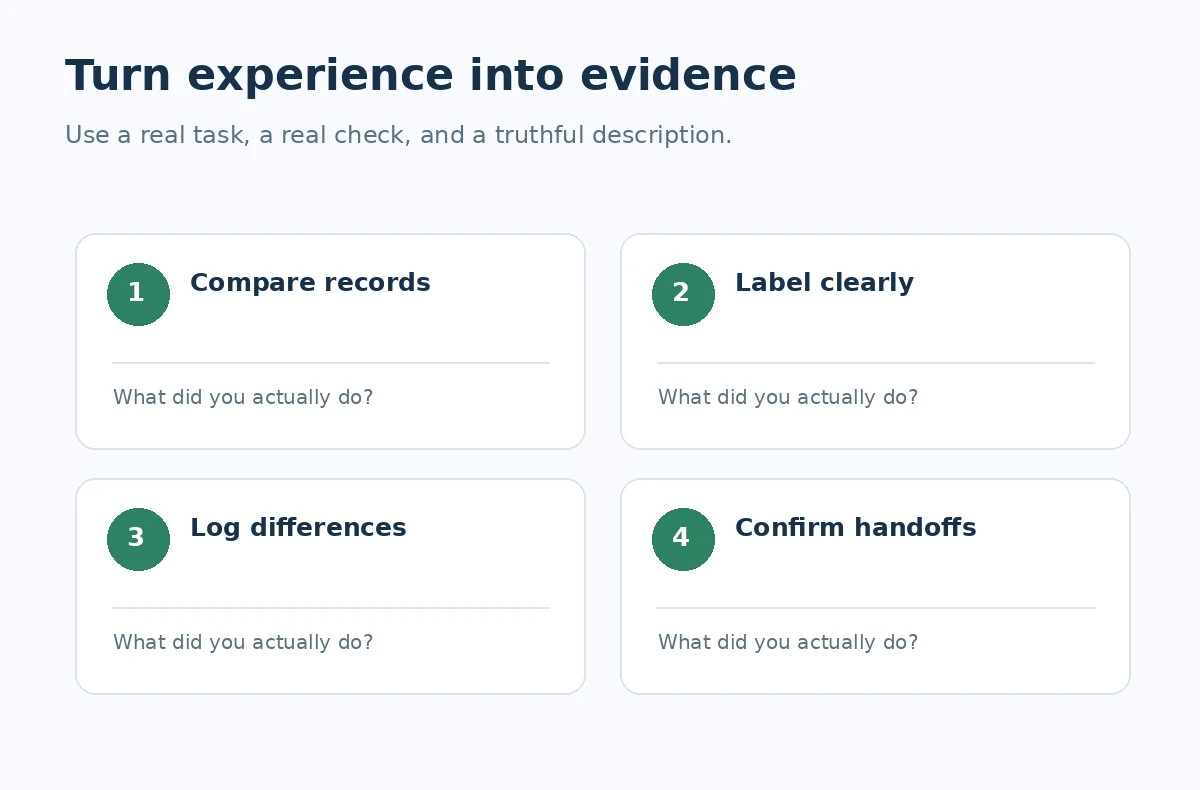
Logistics employers need people who notice when a physical item and a record disagree. A truthful beginner example can come from a volunteer event, stockroom, classroom inventory or personal project. What matters is your role in checking, labeling, documenting and escalating. Do not claim professional warehouse software experience because you have used a personal spreadsheet.
Think of evidence as a three-column record: what the list said, what you personally observed and what you did next under the instructions available. Do not publish confidential shipping information or fabricate an inventory improvement percentage. An honest discrepancy story demonstrates judgment without turning a routine mismatch into a dramatic claim.
| Skill signal | Possible real evidence | How to describe it honestly |
|---|---|---|
| Matching two records | A school, club or job task comparing a list with actual items | Explain how you spotted and reported a difference |
| Clear item labeling | Real inventory, library or event storage organization | State the organizing rule you followed |
| Reliable data entry | An actual spreadsheet or order record you updated | Avoid fabricated precision or efficiency statistics |
| Coordinating a handoff | A documented team transfer of materials or information | Name the person you informed and what you confirmed |
Pick two examples from the table you could explain to a shift lead. Write one sentence about the task, one about the count or label check you did, and one about a result you can confirm. If you do not know the outcome, describe the steps you took instead of inventing accuracy rates. Do not claim a warehouse team’s numbers as your own.
Study a Hypothetical Practice Answer Before Writing Your Own
Hypothetical example, not a real shipment record: “While preparing event supplies, I checked box labels against the packing list, noticed that one category was short, recorded the difference, and asked the organizer to confirm the remaining stock before dispatch.” It models accuracy and escalation, not formal freight experience.
Swap in a shipping or stock task you really did, cut anything unproven, and say who supervised you. Without warehouse experience, start with real work such as stocking shelves, deliveries, or event setup.
Read the Actual Posting for Hidden Requirements
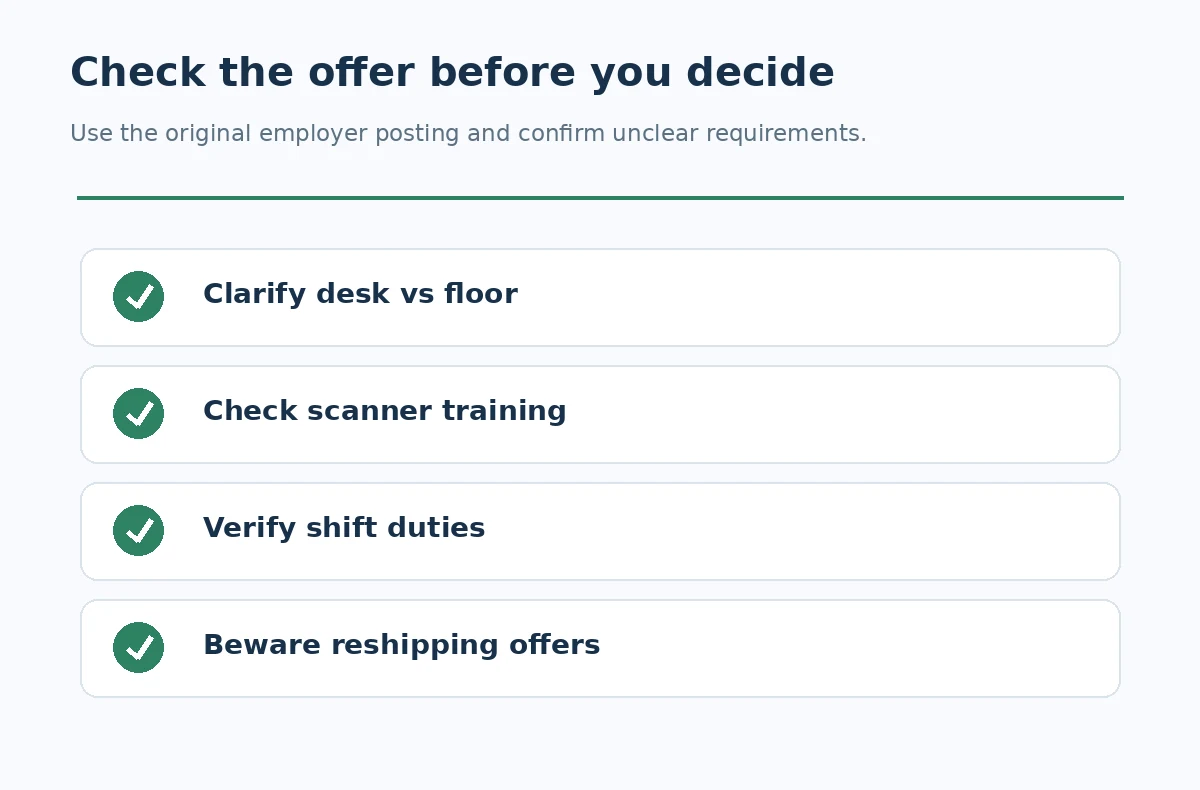
For each listing, identify whether the main job is recordkeeping, movement of goods, external coordination or transport. Check the tools (such as scanners or company software), lifting expectations, required schedules and whether a license is explicitly requested. Do not interpret a warehouse listing as an office-only logistics job. Some roles involve both desk work and physical stock movement.
Beware of phrases like “instant logistics coordinator” that describe senior planning responsibility while claiming no training. The employer may have a legitimate internal training path, but you should ask what work a beginner does in the first month and who checks shipping records before dispatch.
Use a comparison sheet for a few real logistics openings. Record the employer site, job title, location, equipment wording, shift details, and one question to ask. “Preferred” and “required” differ; only the employer can explain an unclear requirement such as a forklift certificate.
Prepare an Honest Resume and Interview Story
Use the vocabulary from the posting only when supported: inventory counting, order checking, labeling, records and handoffs. If you have used spreadsheets, state the actual functions. A simple accurate recordkeeping example can be more useful than naming transportation systems you have never touched. Keep the work setting and level of supervision visible. Our guide “Entry-Level Healthcare Administration Jobs” shows how to start with clinic office work.
In an interview, walk through a missing package scenario carefully. First compare the available records, then document what you actually know, then notify the responsible teammate using the employer’s process. Do not claim you would change an inventory total or authorize a replacement shipment without permission.
For the interview, prepare a 60-second introduction naming the role, one real stock or delivery task, and what training you still need. Then prepare a question about first-week equipment training and shift assignments. Our guide “Entry-Level Manufacturing Jobs” covers how to compare assembly work and training needs.
Run a Practical Search and Verification Routine
On day one, compare two starting routes, such as shipping clerk and warehouse associate. On day two, read three real postings on verified carrier or distribution-center sites. Then, on day three, add two honest stock or delivery examples to your résumé. On day four, write a short application message and check it against one logistics listing.
Next, rehearse two interview stories and prepare questions about equipment you have not used yet. Keep a tracker with role, company careers page, date checked, status, equipment training needed, and next step. Recheck the posting before you apply, since shifts and locations can change.
Recognize Warning Signs Before Sharing Personal Information
An unexpected freight or parcel-handling offer may be a fraudulent reshipping arrangement. Be cautious about anyone asking you to use your home as a shipment hub or to pay fees before working. Independently verify the company and follow the FTC guidance on job offers.
If an unexpected driving or warehouse offer arrives, do not trust only the contact details in that message. Find the company yourself, confirm the job through its official channel, and never send bank or ID details to an unverified contact. For the next step, our guide “Entry-Level Banking Jobs” explains how to find branch roles and show transaction accuracy.
How We Research Entry-Level Career Routes
We used occupational information from the relevant official occupational profile to identify typical work and training, and compared it with an additional task or consumer-protection source when relevant. We checked these sources on 2026-10-21.
Source Links and Affiliate Disclosure
BLS occupational information: BLS covers material recording clerks, shipment and inventory tasks and typical entry training.
O*NET occupational tasks: O*NET specifies checking shipments against records and recording discrepancies.
FTC job scam guidance: FTC provides steps for checking the legitimacy of job opportunities and avoiding payment scams.
Read the site-wide affiliate disclosure for broader information.
Related Job Search Guides
- Entry-Level Purchasing Jobs: Understand Orders and Supplier Records
- Entry-Level Paralegal Jobs: Find Your First Legal Support Role
- Entry-Level Warehouse Jobs: Compare Floor Tasks, Shifts, and Safety
- Entry-Level Manufacturing Jobs: Compare Production Roles Safely
- Entry-Level Remote Jobs: Find Genuine Training and Prove First-Role Skills
It can refer to shipping, receiving, inventory or support work. Titles vary, so inspect the actual duties and training requirements.
BLS says many material recording clerk positions typically require a high school diploma and include on-the-job training. More specialized coordinator roles may differ.
Receiving checks what arrives against records; shipping prepares outgoing items and documentation. Some workplaces combine the functions.
Yes, if relevant and clearly identified as a class or volunteer exercise. Describe what you actually checked or recorded.
A truthful instance of spotting a mismatch, documenting it and escalating through the right channel, with no invented shipment or financial outcome.