
Quick answer. Search for specific nonclinical office roles rather than assuming every “healthcare administration” position is an entry-level management job. Medical reception, appointment scheduling, unit support and medical secretary work can involve patient communication and detailed records. These positions are different from clinical practice and from management roles that may require substantial experience.
This guide is for a job seeker exploring nonclinical entry points into health care. It helps you compare healthcare office roles and apply honestly; it does not list open jobs or predict hiring.
Identify the Starting Roles Behind the Job Title
The O*NET profile for medical secretaries and administrative assistants includes scheduling visits, answering calls and recording correspondence. The BLS Occupational Requirements Survey describes frequent public interaction and employer training in this occupation. Neither source means a new worker can access protected records or undertake medical tasks without the required training and permission.
A patient-facing administrative position may be busy and emotionally demanding. It involves communication, accuracy and following confidentiality procedures. Compare a general front desk role, a medical records specialist post and a clinic coordinator role carefully: they can have different training and software requirements even when employers use similar words in the title.
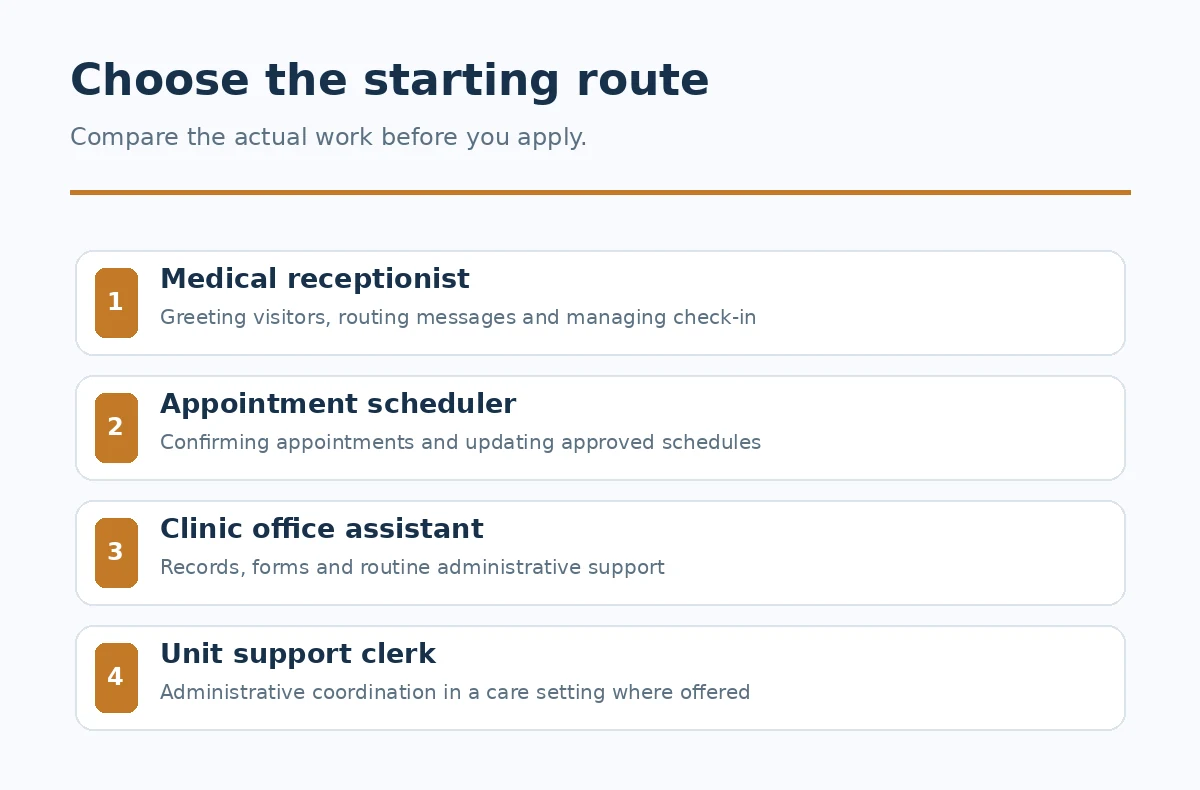
| Role family | Typical focus | Question to check |
|---|---|---|
| Medical receptionist | Greeting visitors, routing messages and managing check-in | Ask how patient information and identity checks are handled |
| Appointment scheduler | Confirming appointments and updating approved schedules | Check phone volume, systems and escalation guidance |
| Clinic office assistant | Records, forms and routine administrative support | Clarify training in terminology and confidential workflows |
| Unit support clerk | Administrative coordination in a care setting where offered | Ask about shifts, handoffs and boundaries with clinical staff |
Shortlist routes only after you can explain how front-desk, scheduling, and billing roles differ. A title alone does not tell you about patient contact, insurance tasks, or which system you will use. When a listing is vague, contact the clinic or hospital through its official site and ask about the actual tasks.
Build Credible Evidence Without Inflating Your Experience
A beginner can offer evidence from reception, customer service, clerical work or supervised service projects. A good application explains an action you really performed, such as confirming an appointment time or routing a message correctly. Never include patient-identifying details, invented clinical outcomes or claims of certification that your records cannot support.
Translate experience to clinic office tasks without pretending the settings are equal. Scheduling an event is evidence of organization; it is not proof that you know an electronic health record system. Handling customer contact details responsibly can show a careful habit but does not replace an employer’s patient-data training.
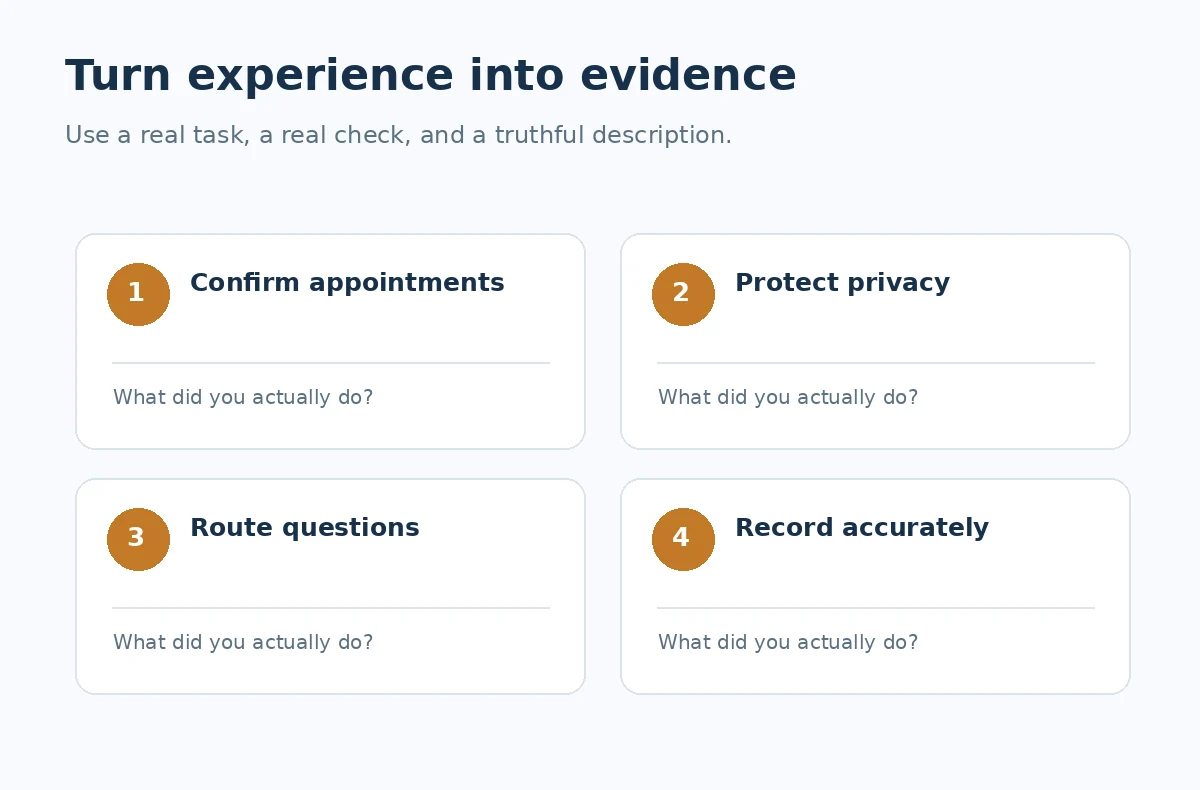
| Skill signal | Possible real evidence | How to describe it honestly |
|---|---|---|
| Scheduling accuracy | Real calendar planning in school, volunteer or paid work | Explain how you confirmed changes and prevented double booking |
| Respectful communication | A verified situation helping someone understand next steps | Describe your words without revealing private details |
| Record discipline | A list, form or spreadsheet maintained under instructions | Emphasize secure handling and escalation |
| Knowing your limits | A time you referred a question to the qualified person | Do not invent medical judgment or patient care |
Pick two examples from the table you could explain to an office manager. Write one sentence about the task, one about the privacy or accuracy check you did, and one about a result you can confirm. If you do not know the outcome, describe your process instead of inventing numbers. Do not claim an office team’s results as your own.
Study a Hypothetical Practice Answer Before Writing Your Own
Hypothetical example, not a real patient or employer record: “At a volunteer help desk, I confirmed a visitor’s appointment time using the approved list, updated the coordinator when a schedule changed, and directed a question outside my role to the staff member responsible.” The wording demonstrates process without implying clinical duties.
Swap in an office task you really did, cut anything unproven, and say who supervised you. Without office experience, start with real admin work such as a school office, club records, or volunteer scheduling.
Read the Actual Posting for Hidden Requirements
Look for the specific nonclinical scope: registration, scheduling, referrals, billing support, forms or unit communication. Check required terminology, computer systems, credentials, background screening, hours and work location. Do not confuse clinic front desk openings with medical coding, nursing or administrative management positions; the latter may have materially different requirements. For the fuller picture, see our guide “Part-Time Medical Receptionist Jobs”.
Privacy and authorization rules are significant in health care, but broad legal claims require context. This guide does not assert that one policy works across every provider or state. The safe applicant practice is to read the employer’s written workflow and avoid accessing, discussing or sharing patient information beyond what the role and training permit.
Use a comparison sheet for a few real healthcare office openings. Record the employer site, job title, location, system or certification wording, hours, and one question to ask. “Preferred” and “required” differ; only the employer can explain an unclear requirement such as a billing certification.
Prepare an Honest Resume and Interview Story
Use plain evidence statements in your résumé: scheduled appointments, organized files, handled inbound questions, maintained clear notes, or escalated sensitive issues—only when these were real responsibilities. Mention a terminology class or training module only with its true status. Do not say “experienced in medical records systems” if you have only seen a demonstration.
Prepare interview examples about conflicting appointment requests, a person who needs a clearer explanation, and a question that must go to qualified staff. Keep the example fictional only if labeled as hypothetical practice; for your actual answer, use your own true experience. Ask how newcomers are trained on confidentiality, software and escalation.
For the interview, prepare a 60-second introduction naming the role, one real office task, and what system training you still need. Then prepare a question about first-week system training and who answers patient questions you cannot.
Run a Practical Search and Verification Routine
On day one, compare two starting routes, such as patient scheduling and medical records. On day two, read three real postings on verified clinic or hospital sites. Then, on day three, add two honest office examples to your résumé. On day four, write a short application message and check it against one healthcare office listing.
Next, rehearse two interview stories and prepare questions about systems you have not used yet. Keep a tracker with role, employer careers page, date checked, status, certification needed, and next step. Recheck the posting before you apply, since hours and requirements can change.

Recognize Warning Signs Before Sharing Personal Information
Verify clinic or hospital job listings at the organization’s real careers page. Be especially wary of messages requesting an application payment or sending sensitive data to an unverified account. FTC consumer guidance describes verification steps and cautions against paying for the promise of a job.
If an unexpected office job offer arrives, do not trust only the contact details in that message. Find the employer yourself, confirm the job through its official channel, and never send bank or ID details to an unverified contact.
How We Research Entry-Level Career Routes
We used occupational information from the relevant official occupational profile to identify typical work and training, and compared it with an additional task or consumer-protection source when relevant. We checked these sources on 2026-10-21.
Source Links and Affiliate Disclosure
O*NET occupational tasks: O*NET lists medical administrative duties including scheduling, correspondence and receptionist work.
BLS occupational information: BLS Occupational Requirements Survey reports the occupational mix of public interaction, training and education.
FTC job scam guidance: FTC advises independently confirming jobs and avoiding payment-based recruitment scams.
Read the site-wide affiliate disclosure for broader information.
Related Job Search Guides
- Entry-Level Logistics Jobs: Start With Shipping, Receiving, and Records
- Entry-Level Manufacturing Jobs: Compare Assembly Work and Training Needs
- Entry-Level Construction Jobs: Compare Helper Roles and Safe Starting Routes
- Entry-Level Banking Jobs: Find Branch Roles and Show Transaction Accuracy
- Entry-Level Logistics Jobs: Start with Shipping and Inventory Records
No. The term can describe many functions, from front desk and scheduling to management. This page focuses on nonclinical office support positions.
Some office jobs are nonclinical, but each employer may require medical terminology, privacy training, prior experience or other credentials. Read the particular posting.
No. Patient intake and scheduling duties differ from specialized coding work. Treat them as separate roles with different qualifications.
Do not invent a real patient or disclose identifying data. Use a clearly hypothetical scenario for practice and your own truthful nonconfidential experience in the real interview.
Ask who teaches the scheduling system, how confidentiality processes are explained and when staff should escalate questions outside the role.