
Entry-level merchandising jobs can involve replacing shelf signs, maintaining a display, restocking products, or arranging a planned presentation. They are not all the same as independently designing a store’s visual identity. Search for display associate, visual merchandising assistant, and store merchandising associate, then read which tasks are assigned and who approves changes. You can build an honest small mock-display example without claiming a real retail client, store permission, or increased sales. Begin with accuracy and safe execution, not decorative pictures alone.
Distinguish restocking from display design
Some postings use merchandising to mean checking stock and presentation; others focus on window concepts, props, signage, and visual plans. A display associate might implement a manager’s plan, while a visual merchandising specialist may develop proposals and coordinate installation. O*NET lists tasks such as arranging merchandise, rotating displays, and consulting with store teams. Read the verbs carefully so you do not apply with a design-only portfolio to a stocking-heavy position.
Look for task boundaries: ‘follow planograms,’ ‘reset fixtures,’ ‘maintain signage,’ ‘take display photos,’ or ‘create concepts for approval.’ A planogram is a placement guide, not permission to rearrange an entire shop. An opening expecting independent construction, powered equipment, or off-site installation can require skills and training beyond entry-level shelf upkeep. Do not assume such equipment is safe or permitted because the posting calls the job junior.

Sketch a small, fictional shelf layout
Build a tabletop mock-up with ordinary household objects or draw a small shelf diagram. Label three product groups, their intended locations, and the corresponding descriptive signs. The goal is to show legibility and consistent grouping. Mark it ‘Practice display, not a store installation.’ Avoid real retailer logos, promotional claims, or prices you have not verified. If your project contains price tags, use plainly hypothetical labels rather than suggesting authentic offers.
Photograph the mock-up from a straightforward viewing angle, then write a brief explanation: Why are related items together? Can a customer read the signs? Are objects supported without unstable stacking? Do not claim the layout improved conversion or customer flow. A photograph of a hypothetical shelf is evidence of organization and care, not a measured retail outcome.
Read the plan and confirm the boundaries
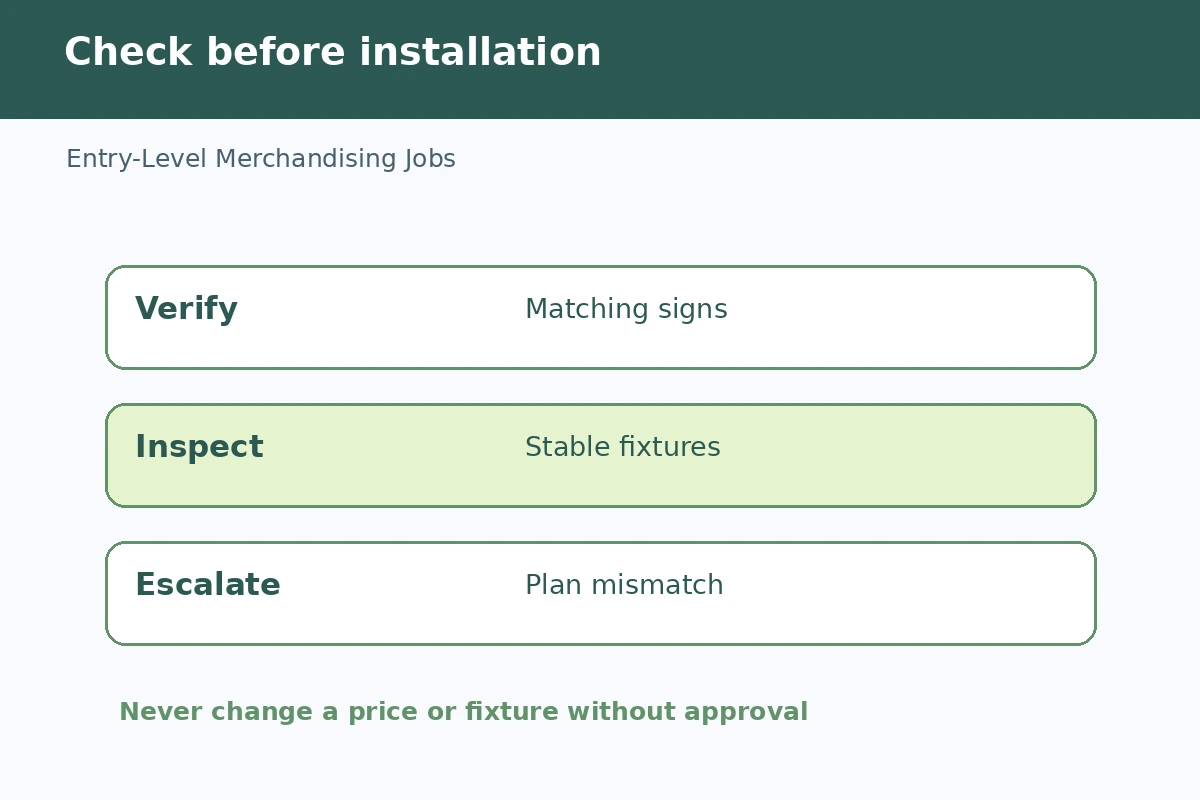
At work, a manager may provide a diagram, fixture dimensions, product list, and approved signage. A junior worker should compare the actual floor or shelf with those instructions and flag missing materials. If an item does not fit safely, do not force the installation or quietly modify structural fixtures. Ask the appropriate lead to confirm an alternative. Visual quality is important, but safe placement and authorized decisions come first.
The same care applies to accessibility and store circulation. A display must not casually block required pathways, doors, or operational equipment. Exact requirements depend on the site, and a new hire should follow the store’s instructions and training rather than improvise. In an application, describe your ability to notice a mismatch and communicate it, not your ability to certify the finished layout.
Write a meaningful display checklist
A practical checklist can cover the approved layout, matching shelf labels, clean visible products, intact fixtures, clear walking space, and a photo for manager review where photography is permitted. Add a field for ‘Issue noticed’ and another for ‘Owner to confirm.’ This turns a visual exercise into a repeatable workflow. A tidy-looking display is not complete if the labels or product placement contradict the plan.
When a sign is outdated, do not invent a discount or change a price on your own. Note the mismatch and follow the approved correction process. If a product is damaged, route it according to store policy instead of placing it in view for the sake of a completed photo. Employers need reliable execution, especially when several people work on different parts of a store.

Translate retail experience without inflating it
If you helped straighten shelves during a part-time job, describe that work accurately. ‘Restocked assigned shelves and flagged missing labels for a supervisor’ is narrower than ‘Designed storewide visual merchandising strategy’ and more believable. If you have no retail employment, show the practice layout and your reasoning; do not turn a home exercise into an employer project. A genuine school event display may also be relevant if you describe your actual contribution.
Be careful with outcome claims. A new arrangement may look neater, but that does not prove additional sales, reduced shrink, or increased foot traffic. Only include results you actually observed with a defensible method and permission to disclose. A prospective employer can still value attention to signs, consistent placement, and efficient handoffs without invented revenue figures.
Compare work conditions and preparation
Visual merchandising and shelf roles can involve time standing, moving objects, store opening hours, and occasional work outside customer-facing hours. The exact demands depend on the location. Read physical requirements and ask about training, team size, and whether the job is mainly floor work or design software. A role heavy in creative layout may need sketches or images; one centered on resets may favor accuracy and following diagrams.
Do not assume a design portfolio substitutes for a required credential or machine training. Conversely, do not assume every display associate needs advanced graphics software. Save the real requirements from each posting and compare them with your skills. When an employer explains a supported learning path, that may be a more useful signal than a flashy title.
Make the application evidence easy to inspect
Build a one-page PDF with the practice display photo, a labeled sketch, and three notes on how you checked grouping, signs, and fixture boundaries. If you used photos in a real store, confirm that they may be shared publicly; a private employer layout may be restricted. Avoid faces, customer receipts, and internal stock data. The page should stand on its own even if a recruiter spends only a brief moment reviewing it.
A fictional application sentence is: ‘I created a mock shelf layout with a matching placement sketch and label-check checklist, and I am comfortable following approved display instructions.’ It does not imply professional store experience. Pair it with any real service, stocking, or event setup work that you can discuss honestly. Relevance is more useful than trying to sound like a senior designer.
Ask what success means in that store
Useful interview questions include: Who approves a revised layout? How are mismatched labels handled? Is photography permitted for completion records? Who verifies fixtures and safety? These are practical ways to understand the team’s process. They also help you tell the difference between an implementation assistant position and an independent design role.
Before applying, inspect the employer’s official posting and record the schedule, location, and actual duties. Keep your sample labeled and permissions clear. If the role requires specialized installation you cannot perform, seek a training-supported entry point or another display-support opening. A careful first merchandising application shows that you can turn a plan into orderly, accurate work and know when to request approval.
How We Research Entry-Level Roles
We compared task descriptions and preparation expectations in O*NET OnLine; Penn Career Services; BLS occupational research. The sources describe broad occupational activities, not a promise that a specific employer will hire a beginner. We distinguished supervised support tasks from experienced decision-making and avoided claims about vacancies, compensation, placement rates or employer outcomes. All example names, records, products, and exercises in this guide are illustrative. Check the current employer posting and keep your application truthful. This guide is not legal, financial, or safety certification advice. See our affiliate disclosure for information about recommendations and relationships.
Related Job Search Guides
No. Some roles focus on stocking while others involve displays, signage, layouts, or visual presentation.
Yes, as a clearly labeled practice example, not a store commission or paid client result.
Only under the store’s instructions and permissions; otherwise flag the mismatch.
Requirements vary. Read the actual posting and distinguish implementation from design ownership.
Accurate grouping, readable labels, a clear sketch and respect for store approval and safety boundaries.