
Entry-level fundraising jobs often appear under development assistant, donor relations assistant, or fundraising coordinator, but the work can range from event checklists to sensitive donor records. Look for roles that clearly explain training, review, and who approves public communications. A strong first application can show volunteering, accurate records, and organized event support without claiming you raised a particular amount or managed a donor relationship. Do not assume that volunteer experience grants permission to share donor names, gift details, or unapproved solicitation copy.
Find the support tasks behind development titles
Search combinations of development assistant, fundraising assistant, advancement services assistant, and donor stewardship coordinator. Read the deliverables: preparing event materials, tracking acknowledgments, maintaining authorized contact information, drafting messages for review, or helping reconcile records. ‘Development’ in a nonprofit often means fundraising, not software development. Learn the organization’s context before applying so your examples address the actual mission and workflow.
An early-career title may still require specific database experience or the ability to work at events outside normal hours. Distinguish entering donor information from independently deciding who should be solicited. A role that owns major gifts, complex campaign strategy, or donor tax questions is not automatically a beginner assignment because the posting includes the word assistant. Treat specialized duties as requirements to investigate, not skills to claim by association.

Understand the donor record boundaries
Nonprofits may store names, preferred contact channels, acknowledgment status, event attendance, and gift history. These details can be private or sensitive. A junior helper should know who is authorized to view, correct, export, and contact records, and when a manager should be involved. A spreadsheet exercise on fabricated donors can demonstrate organization without exposing anyone’s information. Label it ‘illustrative sample, no real donor data.’
Consider a fictional record with a missing mailing preference. Do not guess the preference and send a real message. In a practice log, mark ‘Verify contact preference with authorized staff.’ Similarly, a duplicate-looking name may refer to different individuals. Good data work preserves uncertainty until the organization has evidence. The lesson is careful documentation, not independent access to confidential donor lists.
Convert volunteer tasks into honest evidence
Maybe you helped arrange name tags, checked event registration forms under a coordinator, or entered totals into an approved worksheet. Describe the actual task and supervision: ‘Assisted with event check-in and reconciled attendance sheets for staff review.’ If you do not have such experience, demonstrate an organized hypothetical event checklist rather than presenting it as a completed nonprofit campaign. Paid work and volunteering should never be relabeled to sound more impressive.
Avoid citing invented fundraising returns, confidential guest counts, or donor testimonials. If your organization gave permission to use an aggregate result, accurately explain your role and the source. Otherwise focus on observable behavior: clear sign-in instructions, timely handoffs, accurate spreadsheet checks, and respectful follow-up. These tasks matter because fundraising relies on reliable systems as well as persuasive messages.
Map a campaign from request to approved response
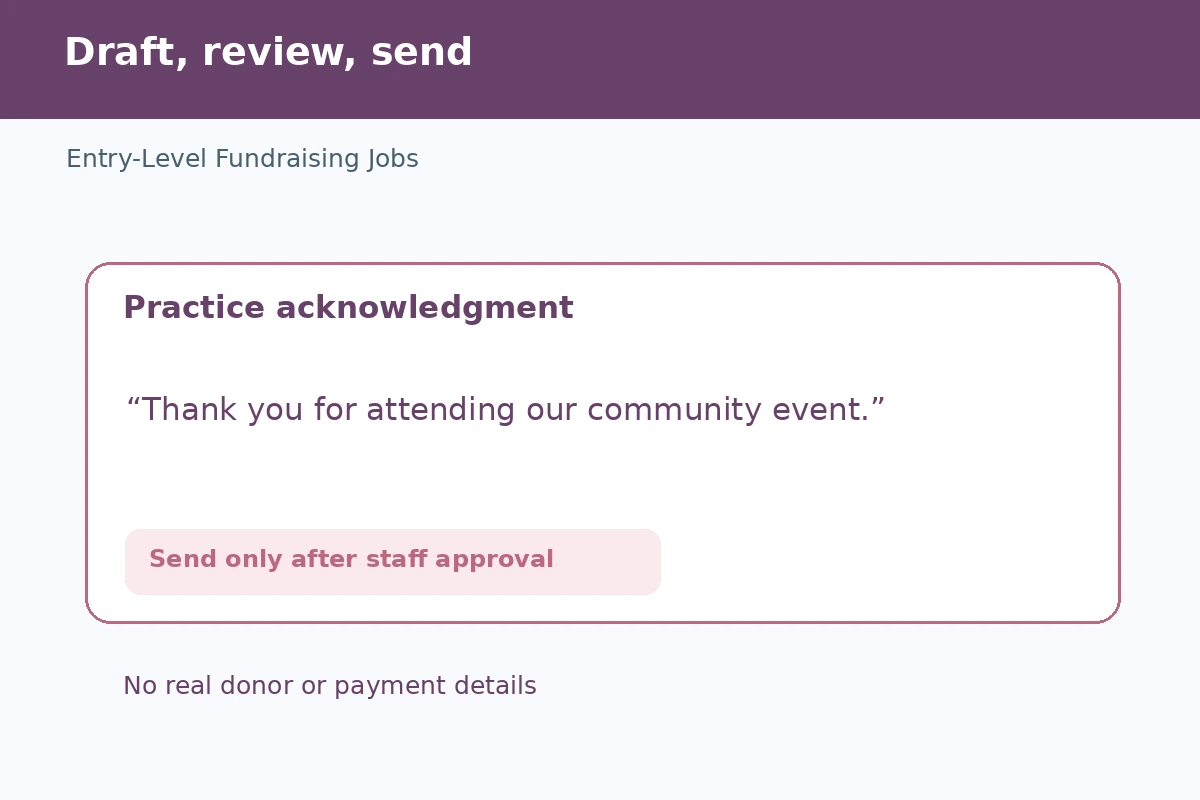
A campaign might involve an event invitation, registration, a thank-you, and a data update. The workflow is not permission to send every message yourself. Illustrate it as ‘draft prepared,’ ‘staff approval,’ ‘approved send,’ and ‘record updated.’ A sample thank-you can be entirely fictional: ‘Thank you for attending our community event. We appreciate your time.’ It should not imply a donation, tax-deductible receipt, or specific gift unless those facts were confirmed.
If someone contacts you with a question about gift restrictions, donor eligibility, or a disputed payment, record the inquiry and route it to the authorized staff member. Do not invent tax advice or explain legal obligations from a general job-search article. BLS notes that fundraising duties can include compliance responsibilities; your application should not claim authority to sign off on that work without actual training and assignment.
Show a safe sample for outreach writing
A realistic applicant portfolio could include a short event reminder, one edited acknowledgment draft, and a checklist of information to verify before sending. Use fictional names and generic event details. Label the material as a practice exercise, never as communication you sent to supporters. Add a brief explanation of tone choices: accurate, appreciative, and clear about the next step.
An example résumé line could be: ‘Created a sample follow-up sequence for a hypothetical nonprofit event, including review steps for contact preferences and message accuracy.’ If you actually supported a nonprofit, describe the genuine activity instead. Hiring teams are evaluating how you handle care, detail, and relationships; unsupported campaign numbers are less persuasive than a narrow account that you can explain.
Choose openings by training and permissions
Ask whether new assistants have training in the organization’s donor system, who approves acknowledgments, and whether events require evening attendance. Review whether the position involves donor prospect research, public communications, or handling payments. These are different functions with different controls. You should be able to name the tasks you are comfortable supporting and the areas in which you expect formal instruction.
Check that the role is paid, volunteer, or an internship as advertised. Some organizations use similar titles across all three. Confirm schedule and supervision rather than assuming that working for a meaningful cause will solve practical job-fit issues. A first fundraising job should provide a path to learn while treating supporters and their records respectfully.
Tailor the application to one mission and function
Research the employer’s publicly described work and use one accurate sentence about why its mission interests you. Pair that with evidence of a task: organized records, thoughtful writing, event coordination, or careful customer communication. Do not pretend to be a longtime donor or member. A fictional line is: ‘I have practiced preparing event checklists and acknowledgment drafts with clear review steps, and I would be glad to support your development team’s record accuracy.’
Avoid a generic appeal that says you love helping people but says nothing about the role. If the opening emphasizes database maintenance, move an accurate spreadsheet example to the front. If it emphasizes events, focus on check-in and shift coordination. Every claim should remain something you can demonstrate or explain without disclosing confidential information.

Prepare questions about donor respect
At an interview, ask how corrections are logged, how volunteers receive guidance, and what a junior colleague should do if a record seems inconsistent. An employer’s answers can reveal whether responsibility is clearly assigned. You can also ask who writes and approves messages and how the team handles requests for changes to contact preferences. These questions are about a healthy workflow, not demanding sensitive access.
Keep a short record of each application, the version of your résumé, and any follow-up you are authorized to make. If an opening turns out to require independent gift strategy or complex compliance work you do not have, seek a record-support position first. The best entry point is one where your careful habits are useful on day one and the next responsibility is taught rather than assumed.
How We Research Entry-Level Roles
We compared task descriptions and preparation expectations in U.S. Bureau of Labor Statistics; O*NET OnLine; BLS occupational research. The sources describe broad occupational activities, not a promise that a specific employer will hire a beginner. We distinguished supervised support tasks from experienced decision-making and avoided claims about vacancies, compensation, placement rates or employer outcomes. All example names, records, products, and exercises in this guide are illustrative. Check the current employer posting and keep your application truthful. This guide is not legal, financial, or safety certification advice. See our affiliate disclosure for information about recommendations and relationships.
Related Job Search Guides
The titles overlap, but responsibilities vary. Read the actual donor-record, outreach and event duties.
Yes, describe the tasks you actually performed and label the experience as volunteer work.
Not without appropriate permission. Use synthetic examples instead of exposing identifiable donor data.
Only according to the organization’s permissions and review procedures.
No. Accurate records, event support, and supervised communications are useful evidence without invented totals.