
Entry-level quality control inspector jobs can be a route into manufacturing quality work, but the term “quality” is not a substitute for asking what you will actually inspect. Search for quality inspector trainee, production quality assistant, incoming inspection clerk and visual inspection associate. Compare whether the role checks packaging, dimensions, labels or test results. Many employers train new inspectors, yet specialized equipment and safety-sensitive operations require proper instruction and authorization.
The BLS describes inspectors using measurements and product specifications, with workplace training that can extend for months. The practical first step is to match a measurement or checklist task to evidence you can honestly discuss, while keeping final product disposition and machine access within workplace procedures. Do not infer that identifying a defect authorizes a newcomer to repair equipment or release a batch.
Start With the Product and Inspection Stage
A receiving inspector may check incoming parts against a drawing; an assembly-line inspector may monitor visual defects; a packaging inspector may compare labels and counts. These are not interchangeable jobs. Read whether the posting specifies measuring tools, sampling plans, visual inspection, calibration or electronic records. Ask what product, materials and working conditions the team handles. Training for delicate measurement equipment is different from counting sealed packages. Match your actual ability to the stage rather than claiming universal quality-control expertise.
Read Specifications Before Measuring
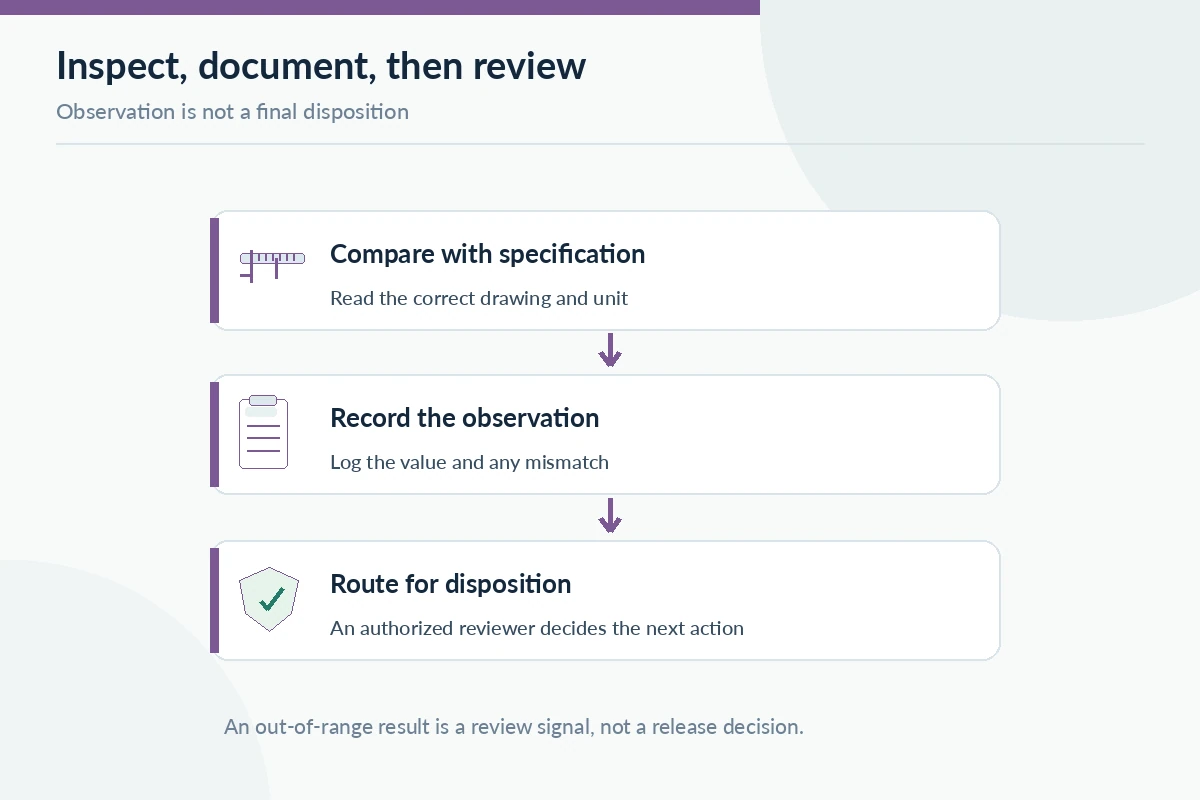
A measurement without a target is not a quality judgment. In a hypothetical practice card, define the required dimension and allowable tolerance, then record an observed value with its unit. If the specification is missing, the correct outcome is “need specification,” not “pass.” If the measuring tool is unfamiliar, do not claim valid measurement until trained. Explain how you would identify the correct revision of a drawing or work instruction before recording data. Precision begins with knowing what comparison is being made.
Build a Fictional Inspection Log With Real Logic
Create a simple example for a non-safety-critical practice item such as a paper folder width. Record item ID, specification, measured result, date, tool, and a status of “review needed” when outside the stated limits. Use imaginary data and do not pretend the result represents factory production. The log should distinguish an observation from an approved decision: a supervisor or authorized quality process may determine whether to rework, hold or reject. Explain this distinction aloud when practicing interview questions.
Know When to Stop and Ask for Training
BLS notes that inspectors may work around moving machinery, noise and contaminants. Before starting any measurement, ask what PPE, guarding and safe-access rules apply. A task that requires reaching into running machinery, entering a guarded area or handling chemicals cannot be improvised from an online article. Stop and ask an authorized supervisor when instructions conflict or equipment behaves unexpectedly. Your resume may truthfully say “followed documented safety procedures” only if you did so, rather than treating safety as a buzzword.
Separate Finding a Defect From Product Release
The inspector may spot an irregularity, but not every role can release, scrap or rework an item. Ask what status labels or digital holds are used, who reviews nonconformances and what happens to the item while a decision is pending. In a hypothetical diagram, the path should read “observe → record → hold for review,” followed by an authorized disposition. Avoid claiming that one visual spot check proves the entire shipment is compliant. The organization’s validated sampling or inspection plan determines the work.
Look for Real Training and Supervision
A solid first role describes how workers learn gauges, drawings, records and escalation. Ask whether someone verifies initial measurements, how instruments are checked and which software is used for quality logs. Some jobs accept a high school credential with on-the-job training; others prefer technical certificates, specific measurement expertise or experience with regulated products. BLS reports variation in entry routes. “Entry level” is a label to investigate, not permission to operate equipment without demonstrated competence.

Translate School or Retail Accuracy Into Evidence
A class lab notebook might show units, observations and repeat checks. A stocking role could show inspection of package labels against delivery records. A maker project can demonstrate measured dimensions if you genuinely used a tool and can describe its limits. Keep the scope visible: “Recorded repeated dimensions in a supervised workshop” is stronger than “certified products for release.” Avoid fictional defect rates, rejection percentages or savings. Quality interviewers may ask how you noticed and documented a discrepancy, not how impressive the claim sounds.
Check Shift Demands and Physical Conditions
Quality roles may require standing, repetitive visual focus, rotating shifts or a controlled environment. Ask whether lighting, protective equipment and workstation setup support accurate work. Some postings mention overtime or overnight coverage; check transportation and practical fit before applying. If vision testing or physical capabilities are stated, review the actual essential functions rather than assuming every inspector role has identical requirements. The goal is an informed match, not a promise that quality control will be an office job.
Avoid Misleading Quality Certifications and Job Offers
Certification requirements vary by role. If you have taken an introductory class, name the class rather than calling yourself a certified inspector. Verify the employer from its own website before uploading identity documents. The FTC warns about recruiters who request money or personal financial information before a legitimate hire. Never pay for a supposed mandatory inspector badge from an unknown recruiter. Ask who issues any required training and whether it occurs after hire.

Practice the Observation-to-Decision Explanation
A concise hypothetical answer is: “I compared a sample measurement with the written specification, recorded the unit and result, and flagged the out-of-range item for the person authorized to decide its disposition. I would not release it or adjust a machine without training.” After that, add a genuine example of careful checking from school or work. Save the job advertisement, mark required instruments, confirm safety training and rehearse your exact responsibilities. Specific humility beats a vague promise of perfect quality.
How We Research Entry-Level Job Requirements
This guide compares official occupational descriptions from BLS Occupational Outlook Handbook, O*NET occupation profile, and Federal Trade Commission job-scam guidance. These sources describe typical tasks, education routes and recruiting risks; they do not confirm that a specific employer has an open job or grants a particular permission. Always read the current employer posting and applicable workplace requirements. Examples in this article are hypothetical unless explicitly stated otherwise. Read JobAsk’s affiliate disclosure for site transparency.
Related Job Search Guides
- Entry-Level Quality Assurance Jobs: Find the Right Inspection Route
- Entry-Level Manufacturing Jobs: Assembly, Quality, and Shift Fit
- Entry-Level Manufacturing Jobs: Compare Production Roles Safely
- Entry-Level Warehouse Jobs: Compare Floor Tasks, Shifts, and Safety
- Entry-Level Accounting Jobs: Choose the Right First Role and Prove Your Skills
Many entry-level roles typically require a high school diploma and provide training, but specialized employers may require more.
Only with appropriate instruction, safe access and authorization for the tool and process involved.
Follow the employer’s approved nonconformance process; the person who records the defect may not be authorized to release it.
Yes, as school experience. State which instruments and records you actually used, without claiming factory sign-off.
No. Inspection stages vary; some focus on labels, packaging or records, while others involve testing and specialized equipment.