
To find entry level remote software QA tester jobs, start with the work rather than the word ‘remote.’ A legitimate listing should describe how the role handles its core tasks, who checks the result, where employees may work, and what equipment and training are available. For qa tester candidates, the immediate distinction is between ‘reproduce’, ‘report defect’, and ‘owner reviews’. Those are not always the same person’s decisions. This guide helps you compare live job descriptions, build truthful application evidence and ask a targeted question before accepting a position. The examples in this article are educational hypotheticals, not verified vacancies or promises that an employer will hire you. Verify each opening on the employer’s official careers site and follow actual workplace policies rather than an internet checklist alone.
Translate a remote QA label into test duties
An entry-level remote software QA tester role can mean checking a user interface manually, executing regression cases, testing a mobile app on specified devices or supporting automation written by a more experienced engineer. A software developer in test, a security tester and a product support agent are not interchangeable roles. Read the required tools, programming expectations and test artifacts, not just the word ‘tester.’ BLS describes testers who design or execute checks, document defects and communicate feedback to developers. A junior position should state who reviews a test plan and who decides whether a defect blocks a release.
Compare manual, exploratory and automation routes
Search ‘junior manual QA tester remote,’ ‘software test analyst entry level remote,’ and ‘remote QA test associate’ separately. Manual execution follows specified steps; exploratory testing investigates behavior and records a reproducible finding; automation work may require code, test frameworks and a continuous integration environment. A posting that demands extensive framework ownership is not necessarily beginner-friendly even if its title says junior. Check whether the job expects browser checks, mobile device coverage, accessibility validation or API testing. Make a requirements matrix rather than applying indiscriminately to all remote software openings.
Build a safe test-case portfolio from a public demonstration
You can prepare a hypothetical sample using an application you own, a public demonstration site that permits testing, or a self-built interface. Write a test title, setup, steps, expected behavior and observed behavior, and record the browser or device version. For a defect, explain how a teammate could reproduce it and include an appropriately redacted screenshot if allowed. Do not test a stranger’s production system without permission or make claims about a real company’s internal failures. A clear sample with honest limitations often communicates more than an invented tally of bugs caught.
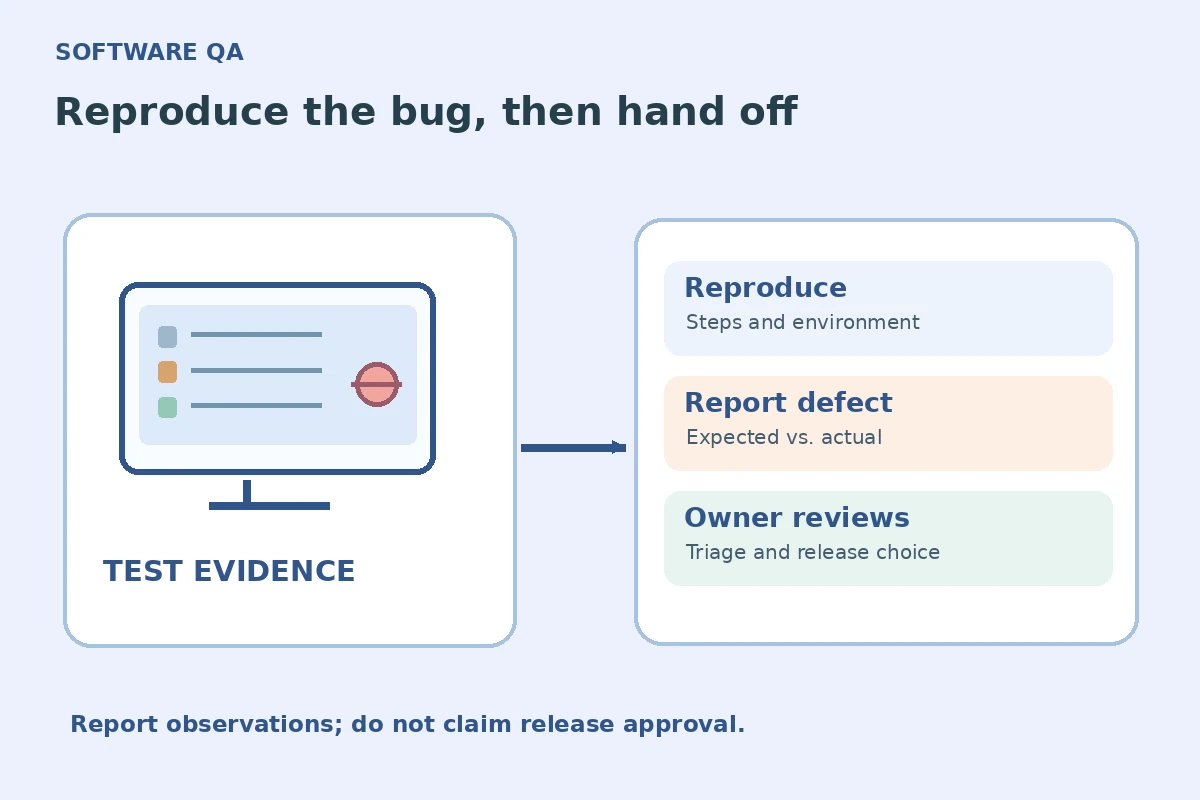
Describe the real defect lifecycle
A tester can discover an inconsistency, record evidence and communicate severity, but severity and priority may be set by different team members. A developer or product owner may decide whether a fix is needed for the next release. Document what changed after review and retest only in the approved environment. In an interview, avoid saying you personally ‘approved’ a deployment if your work was execution and reporting. Ask how the company separates test discovery, issue triage, verification and release sign-off. Those boundaries reveal whether the remote workflow has clear owners.
Check the laboratory behind a distributed testing team
Remote QA still needs access to a test environment, representative devices, safe credentials and a method for collecting logs. Ask if the company provides devices or requires your own equipment; clarify how protected builds and customer data are handled. Some jobs require office visits for hardware labs or device testing even when listed remote. Others coordinate across time zones for release windows. A posting should describe meaningful test access and technical onboarding, not ask you to install an unknown executable from a recruiter in a messaging app before the employer is verified.

Practice writing expected-versus-actual notes
Suppose a fictional checkout demo displays an error after a valid coupon is entered. A useful bug report identifies the starting state, a reproducible sequence, expected result, actual result and any approved supporting trace. ‘Checkout is broken’ is not a reliable ticket; ‘Coupon A triggers message B on demo build C after step D’ is far easier to investigate. Avoid sharing live customer payment details or guessing why the code failed. The point is to show systematic observation and communication, not to imply you can fix the underlying code without evidence.
| Requirement to check | What to record before applying |
|---|---|
| Job duties | Reproduce / Steps and environment |
| Supervision | Owner reviews / Triage and release choice |
| Remote location | Employer-allowed states and working hours |
| Risk or permissions | No false pass result; No live data in portfolio |
Match your skills to junior tools honestly
Employers may mention issue trackers, browser developer tools, spreadsheets, SQL, scripting languages or testing frameworks. List only tools you have used and specify whether the experience came from a class, project or job. An introductory SQL course can support a junior testing application if you can explain a simple validation query; it does not make you an automation engineer. If the role requires coding you do not have, look for manual QA positions with mentored automation exposure instead. Clarify whether accessibility testing, localization review and security testing belong to separate specialist teams.
Verify the employer and access request independently
A remote testing job can involve downloadable apps and login credentials, making impersonation especially risky. Use the employer’s official careers domain, confirm the requisition and verify the recruiter’s address independently. Do not execute an unsolicited installer, provide access to your personal banking account or pay for ‘mandatory test certification’ through a stranger. The FTC cautions against remote-job scams involving equipment checks and upfront money. A legitimate skills assessment should have a clearly identified owner, permitted environment and reasonable scope; decline unsafe requests.

Use three questions at the remote interview
Ask what fraction of the work is executing cases versus writing them, how developers receive and triage tickets, and who signs off on a release. Then ask which test environments and device setups are available to remote staff. These questions distinguish a support-style QA role from a test engineering job and reveal whether a new hire gets review. Be prepared to walk through one real, nonconfidential defect report you wrote. If you have only practice work, call it a project, describe what you tested and explain how you assessed the result.
Make a shortlist based on evidence and ownership
Track the testing route, required tools, permitted location, device requirements, review process and application confirmation for each opening. Prioritize opportunities whose listed tasks match your evidence, not those promising effortless high pay for clicking buttons. Be wary of postings that blur QA testing with paid reviews or ‘product boosting’ tasks; the FTC identifies such messages as a common task-scam pattern. Before applying, check the employer’s official site and read the role’s technical expectations carefully. Your goal is a defensible path from a specific test skill to an appropriately supervised position.
How We Research Remote QA Tester Jobs
JobAsk reviewed the following occupational and government sources on November 17, 2026: BLS describes software QA test planning, manual and automated testing, defect documentation and review with developers. O*NET details software quality assurance analysts and testers and their testing and defect-reporting responsibilities. FTC warns that work-from-home scams seek upfront payments or personal information and recommends independent verification. We compared the described duties with typical job-search terminology and distinguished employer-controlled conditions from general occupational guidance. Neither these sources nor a public search result confirms that any particular vacancy remains open or that an employer hires in your state. Sample work records and interview responses here are explicitly hypothetical; use your own documented skills and follow the actual employer’s instructions. This page does not promise hiring, eligibility, compensation or legal clearance. We have not claimed any specific affiliate partnership. See the JobAsk affiliate disclosure for transparency.
Related Job Search Guides
Some manual testing roles emphasize test execution and reporting, while automation roles often require programming. Check each posting and explain your actual skills.
Use permitted practice projects with steps, expected and observed results, environment details and clear issue notes; never expose protected customer data.
Not automatically. A tester may recommend or report, while sign-off follows the employer’s assigned engineering or product review process.
No. Real QA follows defined test objectives and defect workflows. Offers to earn by boosting ratings or paying to unlock tasks are major red flags.
State what you observed, what you reproduced, what you ruled out and whom you would involve. Avoid guessing a root cause as fact.