
Entry-level remote UX design jobs are easier to evaluate when you look past the “creative remote role” label and check actual outputs: user flows, wireframes, prototypes, design critique, and supervised testing. A junior candidate can show a carefully labeled practice project, but should not imply a class exercise was shipped to customers or that research participants consented when none were recruited.
Separate design research, visual UI work, and implementation
Some vacancies focus on interaction flows and navigation; others ask for high-fidelity interface visuals, usability testing, or front-end code. BLS describes digital interface design broadly, so review the actual tasks and collaboration expectations. A junior role should make clear who sets product priorities and who reviews design changes.
When searching, compare “junior UX designer,” “associate product designer,” and “UX/UI design assistant.” A job that demands full ownership of research, visual systems, engineering delivery, analytics, and strategy without mentoring may not match an entry-level scope. Ask which skills are essential on day one and which are developed with the team.

Build one case study that states what really happened
A credible portfolio explains the user problem, constraints, options considered, design decisions, feedback, and what remains untested. A class assignment can be useful if clearly labeled as an independent or educational project. Show your own sketches, rationale, and prototype rather than borrowing a polished interface and calling it client work.
Distinguish “I designed a clickable prototype” from “users successfully completed the task.” The latter requires genuine observation or defensible test evidence. If you did not conduct a usability study, say so. Instead, show what questions you would ask, the assumptions you want to test, and why your design still needs validation.
Explain the limits of user research and participant data
User interviews, recordings, screenshots, and analytics can reveal personal or sensitive information. Ask who approves research recruitment, consent wording, storage, and access. Do not collect test sessions using real customers or employer accounts without explicit authorization. The strongest entry-level answer respects research limits, not just research enthusiasm.
For a hypothetical library reservation app, create a fictional user journey and label it an assumption map. You can then describe a proposed task-based test and success criteria without claiming the test occurred. If you later conduct authorized research, separate direct observations from your design interpretations.

Check remote collaboration and critique routines
A remote designer often shares files asynchronously, joins critique meetings, and hands off specifications to development. Ask what tools the team uses, how design feedback is recorded, and whether live hours are required across time zones. Remote work can be structured and collaborative; it is not inherently solitary.
If a hiring manager requests an interface exercise, ask how much time is expected, who will review it, and whether the prompt concerns a live proprietary product. A brief, clearly framed exercise can help both sides understand style. Do not disclose protected project screens from a former employer to impress a new team.
Check the authority boundary in this role
| Task or issue | What to verify | Person or process |
|---|---|---|
| Flow and wireframe | Problem and design rationale | Your own work |
| Prototype | Clickable path and limitations | Label as prototype |
| User research | Method, permission, observations | Only if genuinely conducted |
| Shipped outcome | Verified production evidence | Do not claim without proof |
Show decisions rather than just attractive screenshots
Annotate a portfolio slide with the user task, navigation choice, trade-off and unresolved risk. For example, two forms might differ in the order of address fields; explain how you would verify the effect on completion before declaring one superior. Avoid inventing conversion lifts or usability percentages.
Your resume may say: “Created a clickable appointment-booking prototype; mapped the task flow and documented questions for future testing.” That is specific and honest. Add real outcomes only if you measured them and can describe the method. BLS notes usability and interface testing as part of digital design work, but each role decides how those tasks are assigned.
Screen mentorship, access, and decision rights
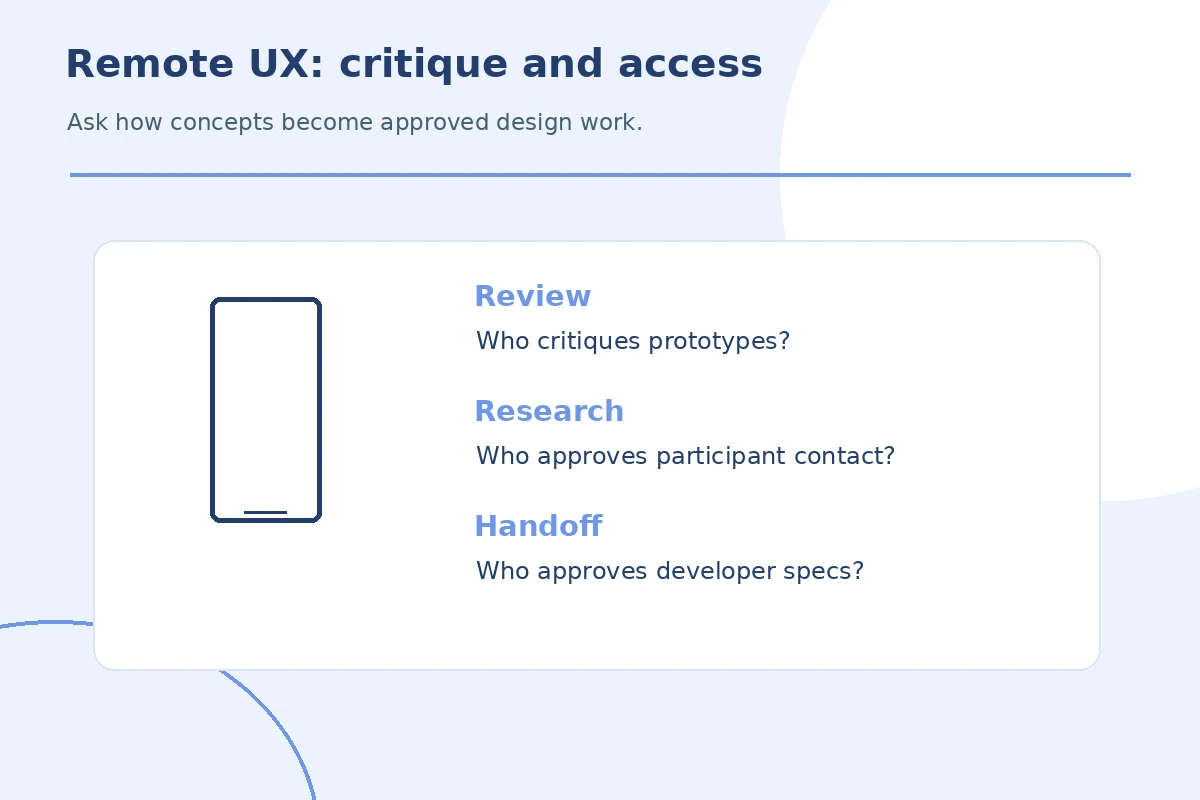
Ask “Who reviews designs before development?” “Will I observe research led by a senior designer?” and “Which systems are safe for practice work?” These questions reveal whether an advertised junior position offers realistic supervision. Ask about design-system documentation and what happens when product or engineering teams disagree.
Avoid assuming that access to a design file means permission to publish it. Company work belongs in approved project systems. Seek portfolio permission in writing and use sanitized, self-created examples when that is not possible. Show your feedback process without exporting confidential boards.
Apply through an evidence-focused remote search
Track the official job URL, location restrictions, schedule overlap, expected portfolio format, research duties, mentoring arrangement, and required tools. Customize the first portfolio link to a case study that resembles the advertised workflow. Attach a clear explanation of what you personally did.
Verify unexpected recruiters through employer-controlled channels. Be skeptical of an instant remote offer that asks you to purchase software or deposit a check. The FTC documents job scams that exploit demand for home-based work. Legitimate opportunity assessment starts with a real team, verifiable work and transparent next steps.
Practice the workflow before you submit an application
Consider a prototype for booking a study room. Build three frames: select a date, choose an available room, and review the request. Label all availability information as fictional. A useful case study explains why the confirmation screen repeats the date and room; it does not claim this changed booking success or reduced user error without measured evidence. Document what you would test with consenting participants later and list what needs product-owner approval before any live research.
How We Research Remote Job Roles
We reviewed the following US occupational and consumer-protection resources on November 7, 2026: www.bls.gov (Digital designers create and test interface layout, navigation and usability); consumer.ftc.gov (Avoiding deceptive work-from-home offers); consumer.ftc.gov (Unsolicited generic remote recruiting approaches). Occupation profiles explain typical work, not a guarantee that a specific advertised position offers remote work, a particular credential pathway, or employment. The checklists and hypotheticals are JobAsk editorial examples. Confirm eligibility, authority, schedules, and terms with the employer.
No employer paid to be featured in this guide, and no job offer, income, or hiring result is promised. See the JobAsk affiliate disclosure. We do not recommend paying a stranger or sending personal credentials to obtain an advertised remote position.
Related Job Search Guides
Yes, if you label it accurately and explain your decisions and what has not been tested. Do not present a class project as client delivery.
Requirements vary. Some teams ask for implementation skills, while others focus on interaction and visual design. Read each advertised role rather than assuming.
Only with authorization. Otherwise use your own work or a fictional, clearly labeled demonstration.
Describe the research plan and assumptions, not a fabricated outcome. Do not claim observed completion rates for a test that never happened.
Ask who reviews early work, how critique happens, how often the team meets live, and where design questions are escalated.