
An entry-level truck driver resume objective should identify the precise driving job you want and the qualification you already possess. A commercial learner permit (CLP) is not a commercial driver license (CDL); training enrollment is not proof of either. If you have only a CLP, name that status and apply to training-compatible opportunities. If you have the required CDL, state the class and any actual endorsements, then connect your previous work to inspections, safe handoffs, scheduling, or customer deliveries.
An objective is optional. It is most useful when your current employment history points toward warehouse, delivery, military transport, or equipment support rather than commercial trucking. The objective translates that history into a clear job target without pretending you have driven vehicles or held endorsements you have not earned. A new licensed driver may also use it to specify local or regional work, as long as the position really matches the license and availability.
Separate Your License Status From Your Career Goal
Start with a credential inventory before drafting a single sentence. Write the license class exactly as issued on your current credential, then list endorsements only if they are already held. For an applicant still working toward a CDL, write “commercial learner permit” or “CDL training in progress” only when true. The Federal Motor Carrier Safety Administration explains that a CLP permits practice under specified supervision; it does not authorize solo commercial driving. Do not disguise a temporary permit as an active Class A CDL.
Next decide whether the vacancy is for an experienced CDL driver, a new CDL graduate, or a trainee. Those are different hiring situations. A driving-school certificate can show completed education, but it is not a substitute for a state-issued license. If a carrier advertises mandatory endorsements, vehicle experience, or minimum driving tenure, treat those as actual screening conditions and ask before you apply when eligibility is uncertain.
| What the applicant has | Truthful resume treatment |
|---|---|
| Training only | Name actual course; do not claim CLP or CDL |
| CLP issued | State permit; seek supervised / eligible route |
| CDL issued | State exact class; endorsements only if held |
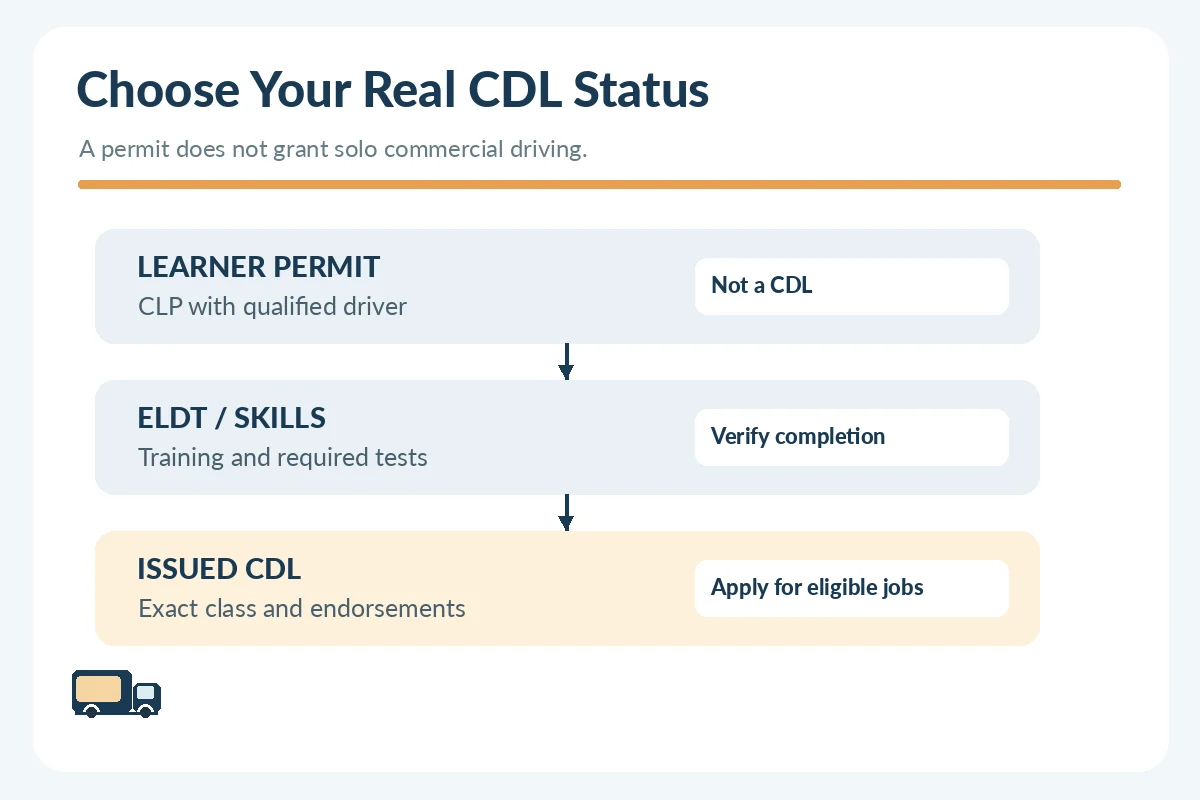
Choose a Targeted Objective for Your Actual Stage
For a CLP holder, one hypothetical objective is: “Commercial learner permit holder completing approved driver training, seeking a supervised trainee opportunity and bringing warehouse loading and daily checklist experience.” This sentence would be suitable only if the person actually has the permit, is completing training, and performed the stated warehouse duties. Do not describe that candidate as independently qualified to haul freight.
For a newly licensed applicant: “New Class A CDL holder seeking an entry-level regional driving position, bringing documented training and two years of shipping-dock coordination.” Replace Class A, regional, and the experience claim to match the applicant. For a local-delivery worker moving into commercial work: “Delivery associate preparing for CDL qualification, seeking employer-approved training and contributing route-record accuracy and customer handoff experience.” None of these examples promises an employer will hire the applicant.
Convert Warehouse and Delivery Tasks Into Driving Evidence
Create a two-column inventory: on one side put responsibilities you have truly performed, and on the other put what a carrier could reasonably value. Loading documentation may support attention to shipment accuracy; pre-shift equipment checklists show procedural discipline; delivery receipts show handoff documentation; incident reporting shows that you know when to stop and ask. Avoid translating forklift, van, or warehouse experience into tractor-trailer driving miles. Vehicle type, route type, and supervision always matter.
If you have no paid transport work, a training log or class assignment can support a claim about learning, provided you identify it as training. Keep the objective short, then give dated training and credential details in dedicated sections below it. Recruiters should not have to deduce whether “experienced with trucks” means observation, classroom practice, or independently authorized operation.

Avoid License Claims That Will Not Survive Verification
Weak: “Certified professional driver with full commercial driving experience.” That can mislead when the applicant has only a learner permit. Better: “CLP holder in registered training, seeking a supervised entry opportunity and bringing accurate materials-handling records.” An objective should not use “accident-free” as a broad career claim based on a single school exercise or limited driving practice; if relevant, describe verified experience in the correct context.
If a posting requires a specific class, medical qualification, or endorsement, look to the state licensing authority and the carrier for current requirements. The FMCSA outlines the general process, but state-issued documents establish the person’s actual status. Do not add endorsements “anticipated next month” as though they were earned or claim training-completion certification before the training provider has recorded it.
| Applicant situation | Illustrative objective idea |
|---|---|
| CLP holder | CLP holder pursuing supervised training; brings verifiable warehouse checks. |
| New CDL holder | Class A CDL holder targeting regional runs with recorded dock experience. |
| Delivery transition | Local delivery worker preparing for CDL qualification and keeping precise routes. |
Check the Route, Schedule, and Training Environment
A local delivery route and long-haul work can require different schedules and lifestyle decisions. The Bureau of Labor Statistics describes work that may involve extended time away from home, long hours, and physical loading tasks. Your objective should name the route you seek only if you understand the advertised schedule. Avoid assuming every “entry-level” vacancy provides an inexperienced driver with a full training program; check the description and whether a mentor or supervisor is assigned.
For each application, record the role title, license requirements, route category, training arrangements, and whether the employer accepts new CDL holders. If an endorsement or qualification is missing, do not bypass the requirement with an enthusiastic objective. Seek the appropriate training route and update the resume after the credential is genuinely issued. A truthful mismatch today is better than a claim that fails during onboarding.
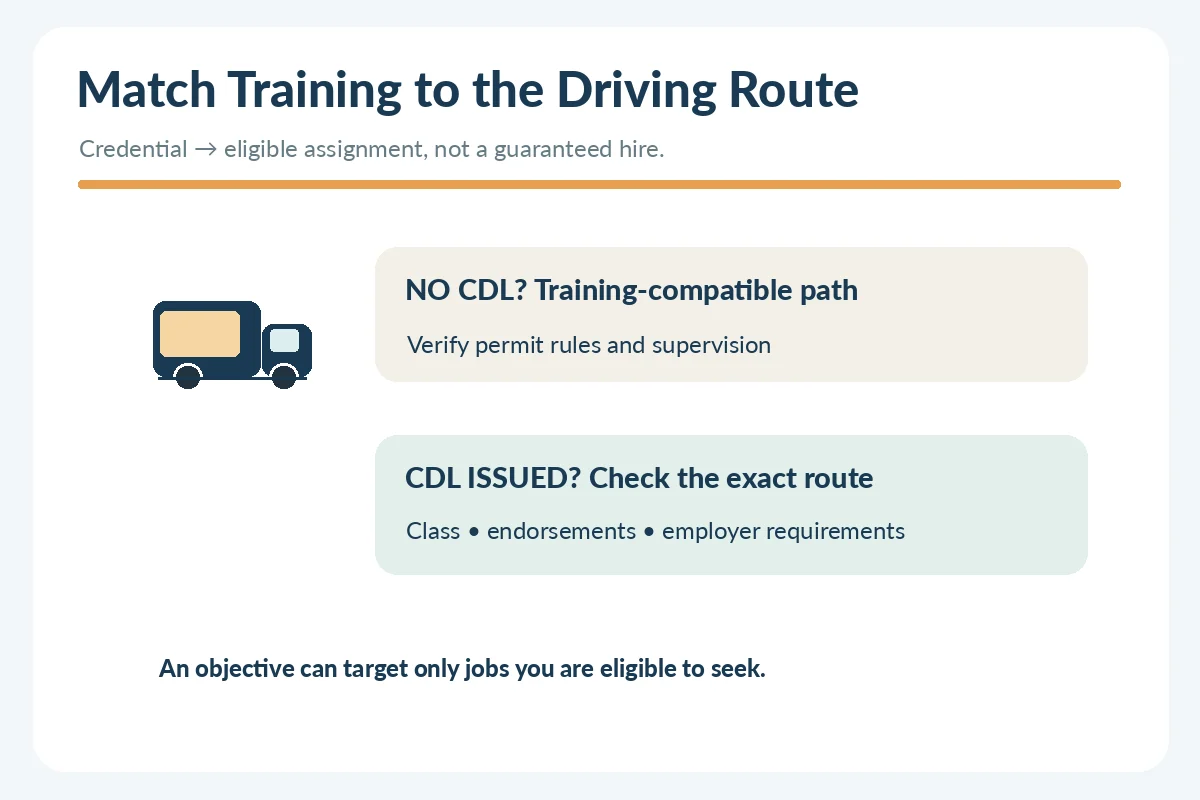
Place the Objective Next to Verifiable Credentials
For an entry-level truck-driving resume, place the optional objective below contact information, then show your CDL or CLP status clearly, followed by training, relevant transport or warehouse work, and other evidence that fits the vacancy. List completion dates accurately. If you used an illustrative school project, do not attach a fictitious trainer endorsement, instructor signature, or road-test result. Employers may inspect licensing records separately from the resume.
Read the finished document like a recruiter with only a few seconds: can they immediately distinguish permission to practice from permission to work? Can they find the exact license class and endorsements? Can they see what tasks the applicant personally performed? If the objective confuses any of those questions, revise it or omit it. No opening sentence can replace a required license.
Do a Final Objective and Resume Evidence Check
Read your opening sentence alongside the actual vacancy, not in isolation. Circle the title you are targeting, underline each qualification you claim, and locate the corresponding proof in the education, credentials, work, volunteer, or project sections. If you cannot point to a real record or describe the task with an honest supervisor or training context, remove or qualify the claim. A statement that sounds impressive but cannot survive a follow-up question works against you. The most useful objective is brief, tailored to this opening, and supported by the rest of the page.
Then read the resume for privacy and consistency. Dates, credential names, software proficiency, and employment titles should match your documentation. Use only authorized work samples or clearly identified fictional demonstrations. Check the final PDF at normal screen size, because broken lines and clipped text can obscure even a well-written opening statement. An objective is not mandatory; if it duplicates a stronger experience summary, omit it. Employers may use different screening workflows, and no particular phrase guarantees that an applicant will be selected.
How We Research Resume Objective Guidance
We reviewed occupational and career-center guidance on 2026-11-14 and compared this specific topic with the supplied JobAsk title inventory. The main references are www.bls.gov (BLS distinguishes truck driving duties, employer training, and CDL qualifications.); www.fmcsa.dot.gov (FMCSA distinguishes a commercial learner permit from a commercial driver license.); www.fmcsa.dot.gov (FMCSA lists entry-level driver training requirements for affected applicants.); the UC Davis Career Center (UC Davis describes a concise position-specific objective and supporting qualifications.). These references describe occupational scope and general resume guidance, not eligibility for a particular opening. All example candidates, records, objectives, and numbers in teaching scenarios are hypothetical unless explicitly identified as published facts. Employers, states, districts, and credential issuers may impose additional requirements. Our affiliate disclosure explains how the site handles potential commercial relationships; this article does not imply any partner endorsement.
More Resume and Cover Letter Guides
No. Name the CLP as a learner permit and clarify that you are seeking supervised training; do not imply a full CDL has been issued.
Only if genuinely held and relevant. Put the exact current endorsements in the credentials section for easy verification.
No. It can help explain a transition or a targeted trainee role, but a clean license and training section may be more valuable.
It can show transferable accuracy, loading coordination, safety habits, and work schedules, but it does not substitute for required driving experience.
No. Course completion and a state-issued CDL are distinct. Check the licensing authority and employer requirements.