
An entry-level bookkeeper resume objective works when it names the kind of records you can support and backs that promise with actual work, class projects, or authorized volunteer duties. State the target role, one or two relevant skills, and the level of responsibility you have performed. Accuracy matters more than a claim that you “managed every account.” A spreadsheet exercise is useful evidence of learning, but it does not turn the applicant into the keeper of an organization’s general ledger.
The Bureau of Labor Statistics describes bookkeeping and accounting clerks using software to record transactions, check figures, and reconcile or flag differences. Responsibilities range from limited entry tasks to broader management of financial records. Your resume should locate you honestly within that range. An optional objective can help a recent graduate or career changer, but an experienced bookkeeper with a clear work history may be better served by a qualifications summary instead.
Identify Which Financial Tasks You Actually Performed
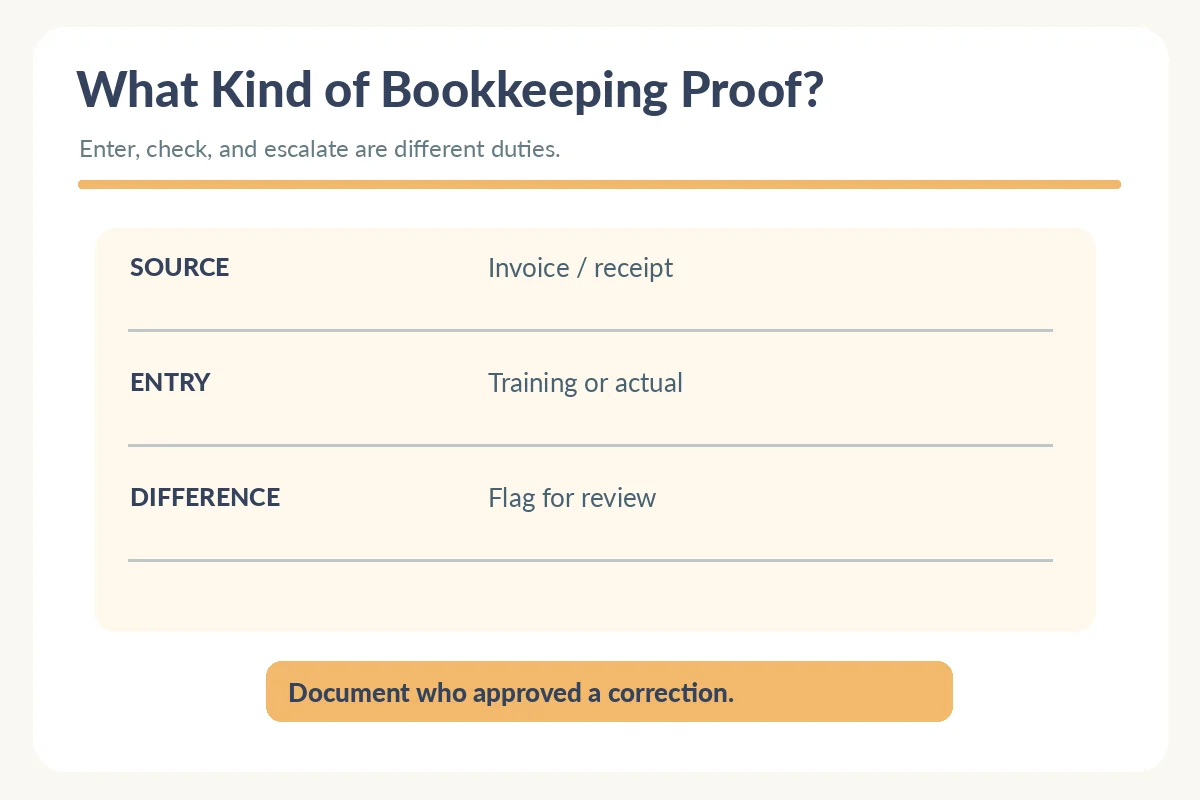
Separate four kinds of evidence: learning activities, transaction entry, difference detection, and authorized resolution. For example, “entered sample invoice rows into a class spreadsheet” is learning; “checked actual invoices against received payments at a nonprofit” is direct work if you truly performed it; “flagged mismatched totals for the treasurer” is not the same as approving a correction. State who reviewed the work when that determines your scope.
Many listings mention QuickBooks or other accounting applications. Only name software you have used sufficiently to discuss or demonstrate it, and do not claim certification without an issued credential. A training sandbox must be described as such. If you maintained your own budget, do not present that as employer accounts-payable experience. An objective should offer one strong example and reserve the detail for a project or work bullet.
| What the applicant has | Truthful resume treatment |
|---|---|
| Class simulation | Label fictional worksheet or training |
| Real data entry | Name verified task and period |
| Discrepancy review | State who authorized final changes |
Draft a One-Sentence Accounting Objective With Evidence
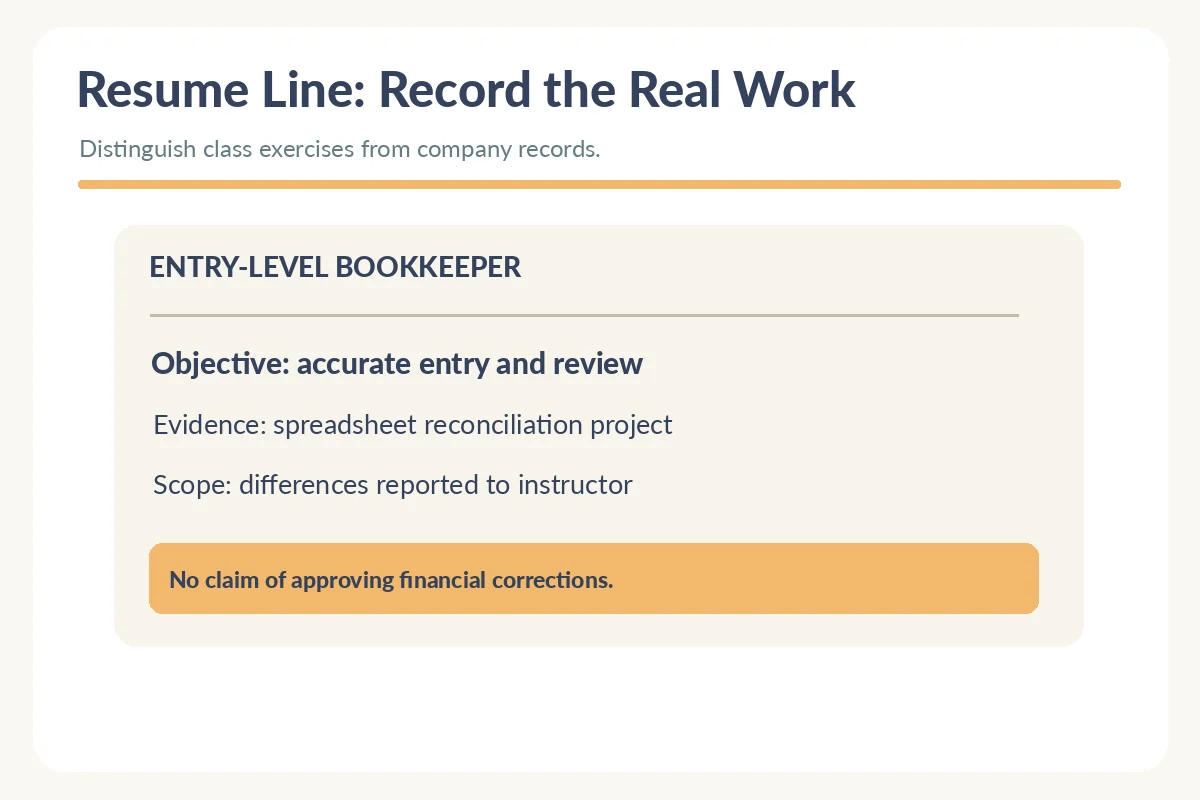
Hypothetical example for an accounting student: “Accounting coursework graduate seeking an entry-level bookkeeping role, with spreadsheet practice reconciling fictional invoice and payment records under instructor review.” This line makes its learning context clear. A candidate who had real volunteer work might instead say: “Volunteer treasurer assistant seeking a bookkeeper role, bringing documented receipt entry and monthly discrepancy reports submitted for committee review.” Use only duties actually performed.
For a career change from retail, an objective could read: “Retail associate pursuing bookkeeping work, bringing documented register closeouts, transaction checks, and careful cash-handling records.” Do not add “prepared tax returns,” “approved payroll,” or “managed client accounts” unless those tasks were real and authorized. The best statement takes a modest but specific fact and makes it relevant to the opening.
Convert a Record Workflow Into a Credible Bullet
A credible chain is source document → entry → check → exception → review. Suppose a hypothetical class case includes a vendor invoice and a matching payment. The student records the entry, reconciles the figures in a workbook, and labels a discrepancy for the instructor. The objective may mention spreadsheet reconciliation practice. The project bullet then explains the exact source documents and review arrangement. No unsupported efficiency percentage or invented business saving is needed.
If you worked with actual business records, do not publish vendor names, amounts, bank details, customer names, or screenshots without permission. For a public portfolio, recreate the structure with wholly fictional data and label it a demonstration. Hiring managers can evaluate the logic of your checking process without access to confidential company information.
Use a Manager-Approval Boundary for Stronger Claims
Weak: “Trusted accountant who managed and approved all financial records.” That claims a senior role and control the applicant may never have held. Better: “Entry-level bookkeeping applicant with invoice-entry coursework and experience flagging inconsistent totals for review.” Be precise about who posted, corrected, or approved transactions. In some organizations assistants can correct certain errors under procedures; in others they must escalate. Never assume universal authority from the job title.
This boundary makes interview answers easier too. If asked about a discrepancy, explain the steps you used to verify the document and who decided the final correction. An objective that accurately represents a review workflow is much more credible than a sweeping claim to “zero accounting errors,” a statistic rarely verified for a beginner.
| Applicant situation | Illustrative objective idea |
|---|---|
| Course project | Accounting student with supervised spreadsheet reconciliation practice. |
| Volunteer records | Treasurer assistant with receipt logs and committee review. |
| Retail transfer | Cash closeout experience supporting a bookkeeping transition. |
Compare Bookkeeper and Accounting Clerk Openings
A “bookkeeper” vacancy may include general-ledger support, customer invoices, bank reconciliation, and reports, while an “accounts payable clerk” opening may concentrate on bills and codes. The BLS notes that duties vary with employer and experience. Use the actual posting to decide which evidence belongs at the top; do not use one identical objective for every accounting role. A candidate with payment-matching practice could emphasize that work for an accounts-receivable role instead.
Before applying, mark required qualifications separately from preferred tools. Check whether the role expects independent close procedures or provides training and reviewer support. If your knowledge comes entirely from coursework, state that. Be candid about deadlines, routine checks, and the software you still need to learn. You should not have to defend invented accounting authority later.

Check the Final Resume as an Audit Trail
Keep dates for courses, job roles, and volunteer activities consistent. Use a separate skills section for verified spreadsheet functions or accounting applications. Place the objective near the top only if it adds a career target that other sections do not already make obvious. Then review the document like an auditor: which sentence can be tied to a real record, project, supervisor, or certificate?
Remove “numbers wizard,” “perfect accuracy,” and other unsupported self-ratings. If a figure is important, show how it was calculated and when it was observed. Confirm that sample data are fictional or authorized for disclosure. The employer needs a candidate who can recognize uncertainty, preserve records, and ask for review—not someone who claims an audit-quality system after a single practice worksheet.
Do a Final Objective and Resume Evidence Check
Read your opening sentence alongside the actual vacancy, not in isolation. Circle the title you are targeting, underline each qualification you claim, and locate the corresponding proof in the education, credentials, work, volunteer, or project sections. If you cannot point to a real record or describe the task with an honest supervisor or training context, remove or qualify the claim. A statement that sounds impressive but cannot survive a follow-up question works against you. The most useful objective is brief, tailored to this opening, and supported by the rest of the page.
Then read the resume for privacy and consistency. Dates, credential names, software proficiency, and employment titles should match your documentation. Use only authorized work samples or clearly identified fictional demonstrations. Check the final PDF at normal screen size, because broken lines and clipped text can obscure even a well-written opening statement. An objective is not mandatory; if it duplicates a stronger experience summary, omit it. Employers may use different screening workflows, and no particular phrase guarantees that an applicant will be selected.
How We Research Resume Objective Guidance
We reviewed occupational and career-center guidance on 2026-11-14 and compared this specific topic with the supplied JobAsk title inventory. The main references are www.bls.gov (BLS details ledger entry, reconciliation, software and differing bookkeeping responsibility levels.); the UT Dallas University Career Center (UT Dallas explains optional objectives and aligning qualifications to the job.); the UC Davis Career Center (UC Davis provides targeted resume objective guidance.). These references describe occupational scope and general resume guidance, not eligibility for a particular opening. All example candidates, records, objectives, and numbers in teaching scenarios are hypothetical unless explicitly identified as published facts. Employers, states, districts, and credential issuers may impose additional requirements. Our affiliate disclosure explains how the site handles potential commercial relationships; this article does not imply any partner endorsement.
More Resume and Cover Letter Guides
It can support a truthful entry-level objective if you identify the coursework and avoid implying paid accounting experience.
Describe software study accurately. Do not claim workplace proficiency or certification you do not have.
Only if you actually reconciled records in a stated work, volunteer, or practice setting.
No universal rule grants that authority. Responsibilities depend on the organization, role and supervision.
A short objective can help new entrants explain direction; established bookkeepers may prefer a concise experience-led summary.