
An event coordinator resume with no experience can still feature real scheduling and logistics work from a university club, local fundraiser, community gathering or supervised volunteer assignment. The key is to name your contribution precisely: preparing a check-in sheet, tracking room setup, confirming an approved schedule or directing an unresolved vendor question to the event lead. These are useful signals without pretending you owned the event’s contracts or budget.
BLS describes event planning as coordinating locations, timing, services and participants, and it notes that university and volunteer events may provide helpful exposure. This page translates that source into an entry-level evidence ledger: what you prepared, the people you informed, the problem you passed on, and what was completed. It does not repeat a general event coordinator resume objective or promise that informal projects meet every professional posting.
Identify the Actual Logistics Behind the Job Title
Different event roles may emphasize attendee registration, suppliers, program scheduling, room setup or follow-up documentation. Read the advertisement and highlight tasks you can connect to a real school, volunteer or work activity. For example, a club meeting might involve maintaining a room reservation, preparing materials and communicating an updated agenda. It may not involve commercial venue negotiation or financial approval. Distinguish supporting an event from acting as its lead planner.
Build a private two-column list of posting duties and real evidence. Write “not yet demonstrated” rather than filling a gap with a slogan. BLS identifies vendor and venue coordination as part of professional event planning, but that does not mean a student who emailed a venue owns the contract. Your resume should show both contribution and decision limits so the employer sees where training would be needed.
Turn a Campus or Volunteer Event Into a Clear Project Entry
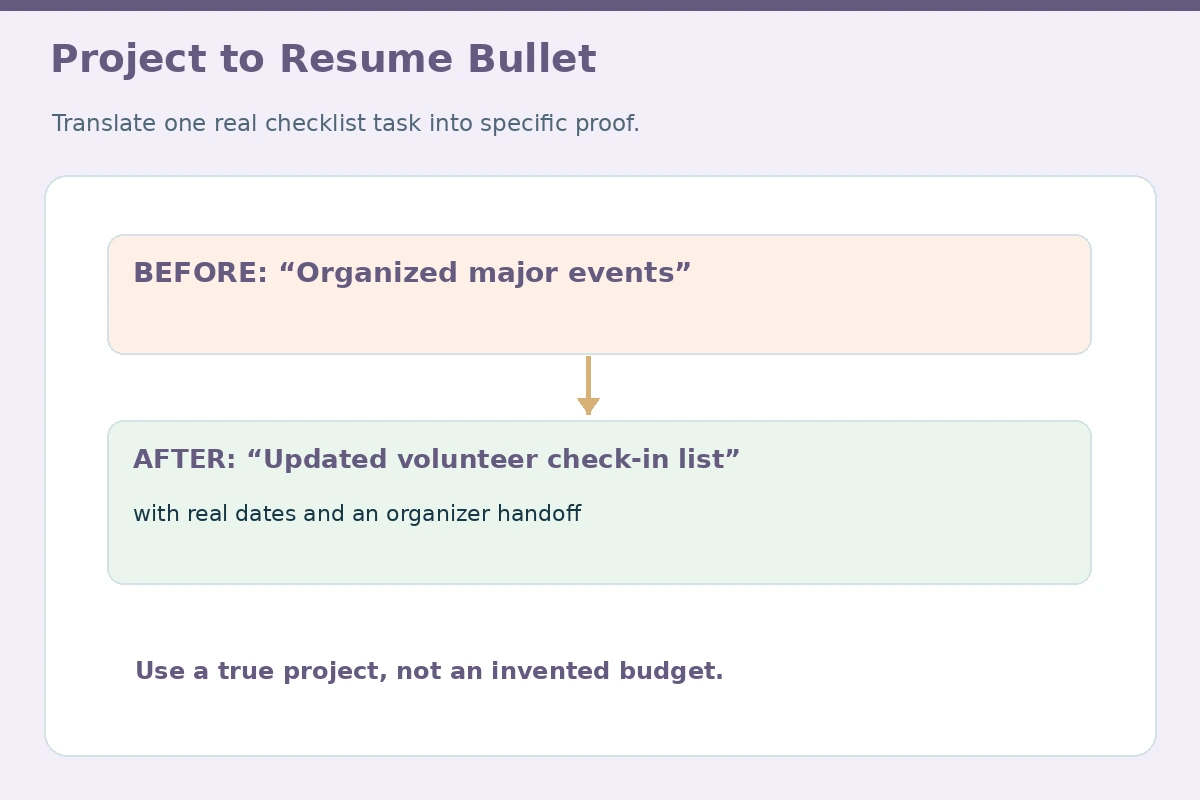
Use a project title, organizing group, date or term, and two to four outcome-focused but truthful bullets. A fictional “Campus Speaker Session — Volunteer Logistics Assistant” example could say: “Prepared the attendee check-in list from approved registrations and updated the organizer when a name did not match.” Another might say: “Distributed the revised room map to volunteer ushers before doors opened.” These are examples of process ownership, not invented audience or revenue figures.
When the event was a class simulation, label it “Course Project” and say what you designed, not that you ran a real public event. If your team produced the schedule, specify your part. A project entry becomes credible when you can show an agenda, a private de-identified checklist, or a note you authored and are permitted to share. Never export guests’ contact lists simply to prove your contribution.
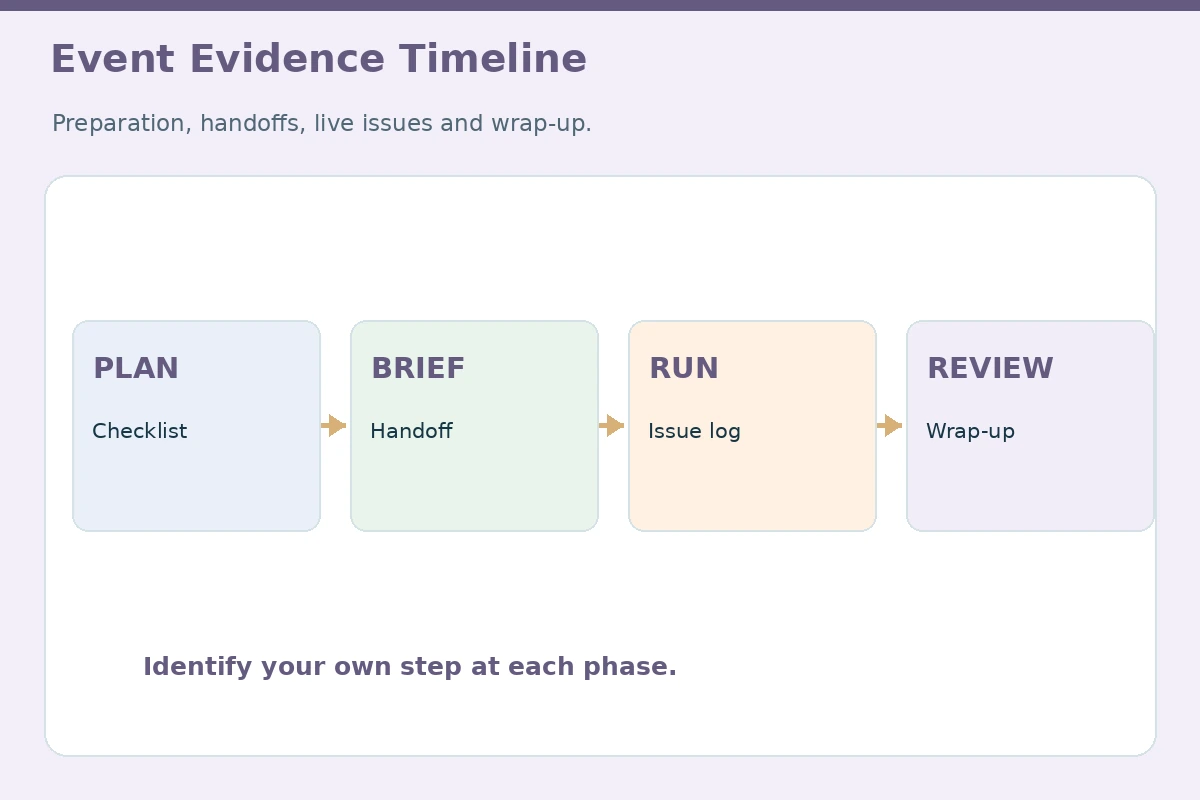
| Event phase | Potential proof | Authority boundary |
|---|---|---|
| Preparation | Room list or schedule draft | Did not approve venue |
| Coordination | Shared volunteer update | Did not sign vendor deal |
| Event day | Recorded issue and routed it | Did not claim safety authority |
| Wrap-up | Updated checklist and notes | No fabricated impact figures |
Separate Scheduling, Supplier Contact, and Approval
An event assistant may communicate with a supplier about delivery time without approving purchases. A useful bullet states “Confirmed the published delivery window with the event lead and relayed updates to setup volunteers” if true. Do not write “Negotiated vendor agreements and approved invoices” unless you were authorized and actually did that work. BLS lists contract and cost planning among professional tasks; junior support may touch only one step.
Show the handoff in practical detail: who needed the update, which document was revised, and which outstanding decision went to the responsible person. If a venue or accessibility request was unresolved, describe how you flagged it rather than presenting an unapproved decision as implemented. This distinction protects both your accuracy and the real people whose arrangements may have depended on the final choice.
Describe Event-Day Changes Without Inflating Outcomes
Events change rapidly. A microphone may fail, a room may fill, or a speaker may run late. A truthful entry can describe setting out revised signs, updating a check-in team or alerting the technician. Do not claim you independently repaired electrical equipment, resolved a safety incident or prevented a cancellation unless the facts support that. The value of your contribution is often how quickly the right person received reliable information.
Avoid invented percentages for attendee satisfaction, ticket conversions or costs saved. If you did not conduct an approved evaluation, write the concrete deliverable: “Recorded missing supply items for the post-event checklist.” A useful resume does not need heroic numbers. It needs enough specificity for a hiring manager to ask intelligent follow-up questions that you can answer consistently.

Build a One-Page Draft With Event Evidence Near the Top
Use a short summary only when it adds role fit, then a Relevant Projects section followed by actual work and education in an order that emphasizes your strongest evidence. Put tools on the page only if you used them: a shared spreadsheet, calendar, slide deck or registration form. Distinguish professional tools from classroom familiarity. A simple line of clear projects often does more than an inflated title such as “Event Management Director” for a small club task.
For every bullet, use the actual event name if public or a generalized label if confidential. Give the month or term and ensure it does not collide with work dates. A former part-time retail employee may have better evidence of shift handoffs than a simulated event; include whichever is genuinely more relevant. The resume is not required to pretend every skill was learned in a dedicated events department.
Check Supporting Artifacts and the Final Export
Review any linked event portfolio or project summary for attendee names, private phone numbers, sponsorship discussions, unpublished contracts and photos you are not authorized to use. You can explain logistics with a fictionalized diagram that is clearly presented as an illustration, or use a blank checklist template you created. Do not disguise hypothetical materials as records from a real employer.
Before submission, verify that every vendor, cost, room, date and final outcome claim is true and relevant. Open the exported PDF and confirm its headings and bullets are readable. Match the job advertisement’s required document type and work location instead of assuming every coordinator job is fully remote. An honest evidence ledger makes your first event application more defensible than a generic statement that you love organizing.
How We Research First-Job Resume Evidence
On 2026-11-14, we reviewed these primary and professional sources: BLS: Meeting, Convention, and Event Planners — BLS describes event planning tasks and explicitly identifies university or volunteer events as possible relevant experience.; NACE: Career Readiness Competencies — NACE career-readiness framework describes communication, teamwork, professionalism and technology as demonstrable competencies.; Harvard FAS: Resume and Cover Letter Resources — Harvard career resources show action verbs and emphasize expressing accomplishments with clear, accurate, role-relevant descriptions.. We compared the intended queries and article titles with the supplied WordPress export and earlier available drafts. Sample resume lines and visual scenarios are hypothetical; use only your own true history. We do not verify a particular employer, vacancy, interview outcome, credential or resume parser behavior. Refer to the actual job posting and the latest source guidance, and read our affiliate disclosure. No sponsored employment or affiliate endorsement is claimed.
More Resume and Cover Letter Guides
Yes as an appropriately labeled project or activity. State the real tasks you completed and the dates.
Use the title you actually held. Coordinating a task is not automatically managing the whole event.
Only if they are reliable and you are authorized to share them. No number is better than an unsupported one.
Describe the information you prepared or relayed, and leave approval credit with the authorized person.
Only permitted, de-identified or personally created samples. Do not publish private registrant records or contracts.