
Executive job boards are one route to senior opportunities, not a complete picture of leadership hiring. Some roles are posted openly, others appear on association career centers, and some are managed by executive search consultants. Decide which channel is appropriate for your experience and industry, then verify the role’s authority, organizational mandate and confidentiality expectations before circulating a detailed career profile.
At senior level, “director,” “vice president” and “chief” may mean different things across organizations. A public posting can be valuable, but a title alone does not reveal budget control, board relationship or decision rights. The Association of Executive Search and Leadership Consultants (AESC) describes candidate safeguards for its member-led searches; use those standards as due-diligence questions rather than assuming every recruiter operates that way.
Understand the Three Main Search Channels
Public executive listings show role summaries and application instructions that candidates can review directly. Sector association career centers may provide more context for a particular industry. Consultant-led executive searches can involve conversations before the client’s identity is fully disclosed, especially where confidentiality is legitimate. Those routes overlap, but they should not be treated as interchangeable guarantees of access to a vacancy.
Start with the organizations and functions where you have defensible experience. Compare board-level leadership, business-unit management and general operations leadership separately. A role advertised as “executive” may oversee a small team, while an unassuming general manager job may carry extensive operational accountability. Search for scope and mandate instead of chasing only a senior-sounding title.
Read the Leadership Mandate, Not Just the Title
The Bureau of Labor Statistics describes top executives as overseeing organizational goals, policies, budgets and activities. The extent of those responsibilities differs by employer size and role. In a real posting, identify reporting lines, budget responsibility, authority over staffing, operational scope, stakeholder groups and measures of performance. If any of these are missing, note them as questions rather than filling the gaps with assumptions.
For example, a hypothetical director candidate may have improved a service process but not approved organization-wide capital spending. That evidence may still be valuable, provided the candidate states personal authority accurately. A chief officer role may require presenting a plan to a board; another leadership post may report to an owner and concentrate on daily delivery. Use the job description and conversations to understand which is expected.
| Search channel | What it can show | What to verify |
|---|---|---|
| Public executive board | Advertised leadership vacancy | Actual authority and employer page |
| Industry association | Sector-specific leadership opening | Organization and current requisition |
| Search consultant | Potential confidential mandate | Firm, role scope and privacy process |

Verify an Executive Search Consultant
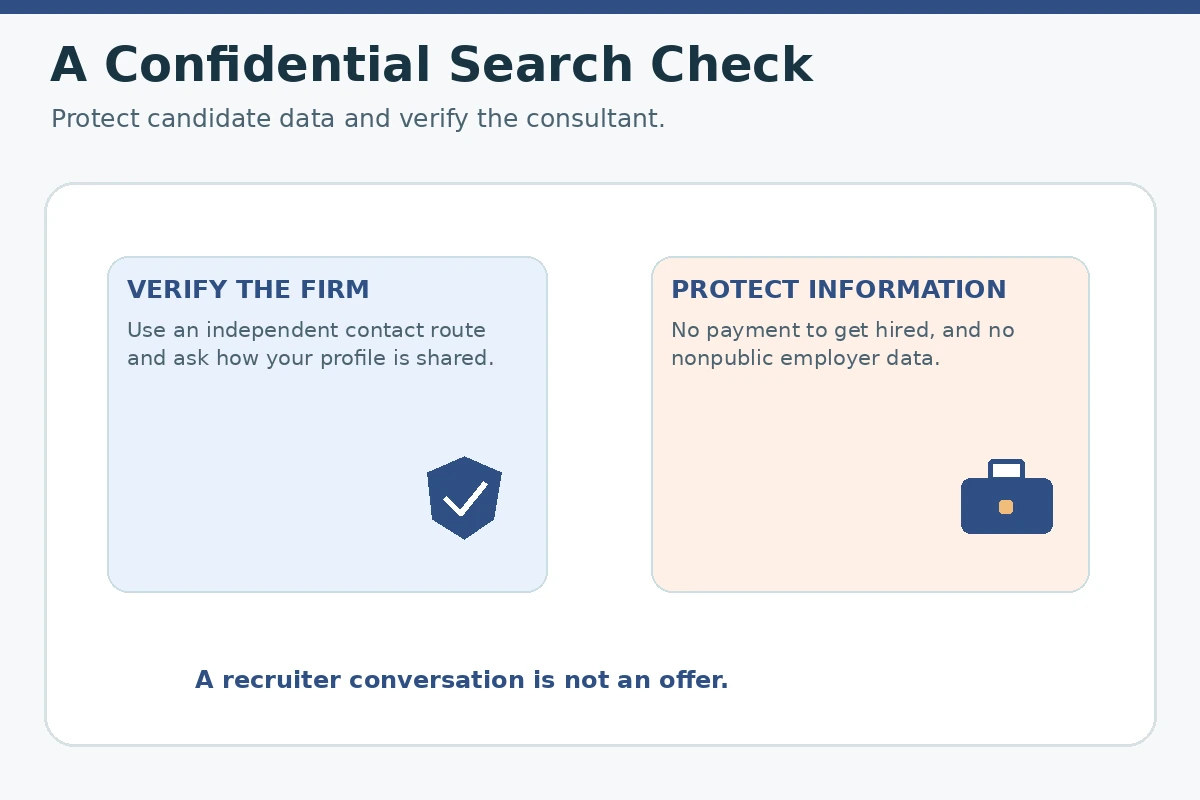
AESC’s candidate guidance discusses confidentiality, timely communication and assessments in searches managed by its members. If contacted by a consultant, verify the person and firm using independently found information. Ask about the general mandate, stages, confidentiality handling, conflicts and when the client organization can be named. A firm’s membership or an impressive website should not substitute for checking the particular opportunity.
Be cautious about providing sensitive details about your current employer, unreleased plans, employee data or nonpublic financial information. An executive application may require a substantial work history, but it should not require breaching existing obligations. If a recruiter asks for an extensive strategic plan before revealing credible information about the role, clarify how the material will be used and who may see it.
Build an Evidence Brief Without Inventing Outcomes
Prepare a one-page private mandate brief for each target role: business context, decisions you owned, people or budgets you actually managed, stakeholders, constraints and a verified result. Distinguish leading a program from advising the person with formal approval. If a metric is confidential or attribution is uncertain, describe the decision and observable process without making up a financial gain.
Evidence should match the organization’s challenge. For a smaller nonprofit, that may include program oversight, governance and limited resources. For a larger firm, it might be cross-functional execution, risk review and reporting to senior decision makers. Do not recycle a polished “turnaround story” when the actual position is about steady operations. Respect existing nondisclosure obligations and avoid claims that imply ownership of an entire team’s results.

Protect Privacy and Distinguish Real Recruiters From Scams
A credible-sounding invitation that arrives unexpectedly is still unverified. The FTC warns that scammers impersonate recruiting professionals and request money or sensitive data. Check the recruiter through the firm’s official domain and independent contact details. Do not pay upfront for an interview, promise to purchase services to enter a search, or send bank information merely to receive a supposed offer.
Confidentiality has two sides: protecting your own interest in exploring a role and respecting the employer’s legitimate search process. Ask how your résumé will be shared, whether permission is needed before a client submission and who can access your profile. Do not request confidential details about other candidates. Even if an initial client identity is withheld, you can still seek a credible description of mandate, location and process.
Track Opportunities by Mandate and Relationship
For each lead, record the source channel, verified organization or consultant, role scope, location, confidentiality status, last substantive contact and next agreed action. Mark whether you have applied directly or only held an exploratory discussion. A database entry or recruiter conversation does not create an active candidacy. Review whether opportunities align with the authority and constraints you are genuinely prepared to handle.
Use public boards to monitor visible market demand, association centers to discover sector-specific routes and vetted consultants to explore appropriate confidential searches. Keep your communication accurate and professional; do not imply a consultant represents a particular client unless that has been confirmed. The useful outcome is a smaller collection of credible leadership mandates where both sides understand the actual role.
How We Research and Verify Job Boards
Checked on 2026-11-14, using the following primary career-center and public-interest resources: Association of Executive Search and Leadership Consultants (AESC describes candidate treatment, confidentiality and assessment practices in member-led executive searches.); U.S. Bureau of Labor Statistics, top executives (BLS describes strategic, budget, oversight and organization-dependent duties for top executives.); Federal Trade Commission, job scam guidance (FTC warns about impersonated recruiters, requests for money and premature demands for sensitive personal information.). We checked the supplied WordPress title inventory, the original JobAsk production plan and the immediately preceding article package for overlapping intent. Board inventories and employer requirements change, so this guide describes a verification method instead of claiming that any particular vacancy remains available. All hypothetical examples are illustrative and are not actual offers or employer endorsements. For monetization transparency, review the JobAsk affiliate disclosure; no paid affiliation is claimed here.
Related Job Search Guides
No. Some are advertised openly and others are managed through consultant-led processes. Use more than one legitimate search channel.
That can happen in a legitimate search. Verify the consultant and request enough mandate and privacy information to assess the opportunity.
Do not send money to secure an interview or a job. Verify the business model and consult FTC scam guidance if a contact demands payment.
Describe your verified authority, decisions, constraints and observable outcomes. Do not invent figures or disclose nonpublic employer data.
No. Reporting line, budget authority, team scope and governance differ. Investigate the actual mandate rather than relying on title alone.