
Sports job boards are useful for discovering more than coaching openings. College athletics, teams, venues, recreation organizations, and event operators also hire for ticketing, facilities, communications, operations, marketing, and fan services. Start by choosing the actual work you want, then compare a sports-specialty board with the hiring organization’s official careers page. A team logo or a prominent league name does not tell you whether the employer is the club, a campus, a contractor, or an event provider.
Search by function before choosing the sport or team
A candidate targeting professional sports may search for “marketing” and miss live-event production or ticket operations because the job titles differ. Set a primary function first: coaching, event operations, facility support, athlete services, communications, sales, analytics, or administration. Then add a sport or employer type. A college athletics department and a professional venue can both advertise event operations, but their calendars, reporting lines, and required experience may be very different.
Create a task-based shortlist. If your evidence is guest-service work, search “ticket operations” or “event services” rather than applying to any job that mentions basketball. If you coached at a youth organization, distinguish the ages, level, supervision, and certifications involved from collegiate or professional head-coach expectations. If you handled statistical data, explain the tools and outputs you actually produced; watching games is not the same as performing professional performance analysis.
Use official athletics listings alongside specialty boards
The NCAA operates a careers marketplace centered on college athletics and related professional roles. Its listing categories span areas such as coaching, athletics administration, communications, and operations. The sports-specific discovery value is real, but a marketplace does not certify every employer statement. Check institutional athletics sites, university human-resources pages, team websites, and venue-operator careers pages for official application instructions and dates.
A hypothetical applicant might find “assistant director of event operations” on a sports board, then verify it on the university’s employment site. Record whether the application takes place through the university HR system or a hiring partner authorized by the employer. Some sports-related postings appear in general career sites rather than any specialty board; don’t restrict your search only to one marketplace, particularly for finance, IT, equipment, and facilities work.

Learn which organization actually controls the position
A sports venue can host jobs from several employers: the team, campus, stadium operator, food-and-beverage contractor, security provider, and seasonal event organization. Their schedules, managers, and hiring terms are not interchangeable. If the listing says “game-day staff,” find out which company issues the employment agreement and which organization directs work on site. Check whether the role is seasonal, part-time, fixed-term, or ongoing before assuming weekly hours.
For college athletics, confirm whether the job sits in athletics administration, student life, a specific program, or an outside vendor. For professional sports, inspect travel expectations, regular office duties, match-day responsibilities, and whether evening or weekend events are mandatory. If a posting omits compensation, benefits, or shift notice rules, mark them as open questions rather than predicting pay or assuming every sports job has event-day perks.
Read coaching requirements with exact scope
Coaching titles can include volunteer, assistant, head coach, instructor, or youth-program leader. Each employer may specify credentials, background screening, experience, supervision, safety training, or duties that vary by sport and population. The job board is a discovery route, not a license authority. Use the posting’s required qualifications and official organization policies. Never claim a coaching certification or clearance you have not received, even if you could obtain it after hire.
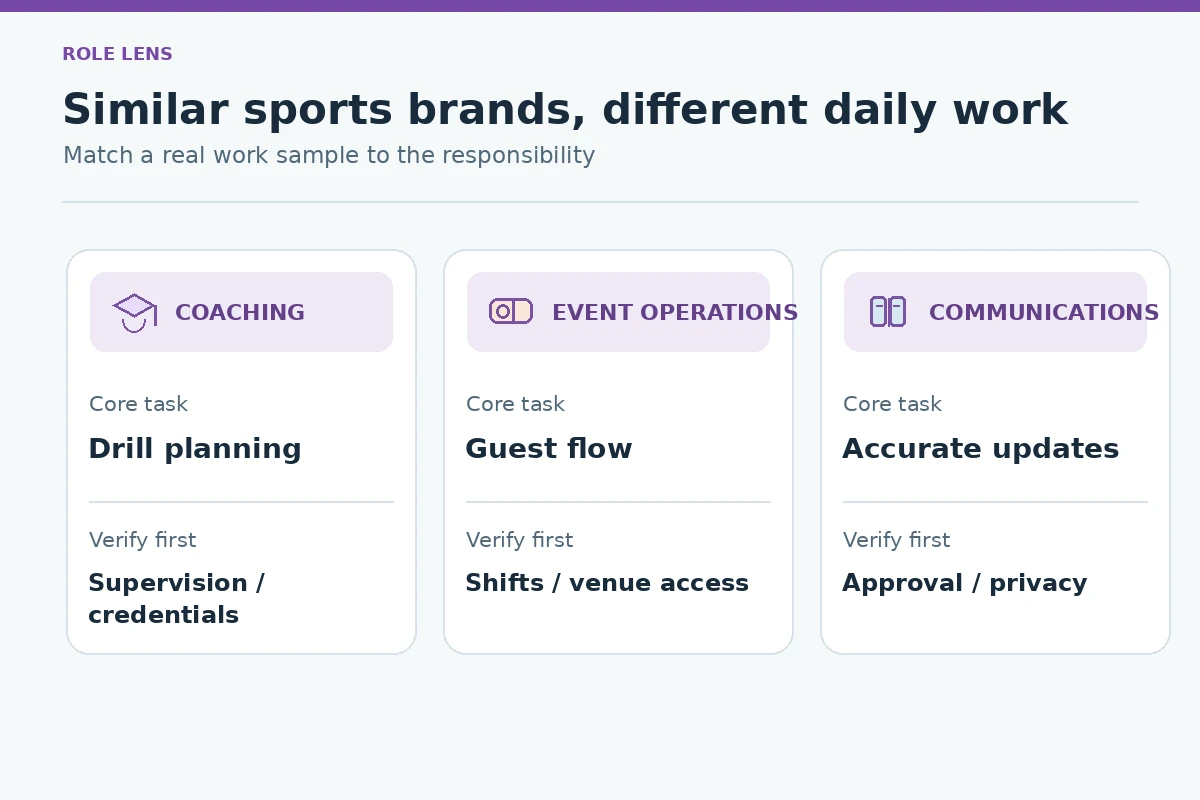
An honest hypothetical resume example: “Assisted a youth soccer coach with attendance, drill setup, and parent scheduling under program supervision.” This gives relevant evidence without claiming independent coaching authority. A candidate for athletic communications might instead describe approved photography captions, a live-event rundown, or accuracy checks on published results. Sports hiring becomes less mysterious when you match the responsibility and evidence, not just your personal enthusiasm for the game.
Verify event operations, travel, and access boundaries
Work in sports can happen at crowded venues, on the road, around valuable equipment, or near athletes and minors. Review the employer’s training requirements and who approves restricted-area access or safety-sensitive tasks. An opening in facility operations may require technical skill or supervised equipment use that isn’t visible in a short board summary. A fan-engagement role may demand frequent public interaction and irregular hours. Ask what the position actually covers on non-event days.
When a job description lists credentials for athletic training, medical support, or another regulated activity, do not treat it as interchangeable with sports performance or fitness assistance. Confirm the required license or certification in the job’s jurisdiction using the appropriate authority, and do not offer medical advice or claim treatment duties based on a general sports background. Keep sport-specific performance information and private athlete records out of portfolio examples unless explicitly authorized.
Check posting authenticity before sharing personal details
Sports brands can attract impersonators who copy official logos and post plausible roles. Independently navigate to the organization’s official jobs page and compare title, organization, location, job reference, and current application route. The FTC cautions that fraudulent recruiters may create realistic postings and demand money or sensitive data. Ignore requests to pay for a guaranteed tryout, job interview, or employment offer. A verified employer may still use a third-party applicant tracking system; access it from the employer’s own site.
If a recruiter contacts you from a personal account, ask for an official posting and independently confirm their role with the organization’s published contact information. Do not use forwarded social-media direct messages as the sole proof of an opening. If a listing closes, save the detail for future research but stop treating it as a current application. No sports job board or career site can promise a placement simply because you created an account.

Compare roles with a practical sports-job worksheet
Keep a simple scorecard: actual employer, role function, sport or venue type, regular tasks, event-day tasks, schedule, travel, contract duration, required credentials, official application destination, and deadline. Add evidence for the most important task in the posting. For a communications position, that may be a fact-checked writing sample; for ticketing, a customer-service example; for venue logistics, an inventory or event-setup record.
Review specialty boards for discovery, direct employers for status confirmation, and application portals for the required materials. Tailor the application only after the employer and task are clear. A candidate might reasonably choose a reliable venue-operations role over a more famous team posting with mismatched travel requirements. The goal is work that fits your abilities and life, not merely a recognizable name on the jersey.
How We Research Sports Employment Sources
We reviewed the NCAA’s official jobs and career-marketplace pages and federal consumer-protection guidance about fake hiring notices. The NCAA examples establish the range of college athletics roles, not a claim that any particular position is open or suitable today. See NCAA Jobs, NCAA Career Marketplace, and FTC job-posting scam guidance. Links are informational, not paid recommendations. Review our affiliate disclosure.
Related Job Search Guides
No. Athletics employers also hire for communications, facilities, ticketing, development, business operations, event services, and other functions. Search by real duties as well as sport.
It can be a team, campus, facility operator, event promoter, or specialist contractor. The current vacancy should identify the employing organization and application process.
No universal schedule applies. Some roles are office-focused while others depend on matches or events. Verify recurring hours, travel, and event-day expectations with the actual employer.
Yes, when described accurately. Name the age group, tasks, supervision, and any real certification while avoiding a claim that volunteer assistance equals professional coaching authority.
Navigate independently to the sports organization’s official careers page, check job details, and avoid payment requests or unverified identity-data requests. A logo alone does not authenticate a posting.