
To find a hiring event, start with a trusted host such as a college career center, a local workforce organization or an employer’s own careers page. Confirm the event date and location directly with the organizer, check that participating employers really plan to attend, and ask whether the event is informational or tied to current openings. A public flyer or social-media post is a lead, not proof that registration or any job offer is legitimate.
A hiring event can be useful even when there is no interview scheduled: you may learn which tasks, shifts or qualifications an employer seeks. The goal of this guide is narrower than general job-fair conversation tips. It helps beginners decide whether an advertised event is real, relevant and safe enough to attend, and how to move from a conversation to the employer’s confirmed application process.
Find the Event Through a Source You Can Independently Check
Search the official calendars of local workforce agencies, public colleges, universities, community organizations and target employers. Look for a page that states the hosting organization, location, date, registration process, contact and intended audience. A social-media repost may omit a cancellation or change of room. When a flyer lists a website, enter the host’s known address independently instead of trusting a shortened link or message from a stranger.
Some sessions are general career fairs; others are one-employer hiring days, occupational open houses or training information events. Their purposes are not interchangeable. A career fair might provide recruiter conversations but require online applications afterward. A hiring day may still use ordinary screening and eligibility steps. Do not describe a session as offering interviews, immediate hiring or guaranteed positions unless the current official event details say so.
Identify the Organizer and the Employers as Separate Parties
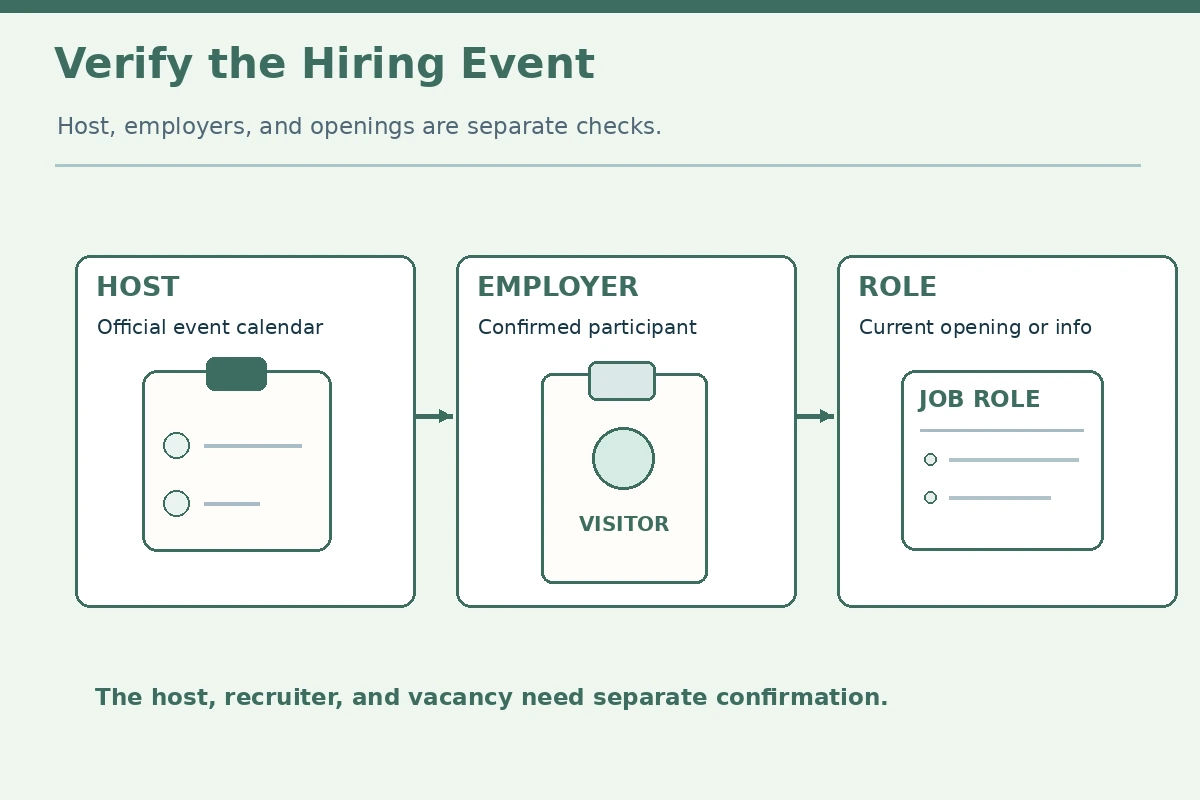
Record who hosts the event and who is expected to recruit. For example, a civic center may provide the room while an employment agency coordinates registration and individual employers run booths. A legitimate venue name does not verify every recruiter who appears on a flyer. Check official organizer contact details and the participating employer list, and note when those names are provisional or missing.
If an unknown person messages you after you register, verify that the message matches the organizer’s established communication process. The Federal Trade Commission warns that impersonators can use real company names and convincing documents to demand money or sensitive information. Keep the host, employer and job opening in three separate rows of your worksheet; only connect them when a reliable source supports the relationship.
| Item to verify | Where to check | What to record |
|---|---|---|
| Event date and venue | Official organizer calendar | Time, room, contact |
| Employer participation | Employer or host announcement | Confirmed vs. unconfirmed |
| Available roles | Official employer careers page | Exact job or information-only |
| Application route | Verified employer portal | Link and deadline |
Check Whether There Are Jobs to Apply For
Before traveling, review the event page for the type of roles, departments, work locations, shifts and expected qualifications. If an employer is listed, visit its official careers site to identify the relevant openings. The event may be about future recruiting or general industry education rather than hiring for a posted role. That can still be valuable, but it changes what questions and materials you should prepare.
Use a realistic example: a student interested in administrative work sees an event with a hospital logo. The hospital might be recruiting for clinical, custodial or front-desk roles. The logo alone does not establish any open office position. Ask the organizer which functions will be represented, then check individual job requirements on the employer’s site. Keep any required license or supervised practice boundaries clear.
Prepare What to Bring Without Oversharing
Read the host’s stated requirements and bring a basic resume only if it is appropriate and safe to share. You may prefer a small list of relevant questions, a notebook and a record of which roles interest you. Do not carry confidential work samples or documents with another person’s details. Never assume a fair requires you to send bank account information, identification images or a fee through an unsolicited message.
Penn Career Services recommends researching employers and preparing a concise introduction for career fairs. For a beginner, that may be one sentence about an actual project or volunteer task, followed by a question about training or role duties. If an event promises on-site application support, verify how official accounts and documents are handled. Consider the security of shared computers and use your own trusted device when practical.

Ask Useful Questions at the Event Without Inventing Experience
Choose questions that an employer representative can answer: “Which team handles scheduling?” “Does this position include supervised training?” “Where is the correct application link?” Write down the response and the representative’s name only if voluntarily provided. Avoid treating a friendly conversation as an offer or a guarantee that your application will move forward. A recruiter may not know the exact decision process for every department.
If you do not meet a published credential requirement, ask whether there is a separate support route rather than presenting yourself as licensed. Similarly, if a booth says it represents a staffing firm, confirm who the actual employer and worksite will be. Be honest when describing school and volunteer experience. The value of the event is reliable information and a next step, not a chance to skip required checks.
Verify the Follow-Up Route Before Applying
After speaking with someone, open the employer’s official careers page from a trusted source. Match the job title, location and required documents. If the recruiter gave a code or an event-specific URL, verify that it belongs to the employer or authorized organizer before entering personal information. A shortened link or unusual new domain should be treated as unverified until confirmed. Use the job’s official application portal when the employer directs applicants there.
A short follow-up can mention the topic you discussed and ask one unresolved question, but it should not claim a job offer. Penn’s guidance emphasizes recording conversations and following up appropriately after career fairs. Keep the status in your log as attended, application submitted or awaiting response, not hired. If an event is canceled, remove it from your plan and check the host’s official updates before rescheduling travel.

Recognize Pressure Tactics and Leave Safely
Treat demands for immediate payment, unfamiliar equipment deposits, personal banking data before a genuine hiring process, or guaranteed placement as serious warning signs. The FTC advises job seekers to verify openings independently and says that paying for a promised job is a red flag. A printed booth banner, professional logo or familiar venue does not substitute for a verified organization and authorized application channel.
If something feels inconsistent, step away from the registration table or digital form. Contact the official organizer through a number obtained separately and ask for confirmation. You do not have to hand over sensitive documents to prove interest. You can report suspected scams through the FTC and notify the event host if someone is impersonating a participant. An event is useful only when the next step is both relevant and trustworthy.
How We Research Beginner Job Search Advice
Checked on 2026-11-14: Penn Career Services: Fair Preparation — Penn Career Services recommends reviewing participating employers and preparing specific questions for a fair.; Penn Career Services: Fair Follow-up — Penn Career Services advises recording employer conversations and following up on real next steps.; FTC: Verify Job Leads — FTC warns job seekers to verify employers independently and never pay for a promised job.; FTC: Fake Job Ads — FTC warns that fake or copied job ads may use real employer names; check independently with the company.. We compared this topic with the supplied WordPress post-title exports and previous JobAsk draft subjects, and reviewed search results for the specific intent. Examples, job leads and worksheets in this article are hypothetical and not open vacancies, predicted interview outcomes or guarantees. The exact requirements, hiring channels and work arrangements must be verified with the real employer. JobAsk does not claim a paid employer or referral partnership. See our affiliate disclosure.
Related Job Search Guides
No. Some are for networking, career information or future recruiting. Check the official event description.
No. Independently verify the event with the hosting organization and current calendar.
Do not share sensitive identifiers simply because an event flyer requests them. Confirm a legitimate hiring need through official channels.
Often, depending on the event audience. Prepare honest examples of projects or volunteer tasks and ask about entry routes.
Record the actual next step and apply through the verified employer or authorized host channel if a suitable opening exists.