
To find a second job, start with the hours you can reliably work after accounting for your primary job, travel, rest, and personal obligations. Then choose roles with verified shifts, clear responsibilities, and no conflicts with applicable policies. A second job that pays more on paper but repeatedly overlaps your first job may not be sustainable.
There are different reasons for looking for an additional role: supplemental income, a new career skill, seasonal earnings, or trying out another field. Name your priority before browsing. Keep an honest view of your energy and schedule. If your first job has on-call duties or rotating shifts, a fixed second-job schedule could be impossible without explicit arrangements.
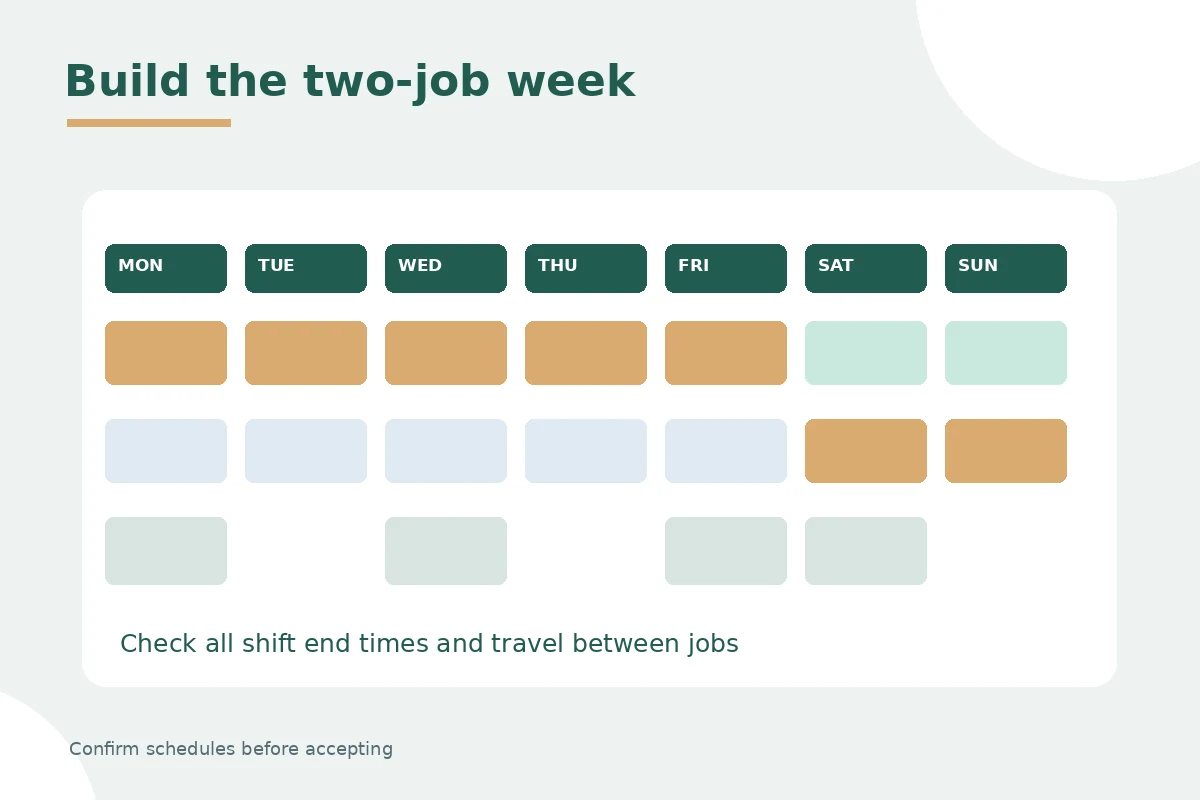
Draw a complete two-job weekly calendar
Start with your published or typical primary-job schedule, and mark fixed shifts, on-call windows, commuting time, and important obligations. Add realistic buffers for travel between worksites rather than assuming you can arrive instantly. Only then color the windows that remain genuinely available. A listing for “evenings” can mean different times, including a closing shift extending after public transport stops.
Ask employers about expected weekly hours, rotating schedules, minimum shift length, training dates, weekend coverage, call-ins, and how far in advance schedules are posted. A position that advertises flexible hours may still require a minimum weekend commitment. Note unknowns in your tracker and do not promise open availability merely to get an interview.
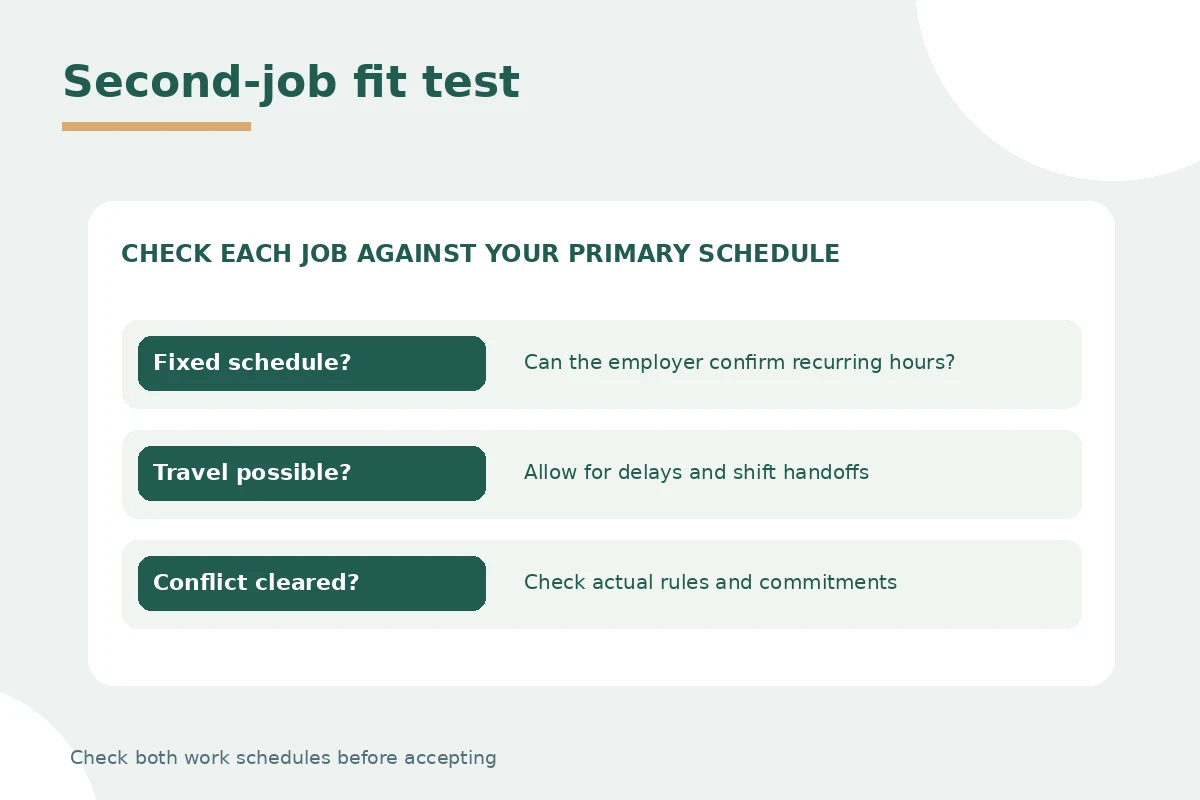
Check policies and conflicts before saying yes
Review any applicable employment contract, outside-employment policy, confidentiality rule, and schedule commitment from your first job. Some positions involve conflicts of interest, customer information, or fatigue-sensitive duties; the relevant rule depends on employer and role. If you are unsure, use an appropriate workplace channel to clarify the policy without asking a new employer to give legal advice.
Never reuse a primary employer’s customer lists, confidential methods, software accounts, or equipment to perform second-job tasks. If the roles compete for the same hours, identify the conflict before agreeing to shifts. If required training takes place during your first job, ask about alternative sessions; do not assume the training will be scheduled around you.
Compare take-home usefulness, not the advertised rate
Build a private comparison that accounts for travel, parking, required work clothing, childcare, unpaid commuting, scheduling unpredictability, and the time you lose to travel. These are personal decision inputs, not a universal wage formula. Tax and benefit effects vary by household and jurisdiction; if the consequences are significant, review authoritative guidance or consult a qualified professional.
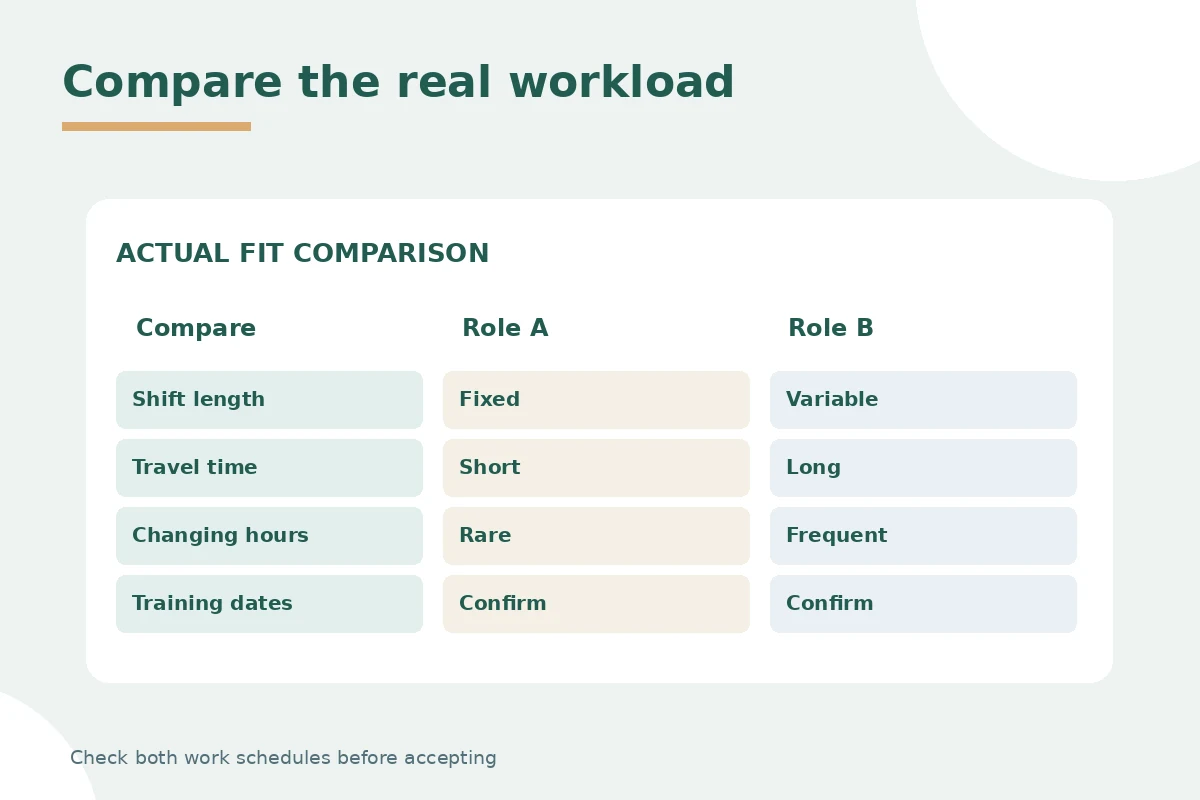
For example, a hypothetical evening role offering a slightly higher hourly rate might involve a long commute and frequent late closing; a closer weekend role may be a better fit even if the listed rate is lower. Do not publish numerical “net income” claims without a defined calculation. The important decision is whether you can complete the shift safely and reliably while preserving existing commitments.
Choose search terms that describe your availability
Use title plus schedule modifiers: “Saturday inventory assistant,” “evening front desk support,” or “weekend event check-in.” Search official employer pages and verified job banks, then read beyond the headline. Also consider seasonal work with a defined end date if your availability is temporary. Avoid applications to roles that require unpredictable on-call coverage unless you can genuinely manage it.
Ask clear questions at the interview: “How much advance notice do you give for schedules?”, “Can shifts run beyond closing time?”, and “Which weekends are essential?” Share your true available windows without revealing unnecessary personal details about another employer. If an interviewer asks about a conflict that matters to the job, answer accurately and do not promise exclusive availability you cannot deliver.
Test the second job for sustainability
Before accepting, review the actual shift pattern, travel time, training schedule, schedule changes, and whether the role involves physical or safety-sensitive work. Write down which existing commitments you would need to change. Consider a defined trial review of your own availability after starting, but do not promise an employer a temporary schedule you cannot honor under the agreement.
The BLS tracks multiple jobholders, but averages across workers cannot determine what is safe or practical for you. Use data to understand that multiple-jobholding exists, not as a mandate to add hours. The FTC warns that jobs requiring up-front payments or fake-check transfers are not genuine opportunities. Verify employers and compare real work terms before sharing sensitive information.
Treat schedule compatibility as a real requirement
Put both roles on the same calendar and include the minutes between locations, possible overtime, and the time you would need before the next shift. An advertised part-time role may still have mandatory meetings or training at different hours. Verify these details before negotiating, and avoid relying on a future shift swap that neither employer has agreed to.
Remember that additional work can affect personal commitments, transportation, taxes, and benefits. Those effects are specific to your circumstances, not captured by the job title. Keep assumptions separate from confirmed terms and decide whether the added responsibilities match the reason you started looking for a second job.
Verify the offer and protect your information
For any attractive listing, independently find the employer’s official site and confirm that the vacancy or recruiting contact is legitimate. Use a personal, accurate application and share sensitive identity or banking data only through a verified and appropriate hiring process. The Federal Trade Commission’s job-scam guidance warns about impostor recruiting, fake checks, fees, and misleading promises. No response, message, or invitation alone proves a genuine employment offer.
Use a simple four-column review: actual role requirement, evidence you have, uncertainty to resolve, and next action. Apply only when the fit is defensible; otherwise contact the employer or seek more training. Track the source and submission date. The CareerOneStop application guide recommends keeping records of the vacancies and organizations you have contacted, rather than relying on memory or automatic notices.
How We Research This Job Search Guide
We compared the stated beginner job-search task with public guidance from the U.S. Department of Labor’s CareerOneStop, relevant government resources, and role-specific material where useful. The examples above are illustrative, not real applicant histories, employer promises, verified openings, or guaranteed results. Requirements, schedules, and available services must be checked against the specific employer and location on the date you apply.
Source notes: BLS tracks multiple-jobholding and distinguishes combinations of full- and part-time jobs. CareerOneStop provides guidance on researching roles, applying, and tracking employer contacts. The FTC advises checking employers and rejecting job offers involving up-front payments or fake checks. We may review or update these resources as public guidance changes. Read our affiliate disclosure; no paid endorsement or affiliate relationship is implied by these links.
Related Job Search Guides
Some people do, but feasibility depends on your work agreements, schedule, obligations, and the type of role. Check conflicts and realistic rest and travel time.
Disclose genuine availability and any job-related conflict when asked or required. Do not mislead either employer about hours you can work.
Combine the role with schedule terms such as weekend, evening, fixed shifts, or seasonal; then verify actual start, end, and training times.
Look at reliable hours, travel time, other costs, role requirements, and schedule changes—not only the displayed hourly pay.
Be cautious about accepting a fixed second shift unless you have a reliable arrangement; ask about scheduling lead time and flexibility before committing.