
To find the right recruiter for a job posting, start with the employer’s official careers page and the application’s contact instructions. Look for a named recruiting contact, a recruiting inbox, or a clearly specified applicant portal. If the posting provides no contact, do not guess a person’s private email or assume every employee with ‘recruiter’ in their title owns the role. Verify the employer and route before sharing anything beyond ordinary application information. Your first message should identify the exact position and ask a question the posting does not already answer—not request that someone bypass the application system.
Start with the original job description and instructions
Save the employer’s official job title, location or work arrangement, requisition number if present, and application deadline. An outside job board may show a shortened title or an outdated copy of a vacancy. Compare it against the employer’s careers page before approaching anyone. Some postings direct candidates to a single application portal and explicitly say recruiters cannot discuss individual applications; that instruction takes priority over an unsolicited email. A visible ‘apply’ button does not mean a named employee can alter the employer’s process.
Look for a hiring-team contact in the posting, a recruiting FAQ, or a verified contact on the company’s careers pages. A role marked ‘talent acquisition’ may cover many departments; a staffing recruiter may represent several client companies. Make a tiny contact record containing the page you used, the exact role, and the channel the employer identified. This prevents a familiar company name from obscuring a mismatch between the contact you found and the opening you actually want.

Choose a route based on what the employer publishes
If an official listing names a recruiter and welcomes role questions, use that business address or approved platform. If it names only a central hiring inbox, address that team instead of looking up personal phone numbers. If the employer accepts questions through the portal, follow the form. A publicly visible company switchboard may also be appropriate for asking which official department handles recruitment, but a receptionist is not obligated to disclose direct personal details.
Distinguish an in-house recruiter from an outside agency. The former represents the employer’s hiring process; the latter may recruit across clients and may not be authorized to discuss a specific direct posting. Ask the agency which organization and role it represents before sharing materials or authorizing a submission. The goal is not to collect as many recruiter names as possible. It is to identify one credible route that matches the actual posting.
Verify the contact before sharing materials
Search for the company’s careers site yourself rather than using an unexpected link in a message. Compare official contact information with the person’s claimed employer, responsibility, and business address. A name, professional photo, or polished company logo is not proof that a recruiting message came from that organization. The Federal Trade Commission advises checking unfamiliar employment contacts independently through trusted information instead of the contact details they supply themselves.
You do not need to send a Social Security number, bank details, ID photo, payment, or account password just to ask who recruits for an opening. If someone insists on those items before discussing the job, stop and independently verify the request. Do not upload documents to an unverified private file-sharing folder. For ordinary applications, use the employer’s published secure process and disclose only what it actually requires at the relevant stage.
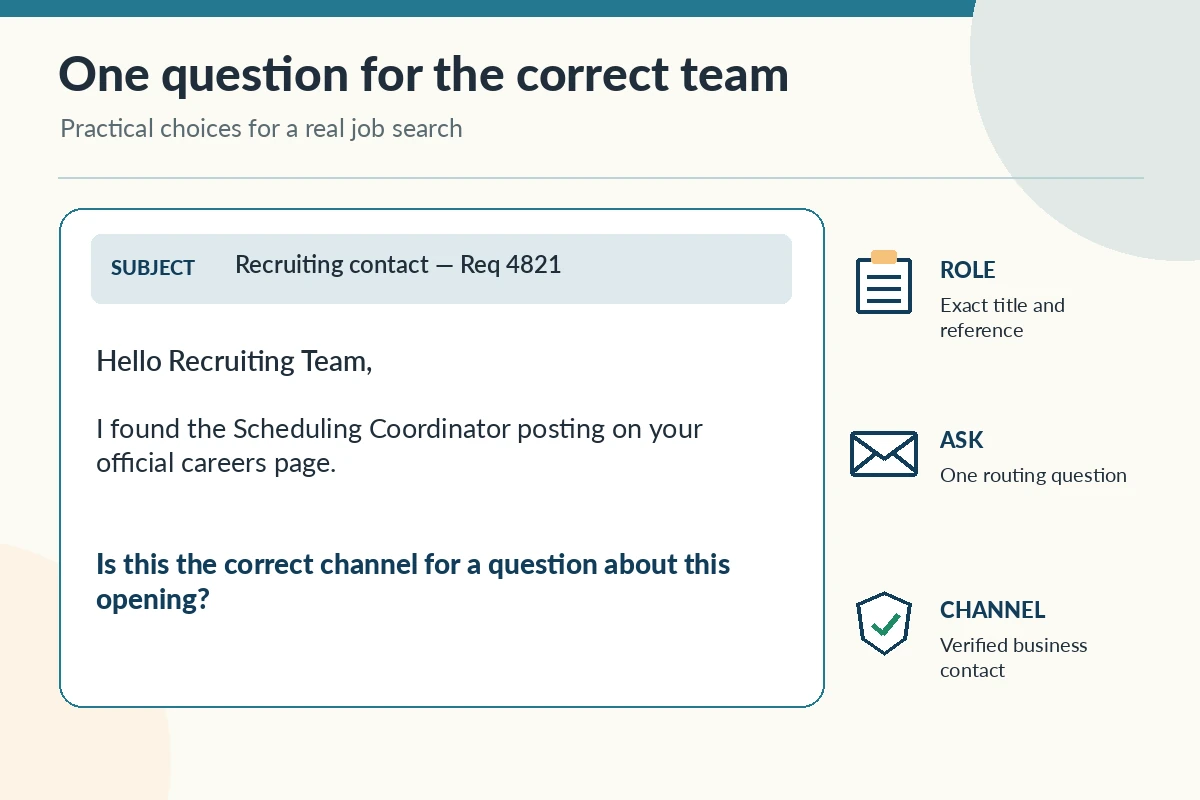
Write a focused message identifying the exact role
A hypothetical note could read: ‘Subject: Question about Scheduling Coordinator — Req 4821. Hello Recruiting Team, I found the Scheduling Coordinator opening on your careers page. My background includes maintaining shared schedules and correcting appointment records. Is the position managed through this recruiting inbox, or should questions go through the applicant portal? I plan to follow the posting’s application instructions. Thank you, Jordan Lee.’ The title, number and person are invented examples, not real vacancies or a verified company contact.
Notice what the message does: it names an identifiable opening, explains why the applicant is contacting this team, and asks one channel question. It does not claim a relationship with the manager or attach an unsolicited folder of resumes. If the purpose is simply to submit an application, do so using the listed route. A recruiter email is not a substitute for required forms, eligibility questions, assessments or documents.
Handle an absent name without inventing a shortcut
Some employers deliberately publish only their central recruiting channel. That is useful information, not a research failure. If a listed form or portal answers the question, use it. If no contact path exists and the deadline is near, complete the application rather than delaying it while hunting for an individual. You can still keep the job title and reference number in your private search tracker for an appropriate later status inquiry.
Avoid sending the same note to several staff members in hopes that one will redirect it. That can create conflicting conversations and unnecessary exposure of your application details. A public professional profile may help you understand someone’s functional role, but it does not grant permission to harvest a private address or contact their unrelated team. If you are unsure whether a recruiter is connected to the vacancy, phrase the message as a routing question and accept a referral to the standard process.
Record the reply and know when to stop
If the recruiter responds with the application link or the appropriate team, thank them and follow that instruction. If they can answer a precise question about responsibility or qualifications, save the answer with the job posting and check that it applies to your requisition, not a different opening. If they ask for a resume in a confirmed professional channel, verify the file version and review its personal data before sending. A reply does not guarantee consideration or an interview.
For silence, resist moving down a list of personal contacts. One brief follow-up may be reasonable when the employer’s process permits questions and the matter remains relevant; otherwise use the published portal. Keep applying for suitable roles elsewhere. Track the source link, initial message, response and any next step so you do not contact the same team again through another route by accident.

How We Research Recruiter Outreach Guidance
We compared career-center and recruiting-industry guidance with current FTC consumer-protection information where relevant, and wrote practical decision rules for this distinct outreach situation. Sources reviewed: Indeed recruiter-finding guidance; USC Career Center job-search guide; Harvard FAS networking email guidance; FTC advice on recruitment impersonation. People, dates, job titles and reference numbers in example messages are hypothetical and do not represent current vacancies. This content is general job-search guidance, not a legal guarantee or a promise of employer response. For commercial relationships and links see the JobAsk affiliate disclosure.
Related Job Search Guides
Check the official job description, careers contact page and applicant portal first. If a named recruiter is not provided, use the published recruiting team channel or apply through the stated system rather than guessing private contact details.
Their title alone does not establish responsibility for your vacancy. Verify a legitimate public business contact and ask about the correct channel only if the employer has not supplied one.
Usually follow the posting. If you are asking a routing question, an attachment may be unnecessary. If the employer explicitly requests an emailed resume, use the authorized address and the requested file format.
Look for the same role on the employer’s own careers site and compare details. A missing posting may mean the listing is old or the employer uses another valid route; do not assume it is still open without confirmation.
No. An outreach note should not be treated as submitted application unless the employer expressly instructs you to apply that way and confirms its process. Complete required application steps separately.