
A productive job search after graduation starts by targeting a few role families, identifying evidence from your degree or training, and testing real job requirements against that evidence. Your credential alone does not explain what work you can do. Give employers examples of methods, tools, collaboration, and decisions that you personally handled in coursework, internships, projects, or paid jobs.
Avoid two extremes: applying only to jobs labeled “graduate program” or describing every academic project as professional experience. Graduate programs can have specific windows and eligibility rules, while ordinary junior and assistant roles can also be appropriate. Read the eligibility, start date, location, prerequisites, and actual tasks. A degree opens some paths, but does not substitute for credentials or experience expressly required by an employer.
Pick role families from actual posting requirements
Choose two or three possible job titles you could explain in a sentence. A biology graduate might examine laboratory support, research coordination, or customer-facing science administration; these paths involve different responsibilities and training. An economics graduate might explore operations support, reporting, or business research. Use several postings to distinguish required tools and certifications from preferred qualifications instead of making assumptions from the degree name.
Create a simple comparison matrix: the title, employer, three recurring duties, mandatory qualifications, reasonable starting level, work location, and evidence you have. Reject jobs that require a license you lack; move unclear positions to a questions list. This prevents you from investing hours in a polished application for a role that cannot legally or operationally hire you yet.
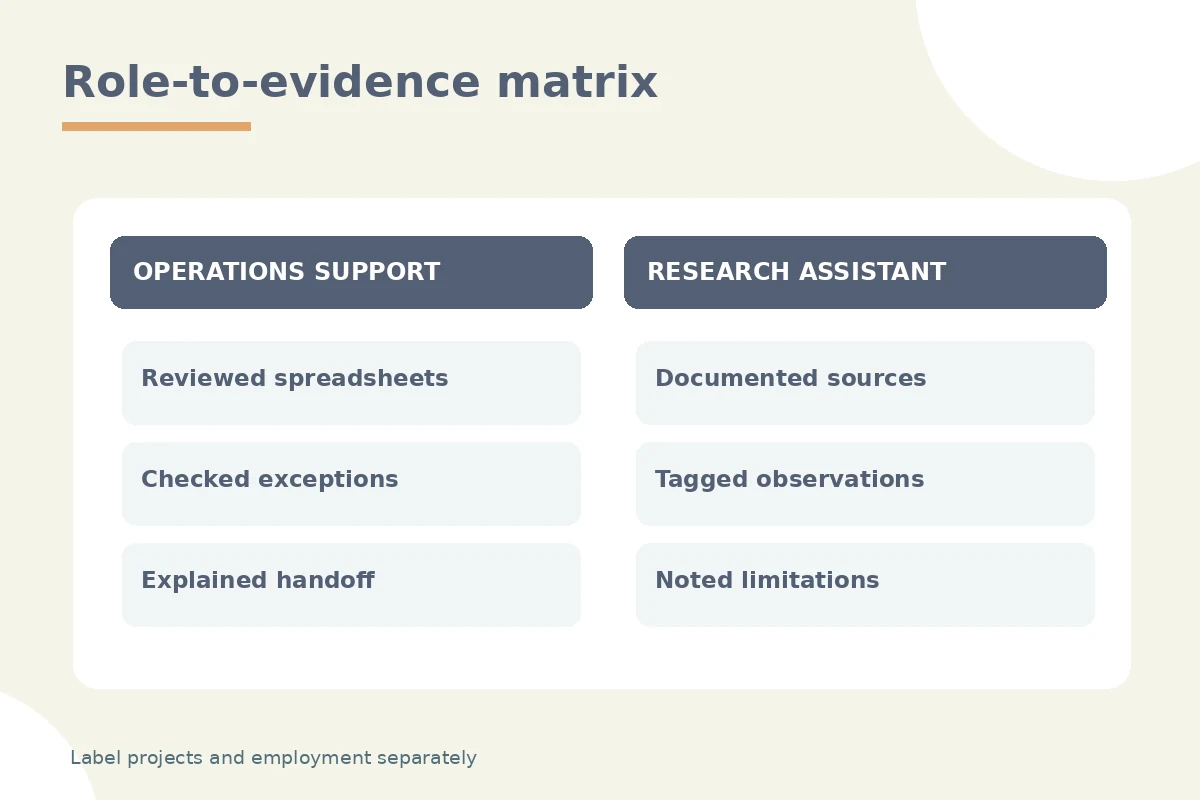
Translate a capstone into an accurate work sample
For each relevant academic project, record the question, the method, your personal tasks, the review process, and the deliverable. “Built a dashboard” can hide important differences: perhaps you cleaned a public dataset, wrote queries, checked anomalies, and presented limitations to a professor. Describe only what actually happened and state whether the work was coursework, independent practice, or paid employment.
If you want a portfolio, publish only your own content or material you have permission to share. Remove course account credentials, private client data, personal information about research participants, and nonpublic partner documents. If a sample uses synthetic data, label it as synthetic. Explain what a reader should inspect: your methodology, revision choices, and how you checked quality.

Use campus and public resources deliberately
Check your school’s alumni career services, department newsletters, employer events, and legitimate company careers pages. CareerOneStop lists Job Finder, occupational profiles, and American Job Centers; USAGov points readers toward state job banks and public libraries. Each resource serves a different purpose, so do not assume a job-board result is a hiring guarantee.
Recent graduates may be targeted by fake internships, personal-assistant offers, and jobs arriving through university-looking messages. The FTC specifically warns students about fake job ads, premature requests for money, and checks that must be forwarded to someone else. Verify the organization through its independently found official contact details before submitting sensitive documents.
Write applications that bridge school and job duties
Create a short first paragraph tied to the advertised tasks, then include one evidence-rich project or internship bullet. Mention the exact tools you used only if you could explain them in an interview. A course title is usually weaker than an example of collecting information, documenting a decision, or delivering a reviewed result. Include relevant part-time employment if it demonstrates customer service, reliability, or operations.
Illustrative example, not a claim about a real graduate: “In a semester-long operations project, I standardized a shared inventory sheet, documented exceptions, and presented the team’s findings with my assigned calculations marked clearly.” The statement is useful only if it matches your actual contribution. Do not invent performance percentages, customer names, or claims that a course project was deployed in production.
Run a graduate search sprint with checkpoints
In the first week, shortlist titles and compare a set of genuine postings. In the next, assemble a concise resume, one accurate project sample, and a small employer list. Alternate applying with genuine outreach to alumni or instructors who know your work. Record date, source, role, requirements, and next action; never treat an auto-confirmation as interview interest. Review what you learned weekly rather than repeating the same unfocused application.
If direct-entry roles remain out of reach, examine a relevant internship open to graduates, short-term contract assignment, assistant role, apprenticeship, or additional training, but check eligibility and costs first. The best bridge is one that adds specific skills or supervised experience. A vague program with an expensive promise of guaranteed placement is not a substitute for verifying what it teaches and who hires afterward.

Separate degree requirements from day-to-day work
Some graduate roles require a specific credential, while others emphasize demonstrated methods, writing, teamwork, or data handling. A job title with “analyst” does not tell you whether the employer expects independent decision-making or supervised support. Compare the actual deliverables and review structure, and resist the temptation to exaggerate proficiency just because you have used a tool in one class.
A useful interview preparation exercise is to choose one project that went imperfectly. Describe a limitation, the revision you made after feedback, and the result you can actually verify. Employers can learn more from a realistic account of your working method than from an unsupported claim that every project succeeded perfectly.
Verify the offer and protect your information
For any attractive listing, independently find the employer’s official site and confirm that the vacancy or recruiting contact is legitimate. Use a personal, accurate application and share sensitive identity or banking data only through a verified and appropriate hiring process. The Federal Trade Commission’s job-scam guidance warns about impostor recruiting, fake checks, fees, and misleading promises. No response, message, or invitation alone proves a genuine employment offer.
Use a simple four-column review: actual role requirement, evidence you have, uncertainty to resolve, and next action. Apply only when the fit is defensible; otherwise contact the employer or seek more training. Track the source and submission date. The CareerOneStop application guide recommends keeping records of the vacancies and organizations you have contacted, rather than relying on memory or automatic notices.
How We Research This Job Search Guide
We compared the stated beginner job-search task with public guidance from the U.S. Department of Labor’s CareerOneStop, relevant government resources, and role-specific material where useful. The examples above are illustrative, not real applicant histories, employer promises, verified openings, or guaranteed results. Requirements, schedules, and available services must be checked against the specific employer and location on the date you apply.
Source notes: UNCF advises graduates to select role targets, map coursework to skills, and organize an employer search. CareerOneStop offers occupational research, job search, local help, and training tools. FTC warns college applicants about forged job offers, fake checks, and payment requests. We may review or update these resources as public guidance changes. Read our affiliate disclosure; no paid endorsement or affiliate relationship is implied by these links.
Related Job Search Guides
No. Graduate programs are one option, but junior, assistant, and support roles can also fit. Compare the work and eligibility requirements for each posting.
Label it as an academic or independent project unless it was genuinely employment. Describe your individual work, review process, and verifiable deliverable.
Show specific transferable tasks and address genuine skill gaps. Do not suggest a degree qualifies you for licenses or professional duties it does not cover.
Yes, if you label the work in progress and describe completed steps accurately. Do not publish restricted university or employer information.
Compare requirements, application quality, and evidence. Ask campus career staff or an American Job Center for feedback and adjust the role shortlist.