
A florist shop can offer a beginner a practical starting route through flower processing, stocking, packaging and customer support, even before that person can design complex arrangements. Full floral designer roles can still expect a diploma or equivalent and supervised training. Compare the specific tasks, delivery deadlines and plant-care procedures rather than assuming a love of flowers is a complete qualification. This guide concerns U.S. job searches; local rules and employer requirements must be checked for the exact position.
Start With Flower-Shop Support Rather Than a Designer Title
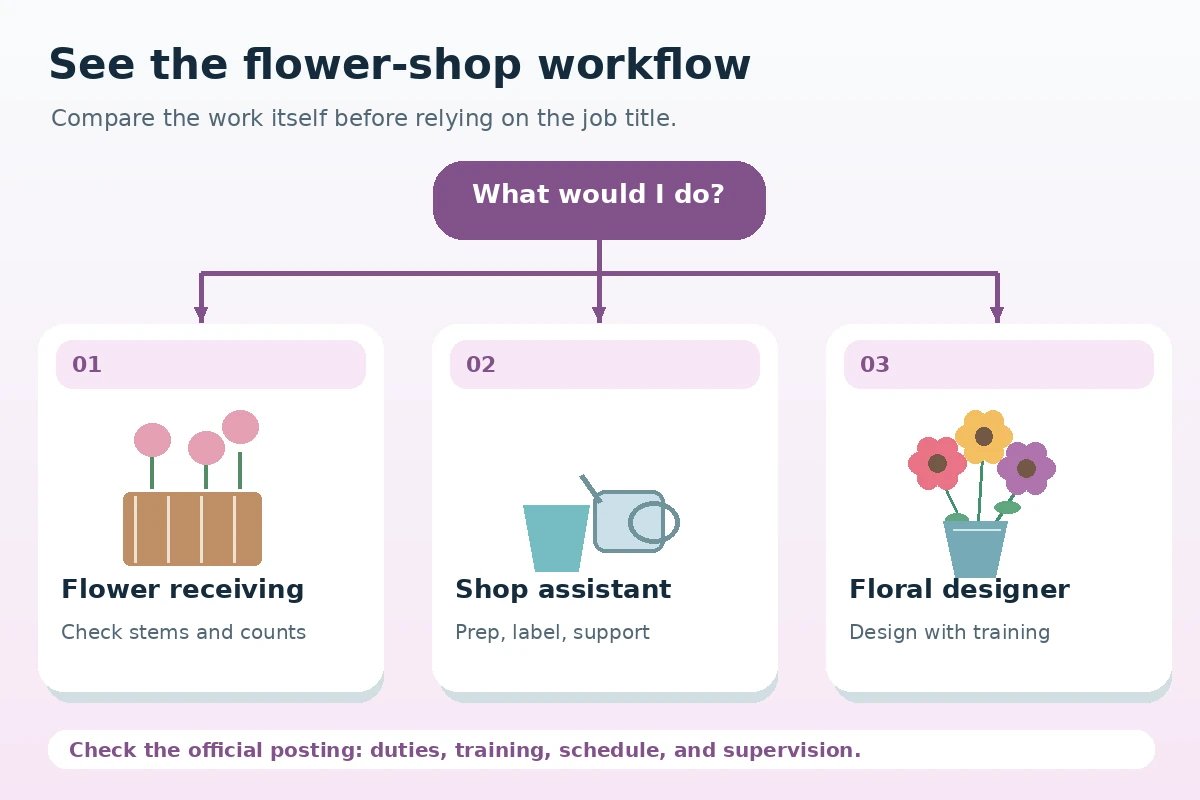
Look for floral assistant, flower shop assistant, stock support, order preparation or seasonal shop help rather than assuming every florist advertisement is an entry-level design position. Experienced designers choose materials, proportions and arrangements for customer requests; assistants may receive deliveries, remove damaged stems, clean buckets, maintain displays and assemble packaging according to instructions. The BLS profile describes floral design as a role commonly learned with hands-on practice over months, so employers can reasonably distinguish supervised tasks from independent creative work.
Read whether the opening is at an independent shop, grocery floral department or event service. A grocery department might emphasize stocking and customer questions, while an event studio may emphasize packing, setup, deadlines and safe transport. Ask who checks custom orders, whether beginners use cutting tools or ladders, and what training precedes independent arrangements. These are distinct jobs despite sharing “florist” in the title. Choose based on the work you can accurately describe and perform.
Learn the Order Flow and Why Details Matter
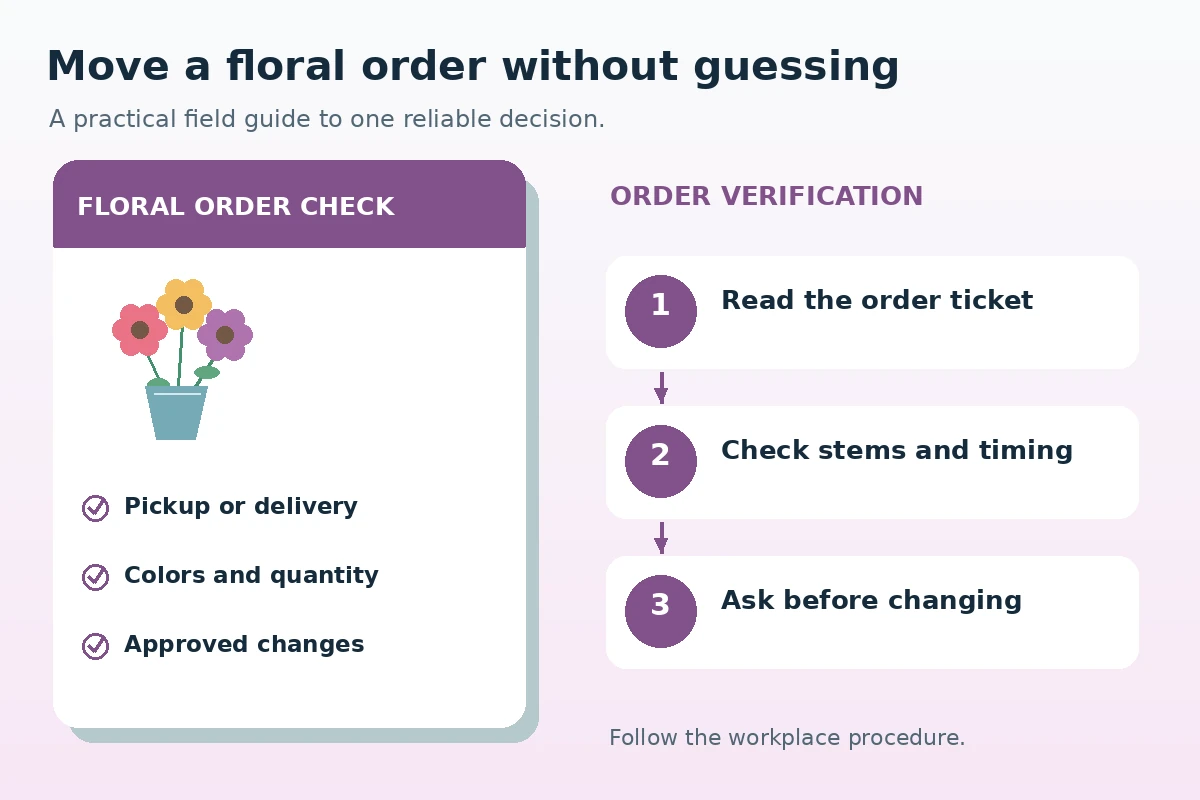
Flowers arrive with product names, quantities and condition to verify. They may need handling, trimming and water or storage steps determined by the shop. Orders have dates, recipients, delivery methods and design instructions that should not be guessed. The goal is not just a pretty display; it is the correct item for the correct person at the promised time. Write the work sequence: receive, check, prepare, label, confirm and hand off. If a flower is unavailable, a beginner should not promise a substitution without the shop’s approval.
A hypothetical shop assistant receives an order tagged for afternoon pickup and notices the color description differs from the available stems. The responsible action is to flag the mismatch for the designer or order lead and wait for an approved change. Avoid changing the order yourself or assuring the customer without authorization. This small example demonstrates how inventory control, customer service and creativity meet in an actual shop workflow.
Show Transferable Evidence of Care and Accuracy
You do not need to claim past floral employment to demonstrate relevant habits. Examples could come from keeping a school garden schedule, accurately checking event supplies, using a point-of-sale system in another retail job or packaging fragile items for a volunteer drive. Describe the real setting and your personal tasks. “Recorded incoming donations by type and checked labels with a coordinator” may show order accuracy, but only include it if it happened. A photo of a bouquet you made for yourself should be identified as a personal project, not commissioned client work.
If you create a small practice arrangement, document what you selected, what instructions or source you followed, what you learned and whether it was a hypothetical practice item. Ask before photographing employer materials or customer orders: privacy and ownership rules may apply. You can demonstrate willingness to learn design principles without pretending to understand perishable stock rotation, approved substitutions or event-scale installations. Honest examples give an interviewer more useful information than calling yourself “naturally artistic.”
Check Seasonal Peaks and Shift Expectations
Retail floristry can involve intense work around specific holidays, weddings and events. Ask whether the job is permanent, part-time, weekend, on-call or a defined seasonal assignment. Confirm when deliveries arrive, whether early setup or late cleanup is required and how customer pickup rushes are covered. A short event assignment may offer useful experience but not guarantee continuing hours. Check transport requirements if the job involves taking arrangements to another site.
During an interview, ask how staff track orders on busy days, who handles disappointed customers and what happens when a requested flower is not available. Look for a defined method rather than a blanket promise to “make it work.” If you are comfortable with customers but not detailed stem preparation, start with support duties where someone trains the handling procedure. If the role includes tool use or lifting, ask for the appropriate instruction and equipment instead of assuming floral work is physically effortless.

Find Legitimate Openings and Clarify Design Supervision
Use the official pages of nearby flower shops, grocery chains and established event-floral businesses, plus verified hiring notices. Compare the exact role title, location, order volume or busy periods mentioned, and whether a portfolio is requested. A beginner assistant role may not require the same work samples as a lead designer vacancy. Record what the employer says about training and whether designs are checked before delivery. Avoid sending a generic mass application that ignores the shop’s specialty.
Independently verify the company contact information. FTC guidance recommends skepticism about unsolicited recruiting messages that ask for money. No reputable training deposit or “starter kit” claim should be accepted simply because it appears in a message. If a seller and hiring manager are different parties, confirm which organization actually employs and pays staff. A real opportunity should have a clear hiring channel and work expectations.
Turn the Application Into a Specific First-Week Plan
Write a brief resume highlighting organization, customer questions, careful packaging, inventory or artistic projects where genuinely relevant. For the interview, prepare a short story about recognizing a mismatch and communicating it to the right person. Ask what beginning employees should master: cleaning buckets, reading order tickets, prepping safe materials, or greeting customers. You are showing that you understand the work and your limits, not promising professional arrangements on the first day.
Before accepting, confirm shift times, whether training is paid, who handles approved substitutions, and which tools are assigned to beginners. OSHA worker guidance supports asking about appropriate safety training. A promising entry path allows steady practice, precise orders, and feedback from a qualified florist. Choose roles that build the experience you actually want while respecting customer orders and real workplace procedures.
How We Research Entry-Level Work and Verify Claims
We compared publicly available occupational and safety guidance with the search intent on October 27, 2026. The examples are explicitly hypothetical, not open vacancies, employer promises, or first-person hiring reports. Entry requirements and work arrangements must be verified with each organization. The public web cannot confirm unpublished WordPress content or the availability of a private database slug.
Source: www.bls.gov. BLS describes floral designers, flower-shop settings, education and hands-on training, and flower handling duties.
Source: www.osha.gov. OSHA explains the right to safety training and safe work procedures when workplace hazards are present.
Source: consumer.ftc.gov. FTC warns job seekers about unexpected recruiting messages and payments demanded to secure a job.
We have not verified any commercial relationship with these sources, and the links are informational. Review JobAsk’s affiliate disclosure for the site policy. No job placement, employer approval, or hiring outcome is guaranteed.
Related Job Search Guides
- Factory Jobs With No Experience: Assembly, Packing, and Safe Training
- Jobs With Animals and No Experience: Kennel and Shelter Entry Routes
- Overnight Jobs With No Experience: Choose a Shift You Can Sustain
- Entry-Level IT Jobs Without Experience: Start With Support Skills You Can Show
- Library Jobs With No Experience: Start With Assistant Roles
Some assistant and support positions teach tasks at work. Designer openings may still ask for relevant preparation, so compare individual requirements.
Not always. A shop may prioritize stock handling and service, while design-focused openings may request samples. Label personal projects honestly.
It depends on the shop. Reading tickets, verifying deliveries, maintaining tidy work areas and following approved flower handling are plausible starting responsibilities.
Do not promise a substitution without the employer’s authorization and an appropriate customer approval process.
Some are seasonal or temporary. Confirm contract period and expected hours rather than assuming a longer role.