
Overnight jobs with no experience can appear in stocking, hospitality support, cleaning and other around-the-clock services. The critical decision is not simply whether the listing says “nights.” You need the exact schedule, expected duties, training coverage, safe transportation and a realistic daytime sleep plan. A night job that looks easy to obtain may be hard to sustain if the shift conflicts with those essentials. This guide concerns U.S. job searches; local rules and employer requirements must be checked for the exact position.
Define the Shift Window Before Searching Job Titles
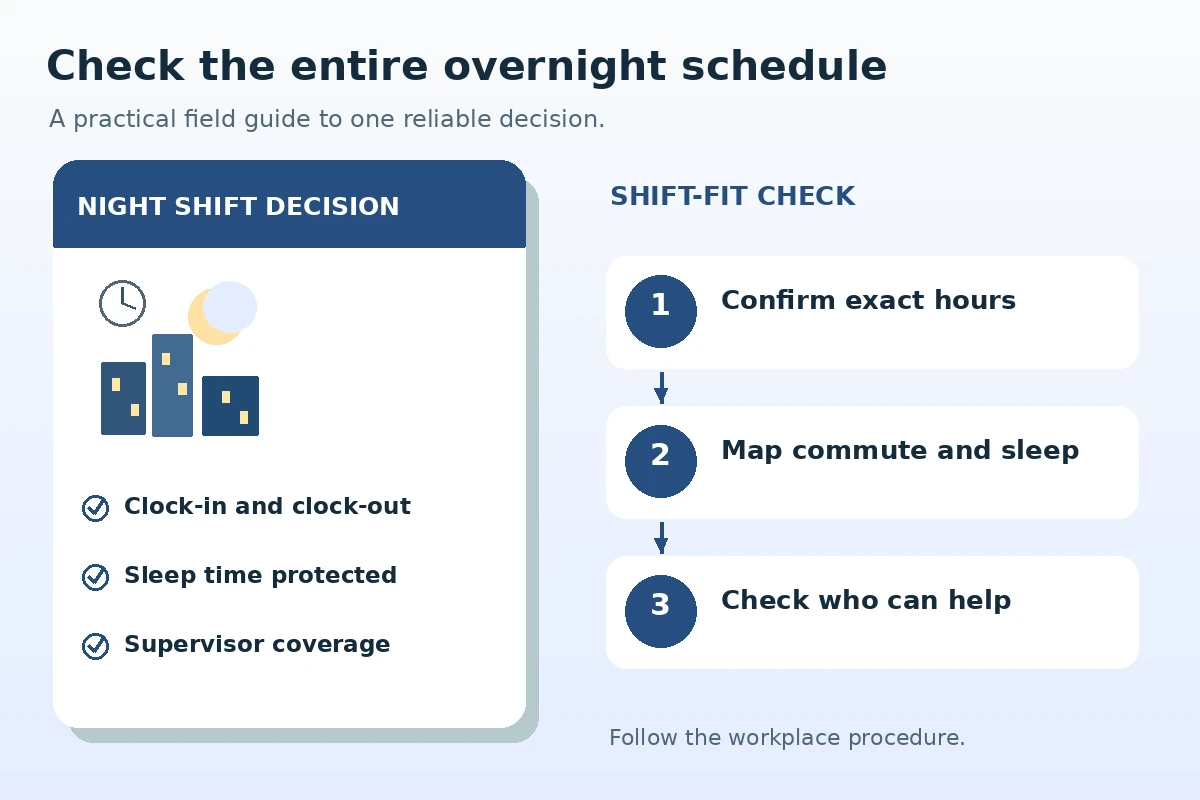
“Overnight” may refer to a fixed graveyard shift, a late-evening shift crossing midnight or a rotating schedule that changes from week to week. These arrangements affect transport, rest and family responsibilities differently. Write the times you can really work, including commuting both ways. Decide whether you are available for weekends and holidays and how much transition time you need before daytime obligations. A listing that says “night shift” without clock times needs a direct clarification.
Make a shift card with start time, end time, frequency, break rules and the schedule used during training. If it is rotating, ask how often it changes and how much notice staff receive. For example, a hypothetical 10 p.m.–6 a.m. vacancy may appear workable until you add travel home, meals and uninterrupted daytime sleep. Those hours are illustrative, not a posted vacancy. You can avoid wasted applications by screening the time window before comparing job duties or wages.
Compare Night Roles by Work and Supervision
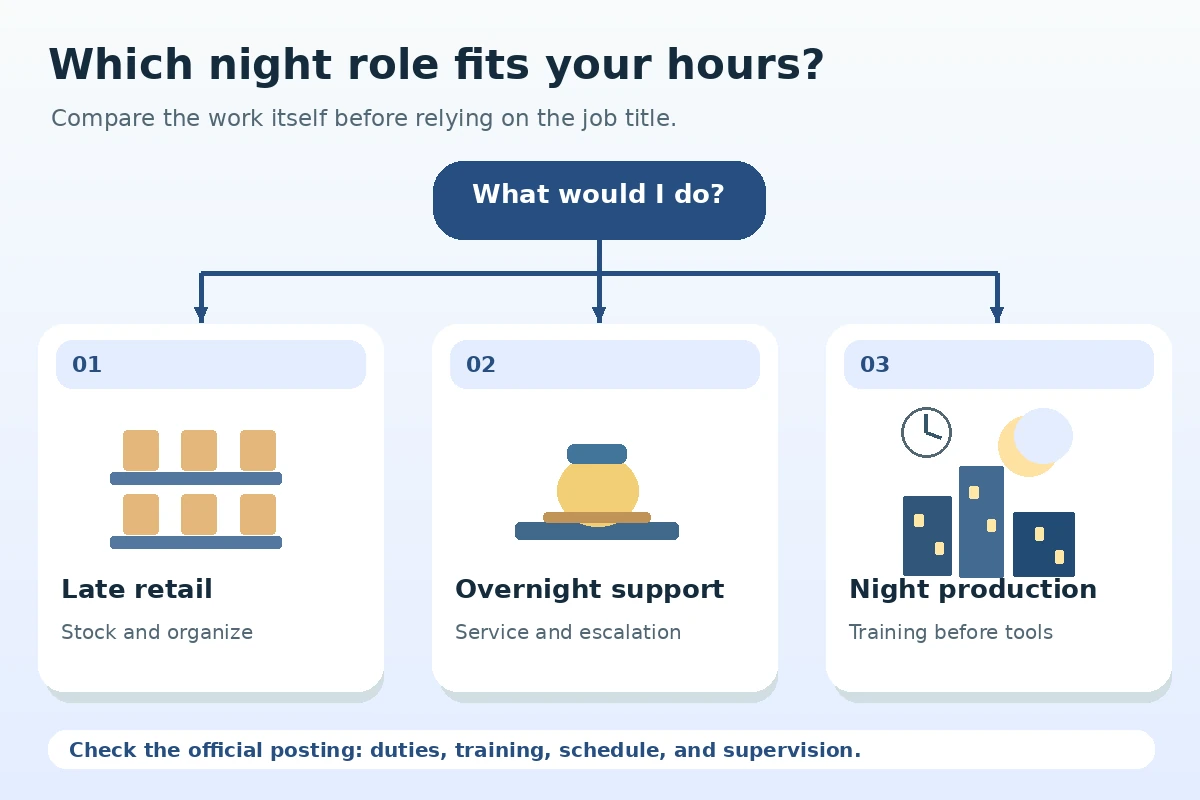
Potential entry paths include retail restocking, some cleaning assignments, lodging support, production packing and service operations with extended hours. They differ sharply. Overnight stocking may involve lifting and location-specific equipment; hotel support may involve guest requests and a small team; production may require machine training; cleaning work can involve chemicals and isolated areas. Do not treat a list of job titles as proof there are currently open vacancies or that each role accepts beginners.
Review an actual posting for tasks, physical conditions, required prior experience, credentials and staff coverage. Ask what a novice does if a supervisor is not onsite and which duties require specific training or authorization. A vague “work independently overnight” statement deserves follow-up if your role might encounter machinery, unsafe premises or urgent customer situations. A supportive night environment provides a clear route for help, not just a phone number printed in an onboarding packet.
Treat Sleep and Commuting as Work Requirements
NIOSH describes how shift work can affect sleep, alertness and safety. It also notes that repeatedly switching sleep schedules can create strain. This does not prove night work is inappropriate for everyone, but it means sleep should be planned rather than left to chance. Map the hours after your shift when you could reliably rest, and consider daytime noise, light and household expectations. If you already struggle with a schedule, seek individualized medical guidance rather than relying on a universal tip.
The NIOSH shift-work guidance discusses keeping some consistent sleep time across work and rest days. Consider your own constraints before changing routines. Also test transit availability and the safety of the route home at the actual finish time; a train running at 6 p.m. may not run at 6 a.m. If you expect to drive while very tired, that is a real safety problem, not evidence you lack motivation.
Identify Training and Emergency Coverage at Night
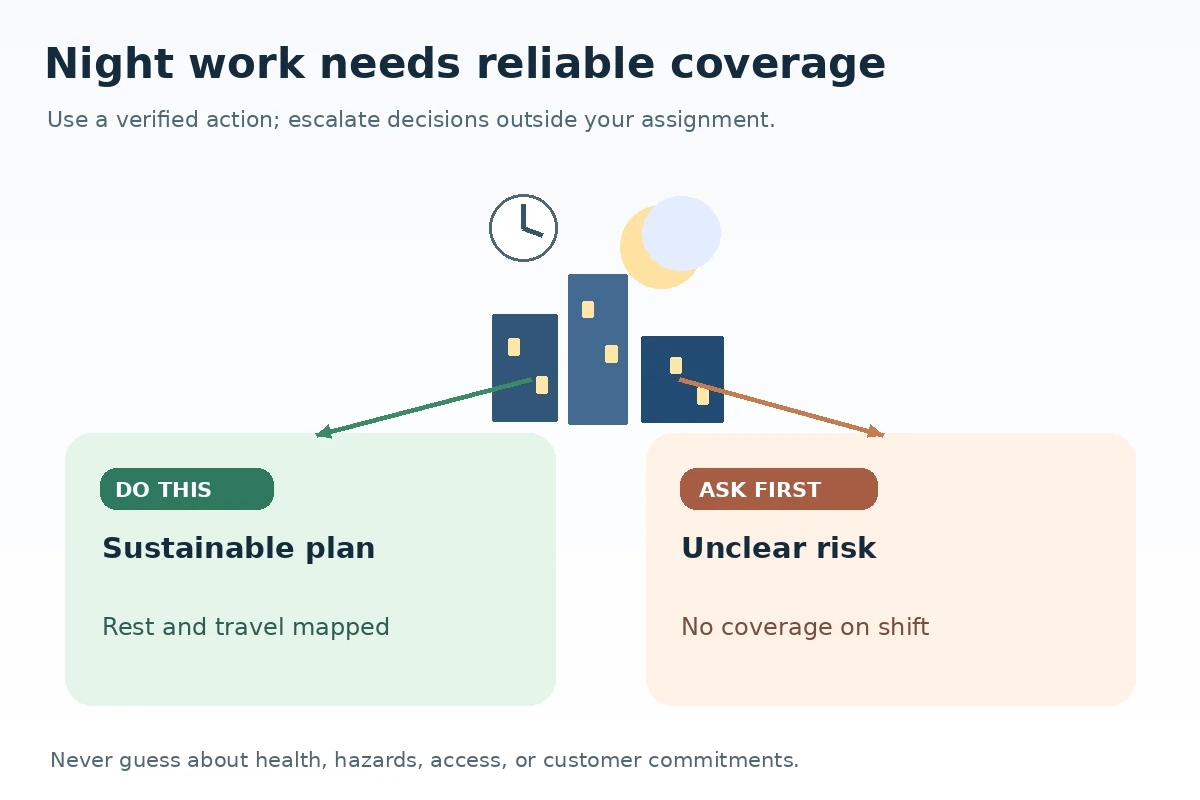
An employer may train new staff during the day and later move them to nights. Confirm both schedules before accepting. Ask who handles equipment problems, customer incidents, injuries, security concerns and building access. If tasks require safety-specific procedures, obtain the required instruction rather than adapting from a coworker’s shortcut. In an isolated workplace, know how to reach help and what to do if communication fails. A night shift should not turn a beginner into the default emergency decision-maker.
Use a two-part screening question: “What tasks can a new hire complete independently after training?” and “Who is the escalation contact during my exact hours?” A strong reply names a training process and coverage route. A weak reply is “you’ll figure it out.” If the role involves restricted access, hazardous materials or regulated functions, check actual requirements. Safety procedures and employer policy take precedence over a general blog guide.
Show Evidence That Transfers to Late Hours
Focus on reliability, accurate records, calm communication and following routines. An applicant might have volunteer event closeout or evening class duties, but should not claim paid overnight experience without it. A hypothetical honest example: “Closed the community event sign-in area, verified the supply checklist, and reported missing items to the coordinator.” It does not mean the applicant has worked with machinery or handled emergencies. Adapt it only if a comparable action is part of your true history.
Write one resume bullet showing a specific task and one interview answer describing how you respond when instructions are unclear. Avoid phrases like “I can work nonstop” or “I never get tired.” Employers benefit from workers who notice fatigue, understand break procedures and communicate problems. State exact scheduling availability; promising all night and all weekend shifts is unhelpful if you are responsible for daytime commitments that leave little opportunity to sleep.
Verify Listings and Make a Sustainable Decision
Compare two real listings using a simple sheet: exact shift, entry requirements, key duties, physical demands, supervisor availability, location, transport and unresolved questions. Source the positions through official employer pages where possible. FTC guidance cautions against unsolicited job texts that seek payment; no “overnight premium” should distract from checking legitimacy. Do not rely on an unverified recruiter to establish the workplace or hiring process.
Before accepting an offer, confirm in writing the schedule or scheduling method, worksite, orientation times and who approves changes. If the role has rotating nights, calculate what that means for your recovery days and other obligations. Pick the opportunity that meets your real constraints and has a safe training structure, not the one with the most exciting schedule description. You can reconsider later, but a sensible first night shift starts with accurate information.
How We Research Entry-Level Work and Verify Claims
We compared publicly available occupational and safety guidance with the search intent on October 27, 2026. The examples are explicitly hypothetical, not open vacancies, employer promises, or first-person hiring reports. Entry requirements and work arrangements must be verified with each organization. The public web cannot confirm unpublished WordPress content or the availability of a private database slug.
Source: www.cdc.gov. NIOSH describes how shifting between night and day sleeping patterns can disrupt rest and recommends considering consistent sleep timing.
Source: www.cdc.gov. NIOSH explains the fatigue and safety risks associated with night and long work hours.
Source: www.bls.gov. BLS confirms varied evening and late-hour schedules in some accessible service roles.
Source: consumer.ftc.gov. FTC guidance helps applicants evaluate unsolicited job offers and avoid payment scams.
We have not verified any commercial relationship with these sources, and the links are informational. Review JobAsk’s affiliate disclosure for the site policy. No job placement, employer approval, or hiring outcome is guaranteed.
Related Job Search Guides
- Florist Jobs With No Experience: Shop Assistant and Flower-Care Skills
- Factory Jobs With No Experience: Assembly, Packing, and Safe Training
- Jobs With Animals and No Experience: Kennel and Shelter Entry Routes
- Hotel Jobs With No Experience: Choose Front Desk or Housekeeping
- Overnight Work-From-Home Jobs: Compare Shifts and Coverage Rules
Some stocking, cleaning, hospitality support and production support positions do, but every actual posting has its own requirements and supervision needs.
No. Overnight describes time of day; a rotating schedule changes between shift windows. Confirm the exact pattern.
There is no one-size-fits-all answer. NIOSH warns that frequent switches can disrupt rest; seek a sustainable routine appropriate to your circumstances.
Ask what tasks are authorized, how to contact qualified support and what happens during emergencies or equipment problems.
Use independently verified employer career pages and never pay to obtain a job or unlock alleged wages.