
Quick answer: Put GPA in your resume’s Education section if the employer asks for it or if it meaningfully strengthens a student or recent-graduate application. Check your official academic record first. Write “Cumulative GPA” when you mean overall GPA and “Major GPA” when you mean grades calculated for your major; never switch the labels. Include the actual grading scale when useful, and do not invent or silently round up a score. For most experienced applicants, GPA is optional unless the posting requires it.
Read the Posting Before Choosing to Include GPA
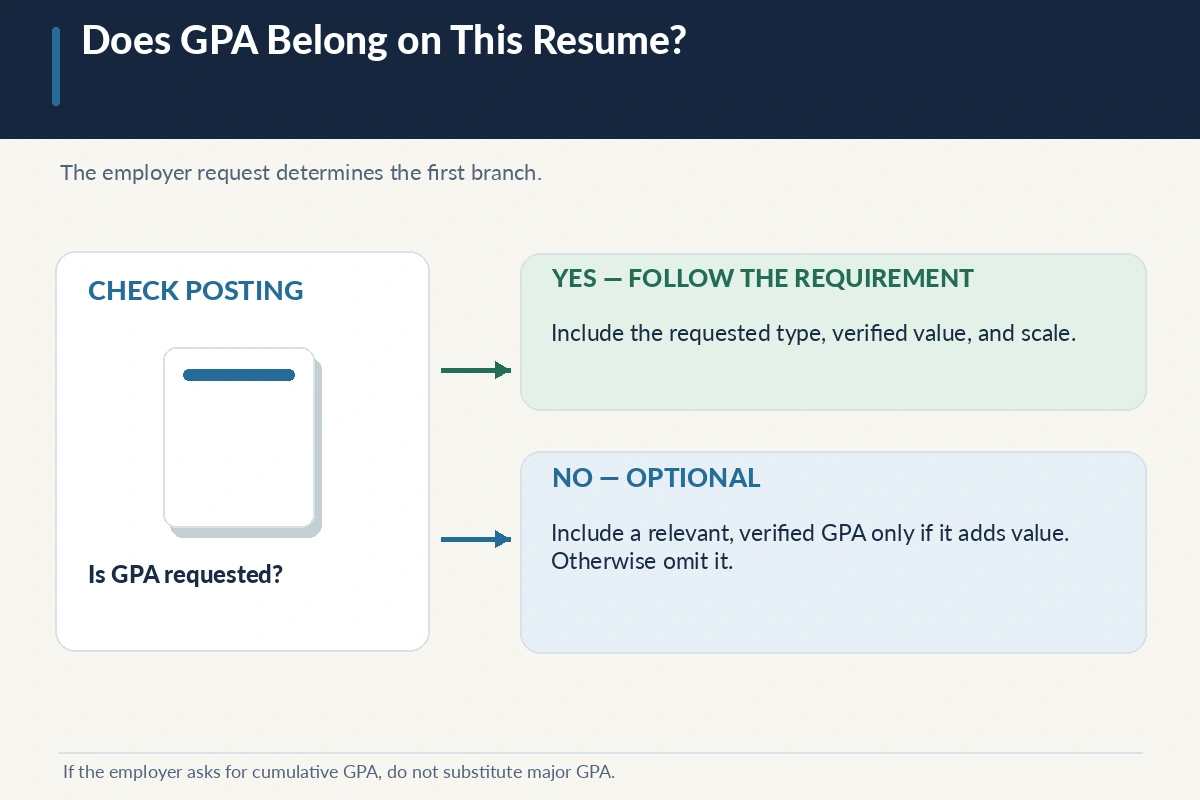
Some internships, graduate-entry programs, and early-career roles request GPA; others judge applicants mainly on coursework, projects, professional experience, and relevant skills. If the job posting specifically requires a cumulative GPA, do not replace it with a higher major GPA. Follow the employer’s requested calculation, date, and format. If GPA is only optional, decide whether it supplies meaningful evidence for this opportunity instead of treating it as a permanent resume field.
Washington University in St. Louis explains that a candidate may list cumulative, major, or science GPA depending on goals and employer requirements. The important distinction is the type of number shown. A strong GPA can be useful when you have limited work experience; later in a career, job achievements may deserve that space more. No single GPA cutoff applies to every employer, academic field, or hiring program.
Verify the Number Against an Academic Record
Find the GPA reported by your university’s official transcript, student portal, or registrar guidance. Check whether the score covers your full undergraduate program, a semester, a major, a graduate program, or a defined set of courses. Copy the number and scale carefully. An old screenshot might be out of date after new grades post; update your resume only when you have the current record. If the portal provides an official rounded value, prefer that value.
Do not reverse-engineer a “better” average by dropping a difficult class unless the school’s documented calculation permits it. A 4.0 scale is common in US resume examples but is not universal. If your program uses another denominator, explain the real scale rather than converting it unofficially and presenting the result as the registrar’s number. For an employer’s required online GPA field, follow that specific form’s conversion instructions or seek clarification.

Label Cumulative, Major, and Science GPA Separately
Cumulative GPA generally covers coursework counted by the institution toward its overall average. Major GPA usually refers to courses in a major under the school’s defined rules, while science GPA may follow a different professional or institutional calculation. These are not synonyms. Use the exact available definition from your institution or program, and label the type explicitly when the distinction matters. A recruiter should not need to guess which courses were included.
An illustrative Education line might read “Major GPA: 3.46/4.00,” but that number is entirely hypothetical. It would be misleading to replace the prefix with “GPA” if a reader would reasonably assume a cumulative GPA. When a posting asks for both cumulative and major GPAs, enter both separately if you can verify them. Do not manufacture a major GPA when your institution never calculates one without first confirming an acceptable method.
Use a Readable Education Entry With the Scale
Place the GPA near the degree and graduation date so the number has context. A compact hypothetical model is: “Bachelor of Science, Biology — Expected May 2028” followed by “Cumulative GPA: 3.42/4.00.” Both the degree and the number here are made-up illustrations, not a real student’s record. Replace every sample field with your own accurate information. UConn’s published resume examples likewise show the GPA and its denominator in the Education section.
Keep formatting consistent: write “3.42/4.00” or a similarly clear scale rather than an unlabeled “3.42.” If the school reports grades to one decimal place, do not manufacture hundredths for presentation. If you include education from two institutions, attach each GPA only to the institution and coursework it covers. A transferred student’s GPA is not automatically the same as a combined GPA across both schools.

Check Rounding Rules and Avoid Cosmetic Inflation
Rounding can change the impression of a score. Never turn a 3.49 into a 3.5 simply because a posting mentions a minimum of 3.5 without checking the school’s official reporting and the employer’s stated precision rules. Where an official transcript shows two decimal places, copying them exactly is usually the clearest choice. If a form asks for a different precision, read its instructions and calculate only in the permitted way.
If the employer asks for a document confirming GPA, provide the genuine transcript through the specified channel instead of altering a PDF. Do not hide a required cumulative GPA by substituting an unofficial higher average. A requirement is a requirement even when the number works against you; present any other relevant academic achievements separately and truthfully. If you are unsure whether a borderline number meets a threshold, ask the authorized recruiting contact rather than assuming.
Decide When to Remove GPA From Later Resumes
As you accumulate relevant jobs, projects, and credentials, the strongest evidence may move from academic performance to demonstrated work. University career centers describe GPA as optional in many standard resume layouts. There is no universal graduation anniversary after which it becomes forbidden or obligatory to remove it. You can retain a verified GPA when the employer or a particular program asks for it, regardless of years since graduation.
Compare the top half of your resume with the job posting. If the hiring decision depends on a degree, a research method, or a specialized course, academic evidence can still matter. If a verified project or role offers more direct proof, use the space for that instead. Do not bury required GPA below unrelated details just because a generic template suggests GPA should disappear after a set number of months.
Audit Every Application Field for the Same GPA
Before submitting, compare the resume’s Education entry with any online application fields. Check the type label, decimal precision, denominator, institution, degree, and graduation status. If a portal asks for “overall GPA,” do not input your major average; if it asks for “most recent GPA,” determine what period it defines. Read the posting and form together instead of applying one standard to every employer. Save a copy of the documents you actually submitted.
If your newest grades are still pending, use the latest officially available record rather than predicting a future average. If a required calculation is ambiguous for transfer credits, pass/fail classes, graduate study, or a non-US grading system, ask your registrar or the legitimate employer before guessing. An accurate, clearly labeled academic record builds more trust than a selectively presented number with unclear origins.
How We Research and Verify This Advice
How We Research: We consulted WashU career guidance, UConn resume formatting, UConn Education examples on October 28, 2026, and screened the transferred JobAsk topic index for overlapping content. The specific examples are hypothetical, not actual applicants, institutions, employer results, or verified work histories. Guidance is based on the cited university or government resources; particular employer application instructions may be different, and unpublished WordPress drafts cannot be fully checked from public search alone. The materials do not guarantee hiring or offer paid placement. Read our affiliate disclosure.
More Resume and Cover Letter Guides
- Double Major on a Resume: Distinguish One Degree From Two Degrees
- Resume Education Section: List Degrees, Training and Incomplete Study
- High School Student Resume Format: Turn Activities Into Job Evidence
- Expected Graduation Date on a Resume: Clear Formats for Students
- College Student Resume Layout: Order Education, Projects, and Work
Usually in the Education section beside the institution, degree, and graduation information, if the posting asks for it or it strengthens the application.
When GPA is optional, you may list an honestly calculated and clearly labeled Major GPA. If a posting requires cumulative GPA, follow that requirement instead.
Do not cosmetically round to meet a threshold. Use the officially reported precision or the employer’s explicit rounding rules.
Not generally. GPA is often optional, but a specific role or program can still require it.
Show the actual scale or follow the official conversion instructions provided by the employer. Do not invent an equivalent GPA.