
A good answer to “What is your greatest achievement?” chooses something real and explains the problem, your individual contribution, and the outcome you can support. Your proudest moment does not need a famous employer or a dramatic numerical improvement. It needs to show how you approach work that matters for the job you are seeking, while giving proper credit to teammates and avoiding invented results.
Penn Career Services recommends tracking accomplishments so you can retrieve evidence for interviews. Its behavioral interview guidance also stresses specific situations, personal contribution, and outcomes. This article focuses on a scope-of-credit worksheet: what the whole group did, which actions were yours, and what you genuinely know happened.
Choose an Achievement That Fits the Question
Look for a completed task where your decisions or actions made a useful difference. It may be solving a recurring documentation problem, delivering a class project after a setback, organizing an accessible event, or helping a team meet a defined obligation. Relevance can matter more than scale. If a job requires detailed records, a verified record-handling achievement may be more informative than a large but unrelated personal milestone.
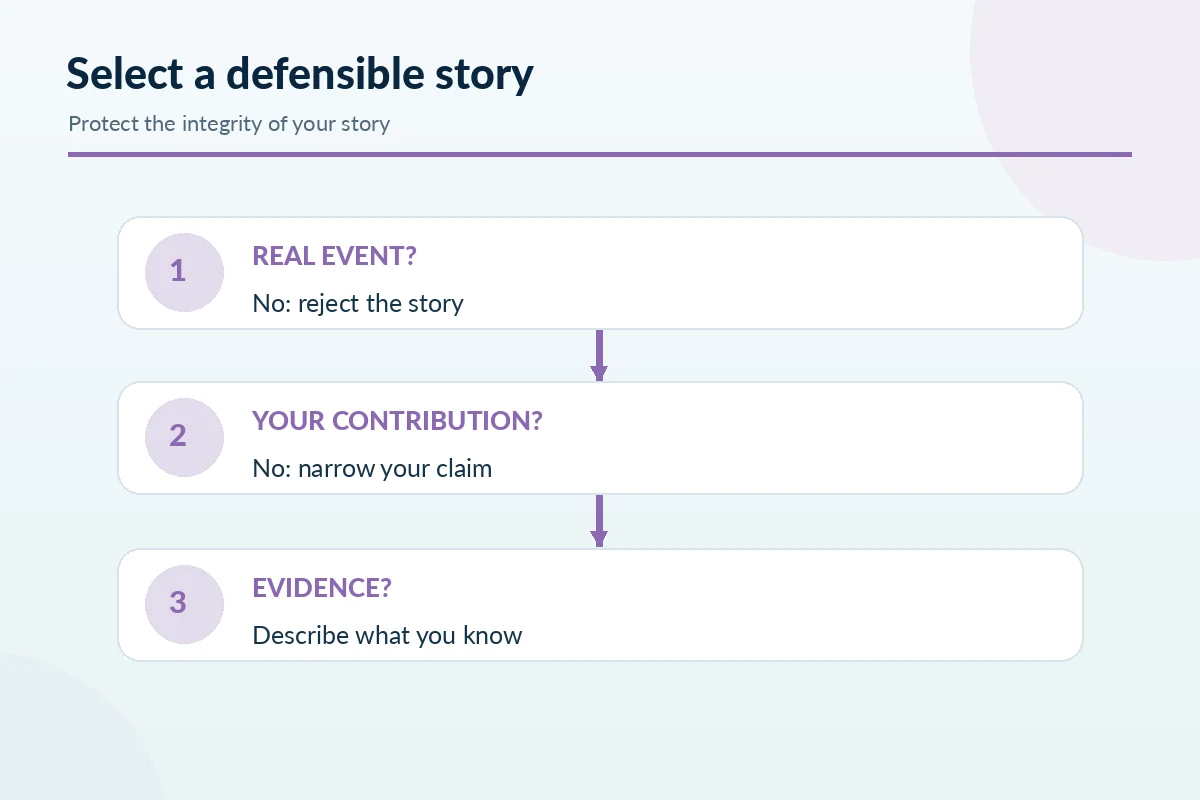
Create a shortlist of three real events. For each, note why it mattered, who was involved, and what you directly did. If you cannot separate your own responsibilities from those of others, choose another story or clarify the limits. A team outcome belongs to the team unless you can establish which part you owned. Honesty about collaboration does not diminish the value of your work.
Separate Team Results From Personal Actions
A project may have succeeded because several people planned, checked, approved, and implemented different pieces. Do not say “I designed and launched the full process” if you only prepared the worksheet. Instead, say “I prepared the worksheet that our team used to reconcile the items before the review.” This identifies a tangible contribution without seizing credit for approvals or final decisions.
A reader can strengthen a narrative by using active verbs that describe true scope: drafted, tested, coordinated, documented, compared, escalated, or checked. Do not use led, supervised, authorized, or approved unless you really had that responsibility. Interviewers may ask who made decisions, whether other people reviewed your work, and how you know the result.

Describe the Situation Without Overselling It
Provide enough context to explain why a decision was necessary. Were records inconsistent? Was an event roster incomplete? Was a software feature poorly documented for beginners? Identify the challenge in ordinary words, then move quickly to what you did. Long background stories can obscure the actual accomplishment and encourage irrelevant claims.
A hypothetical candidate for an operations assistant role could say: “In a student-run donation drive, our intake list contained several items without matching locations. I compared the sign-in sheets with stored boxes and prepared an exception list for the volunteer coordinator to review. We then had a clearer list of unresolved items.” This is hypothetical; do not copy its outcome into a real application unless it happened to you.
Use Results You Can Actually Verify
Numbers are useful when they come from a known source, but invented precision is worse than a useful qualitative outcome. If you measured hours saved, explain the method, the period, and your degree of contribution. If you only know that a document was accepted for the next step, say that. “The team used my checklist to continue the review” is more defensible than “efficiency improved by 47%” without underlying data.
Possible evidence includes a completed deliverable, a documented handoff, written feedback, a corrected record, or a clearly described decision. Even then, avoid suggesting that one action produced every later result. A reviewer approving your work does not by itself prove improved revenue, retention, customer satisfaction, or a hiring outcome. Use appropriately limited language such as “helped clarify” when the causal impact is uncertain.
Explain What Makes the Achievement Meaningful
The interviewer may be evaluating judgment, perseverance, care for quality, or the ability to finish work. State why the moment matters to you. Perhaps you made a complex process understandable, took responsibility for a missed step, or learned to consult the right person. Avoid declaring that the achievement changed an industry or made you uniquely qualified. Show the reader what you value through actions.
For applicants without employment history, a school or community story is valid when properly labeled. An engineering course prototype is not a commercial production launch. A student event is not a managed corporate conference. State the real setting and what was tested or delivered. As Harvard’s interview resource recommends, connect the example to qualifications for the role instead of treating the interview as a trophy display.
Prepare for Questions About Credit and Evidence
Expect follow-ups such as “Who else worked on this?”, “How was success measured?”, and “What would you do differently?” A convincing answer survives those questions without revised numbers or expanded authority. It is acceptable to say you do not know the effect of your task after it was handed off. You can still explain why your work was necessary and how you verified your own part.
Confidential or sensitive projects need care. Describe the nature of the work without sharing personal client details, private employee information, proprietary methods, or restricted files. If a project cannot be explained responsibly, choose a different achievement. A simpler public or academic example may be both more credible and easier to discuss.

Practice a Short Credit-Aware Story
Write four lines: challenge, team context, personal actions, supported outcome. Read the story aloud and underline every first-person statement. Check that every “I” describes a task you carried out. Then underline each numerical or causal claim and note how you could substantiate it. If you cannot explain the source, revise the language rather than inventing documentation.
You can adapt the same real event for a question about initiative, accuracy, or problem solving, but emphasize only the dimension relevant to the prompt. Keep the core facts unchanged across versions. A strong interview response is not a performance of perfect metrics; it is a clear account of what you did, learned, and can bring to this position.
How We Research and Verify These Examples
This guide synthesizes Penn’s accomplishment-record advice, its behavioral question guidance, and Harvard’s interview preparation recommendations. The scope-of-credit worksheet and diagrams are original editorial tools, not results of a controlled hiring study. Every personal story is hypothetical. Review the affiliate disclosure.
Related Guides
- What Are Your Greatest Strengths? Prove Them in an Interview
- What Is Your Greatest Weakness? Give an Honest Interview Answer
- Research Experience on a Resume: Show Your Actual Contribution
- Teamwork Interview Answer: Show Your Part in a Shared Result
- Constructive Feedback Interview Answer: Explain What You Changed
No. It may come from coursework, volunteering, a project, or paid employment. Label its setting truthfully and make the link to the role clear.
Only when the underlying data is available and you can explain its scope. Do not invent percentages to make a story sound stronger.
Yes, as long as you separate what the team accomplished from the part you personally carried out or influenced.
A modest, relevant achievement can work when the problem, your action, and credible result are clear. Scale alone is not the point.
Use a non-sensitive description of the process or an authorized public example. Do not disclose private records, client data, or proprietary details.