
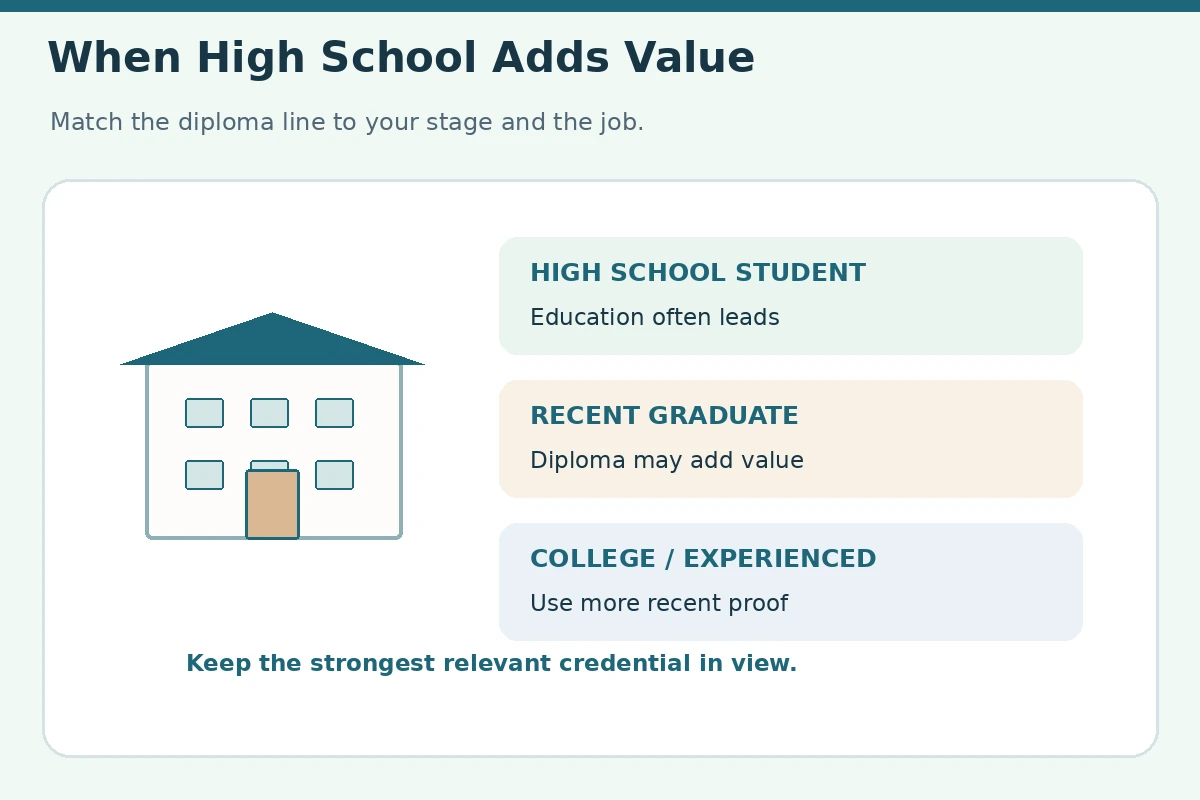
List your high school diploma on a resume when it is your highest completed credential, you are still in high school, or the school is relevant to the opportunity. State the real school name, location and either the graduation date or an explicitly expected graduation date. If you already have substantial college education or a higher credential, the high school line often adds little and can be removed to make space for stronger proof.
The key distinction is status. A diploma you have earned is an award; current enrollment is not. An application may ask directly whether you have graduated, so the resume should agree with your records. CareerOneStop and CUNY offer practical education-section guidance; their examples support choosing the most recent useful information rather than creating a long history of every school you attended.
Choose the Right Diploma Status Before Writing
If you graduated, write the school name, city and state, and “High School Diploma” with a completion month and year if that date is useful. Do not upgrade it to an associate degree or claim academic honors merely because you completed a course. If the official school name changed, use a verifiable name; extra explanatory notes are rarely necessary in a short resume. Keep the wording straightforward because employers may compare it with application forms.
If you are enrolled but have not graduated, label the date “Expected Graduation” or “Anticipated Graduation.” A sample fictional entry is “Westfield High School, Springfield, IL — Expected Graduation: May 2027.” This is an illustration, not a real credential. Do not use “High School Diploma, 2027” without making the expectation clear. If no expected date is known, state the enrollment status and confirm the information with your school.
Place High School in the Right Resume Section
Use a conventional Education heading. For a first job, a student can place Education near the top because coursework, activities and participation may be the most relevant evidence. A worker with directly related work experience may lead with the job history instead. The section order should help an employer find the strongest evidence quickly; it is not a fixed rule for every applicant.
A current college student should normally emphasize current college education first and consider whether high school remains useful. College graduates and experienced professionals can usually remove the high school entry. CareerOneStop advises keeping high school when it is recent or the highest level of education, but not adding it automatically once later education is more informative. Follow any employer-specific form instructions even when the brief resume omits the school.
| Your situation | Resume wording | Typical priority |
|---|---|---|
| Diploma earned | High School Diploma, earned date | Include if relevant |
| Still enrolled | Expected Graduation: month/year | Include for student roles |
| Later education | List stronger college/other award | High school often optional |

Show Relevant Activities Without Inflating Credentials
A high school student can add a targeted project, club activity, volunteer role, part-time job or class assignment when it shows relevant skills. Label it according to what actually happened: a class project is not employment, a club treasurer is not a corporate accountant, and completing a course is not the same as earning professional certification. Select one or two examples tied to the posting rather than padding the page with every class.
A hypothetical retail applicant might describe helping maintain a school event inventory and recording item counts, if they truly did those tasks. A hypothetical office applicant might mention preparing a club meeting agenda and sharing accurate notes. These statements are stronger than claiming “excellent leadership” without proof. Avoid grade averages or awards unless you can verify them and they serve a purpose in the application.
Keep Diploma and Equivalency Credentials Distinct
A high school diploma and a high school equivalency credential are not interchangeable labels. Use the precise award shown in your records. This article focuses on diplomas, while a separate JobAsk guide explains how to describe a GED or other equivalency accurately. Do not list a credential you plan to pursue as already awarded. A short explanation of an expected date or program status is more credible than a vague qualification claim.
If you attended more than one high school, the school that granted the diploma is ordinarily the clearest entry. When changing schools affects a current expected graduation, describe the current school and verify the anticipated award there. The resume need not disclose sensitive reasons for a transfer or personal circumstances. If a formal application separately requests all institutions attended, provide what it asks for in that form.
Adapt the Entry to the Employer’s Screening Needs
Look at the actual qualification requirement: “high school diploma or equivalent,” “currently enrolled,” or “graduation required before start” imply different eligibility checks. A resume line can communicate your status, but it cannot override a job’s written requirements. If graduation is expected after the proposed start date, clarify the timing rather than hoping the recruiter will overlook it. Do not assume a diploma automatically satisfies required licenses, training or minimum-age rules.
For a hypothetical trainee opening that welcomes students, putting “Expected Graduation” and real available work hours may be useful. For a role requiring completed education, an earned diploma should be explicit. Avoid sharing transcripts, student IDs or other private school records unless the verified employer requests them through an appropriate process. The applicant’s goal is a clear statement of status, not a folder of unnecessary personal information.
Proofread Against Records and Save a Simple Layout
Compare the final resume with your school name, award, dates, activities and any stated honors. Ensure that “graduated” is not used for current students, and that a planned academic project is not phrased as completed. Use a legible Education heading and plain text that survives PDF export. It is usually unnecessary to list a full street address or student number, and abbreviated school names can be confusing to employers outside your area.
Before applying, read the saved PDF on a phone and a computer. Check that dates sit beside the right school, that Education and Experience are easy to distinguish, and that an expected date has not been cropped. If a posting asks for a different format or an online form, follow its explicit instructions. Keep the brief resume focused on skills and proof that genuinely match the role.

How We Research Resume Education Claims
We checked the referenced career-center and registrar guidance on 2026-11-14: CareerOneStop education guide (CareerOneStop explains reverse chronology, education placement, when to include high school, and truthful expected dates.); CUNY resume guide (CUNY advises listing school, credential, graduation status, major or minor, and relevant optional academic honors.); Santa Monica College career services (Santa Monica College distinguishes earned awards from expected awards and commonly omits high school when postsecondary credentials are relevant.). We also compared this specific intent with the supplied WordPress title exports, the existing batch inventory and public search results to reduce overlap. Institutional academic terms and policies vary: always verify a credential, date and honor against your own official records. All person, school, program and date examples in this article are hypothetical unless explicitly identified as source policy. Read the JobAsk affiliate disclosure; no paid relationship or approved affiliate program is claimed.
More Resume and Cover Letter Guides
Usually not. If college study or work experience better demonstrates your qualifications, omit high school unless a particular employer requests it.
Only if the diploma has actually been awarded. Otherwise label current enrollment and the expected graduation date.
Only when relevant, requested or strong enough to support the role. Verify the number and label its scale if used.
Yes, when they show real skills and you describe your own contribution without presenting school activities as paid employment.
Usually the school awarding the diploma, or your current school if still enrolled. Follow any separate application-history requirements.