
List a master’s degree on a resume using the official award name, the awarding university, the field of study, and a truthful completion date. If you are still enrolled, use ‘Expected’ or ‘Anticipated’ with a realistic date; do not present the degree as awarded. If you completed some graduate courses but left the program, describe the study without claiming a master’s qualification. Your transcript or registrar record, not your preferred job title, determines the credential status.
CareerOneStop and several university career centers recommend listing advanced degrees before earlier degrees in reverse chronological order. The practical challenge is to keep the status visible while selecting a small amount of relevant graduate work. A thesis, capstone or research assistant role can add evidence, but it must not blur the boundary between coursework, supervised work and a separately earned professional license.
Check the Official Graduate Award and Completion Date
Use the university’s actual degree title such as Master of Science, Master of Arts or Master of Business Administration, rather than inventing a variation to fit the vacancy. Include the program or field when it improves clarity. If a degree was conferred, you can use the official conferral date or an accurate graduation month and year where appropriate. Do not use a commencement event as proof that all requirements were completed if the school has not awarded the degree.
A fictional completed example is “Master of Science in Information Systems — River City University, June 2025.” The university and date are invented solely to demonstrate layout. If you took courses but did not finish, the same line without an “in progress” or “coursework completed” label could mislead a reader. Verify the award against the credential the institution can confirm.
Label Active Enrollment Without Claiming Graduation
For an enrolled graduate student, give the program and an explicitly expected date. “Master of Arts in Communication, expected May 2027” is a hypothetical format, not an awarded qualification. If your completion date is uncertain, avoid a precise promise and state enrollment status or anticipated timeframe only when supported by your academic plan. You can update the resume after a change in program standing.
Separate future aspirations from current facts. An applicant who has applied for a master’s program but has not enrolled should not list an active graduate degree as if coursework has started. Someone pursuing a combined bachelor’s/master’s path should confirm which credentials have already been awarded and which remain expected; a single program brochure is not a personal degree record. Align the resume and application fields.
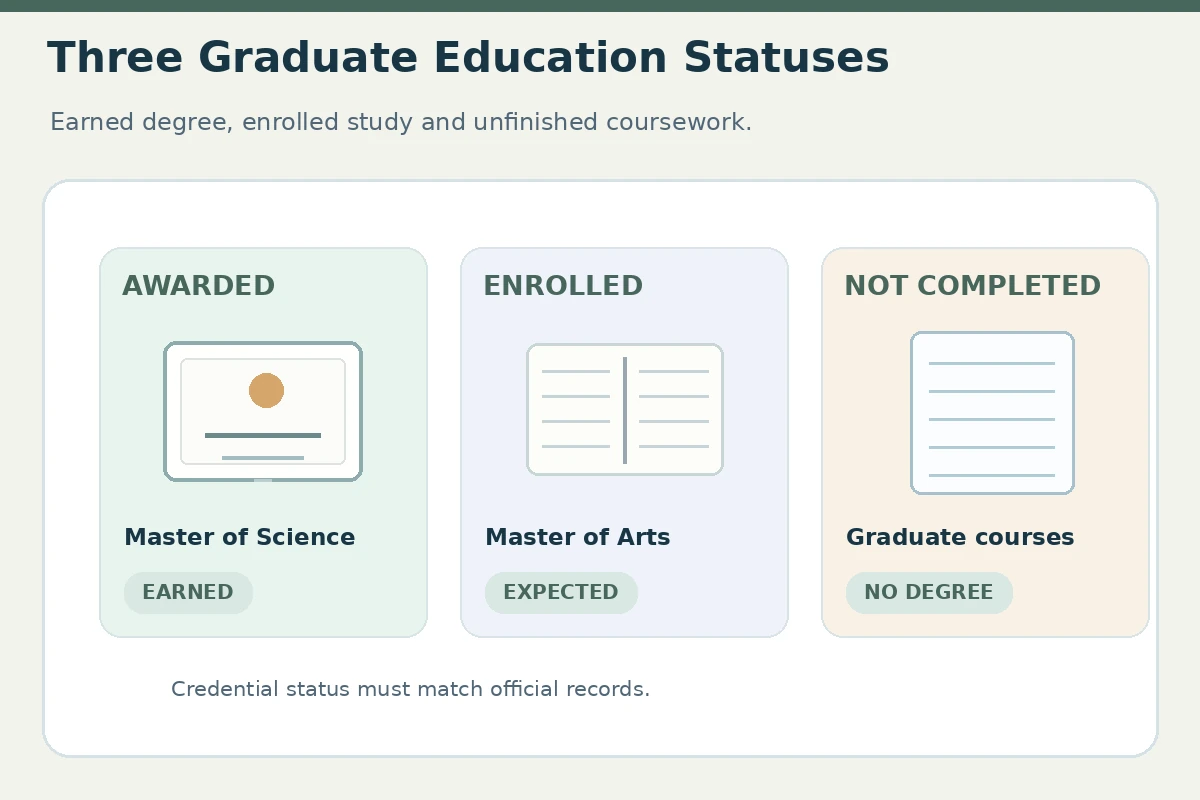
| Graduate status | Accurate description | Do not imply |
|---|---|---|
| Degree awarded | Master of Science, earned month/year | Only coursework |
| Currently enrolled | Master of Arts, expected month/year | Degree already conferred |
| Program not completed | Graduate coursework, dates attended | Earned master’s degree |
Describe Unfinished Study Without a False Credential
If you completed graduate courses but withdrew, consider whether the study contributes to the job before using space for it. Accurate options include the institution, area, dates attended, and “graduate coursework completed” with appropriate course details. Do not abbreviate a partial program as “M.S.” without a clear statement that no degree was earned. The goal is to demonstrate relevant learning, not imply an award that an employer may later try to verify.
Avoid excessive explanation about why the program ended on the resume. When an employer asks, give a concise factual response rather than hiding the status. A graduate certificate is a different credential from a master’s degree; list it as a certificate only if granted. Some roles have strict degree requirements, and substantial graduate coursework cannot automatically substitute for an earned degree under those policies.
Order Graduate and Undergraduate Degrees Clearly
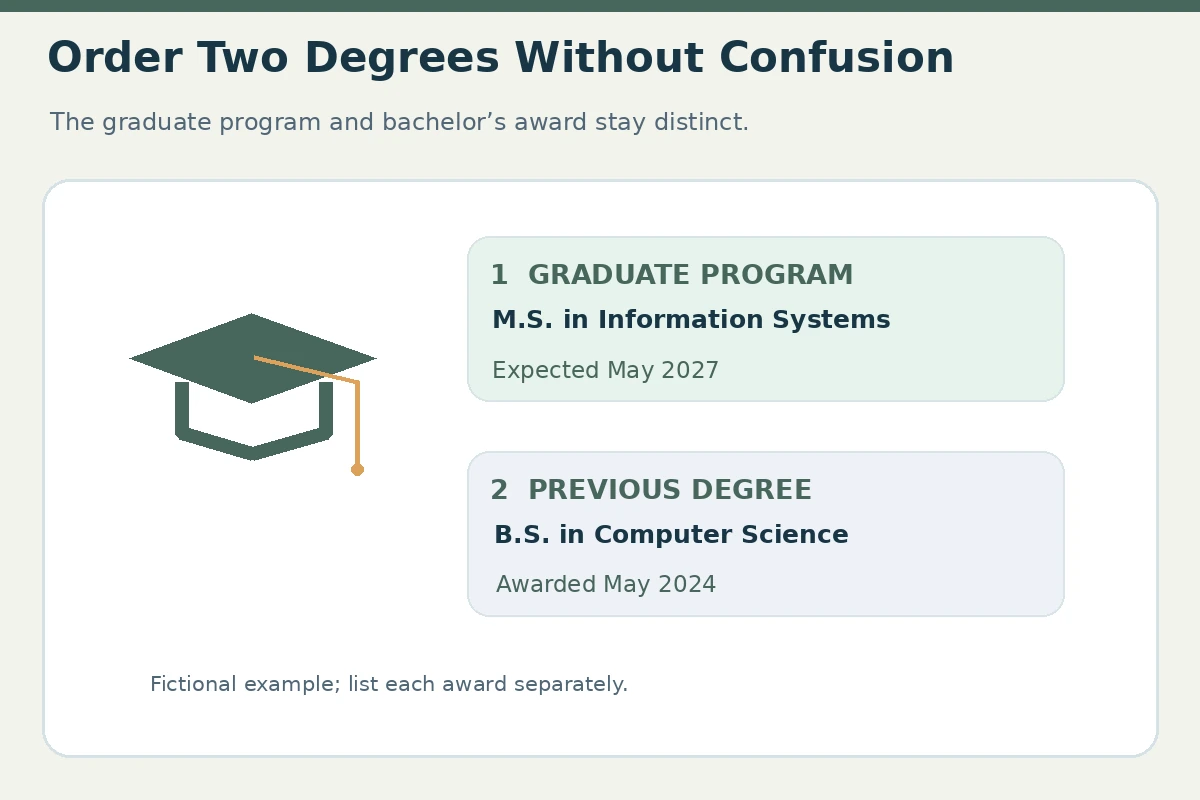
Typically the most recent or highest relevant completed degree goes first, followed by earlier degrees. A completed master’s may sit above a bachelor’s degree, each with its own school and award. An in-progress master’s often comes first too, provided the expected status is obvious. University of Scranton and Southwest Minnesota State University describe this advanced-first approach, while acknowledging that layout depends on career stage and the job.
For a recent graduate, Education may appear high on the page. A mid-career applicant may lead with achievements from work and keep the degrees in a compact section below. Do not hide a required credential in a dense paragraph or list the same degree under Skills and Education. Keep the labels consistent across resume and application forms, including whether the degree is earned or anticipated.
Include Thesis and Capstone Evidence Selectively
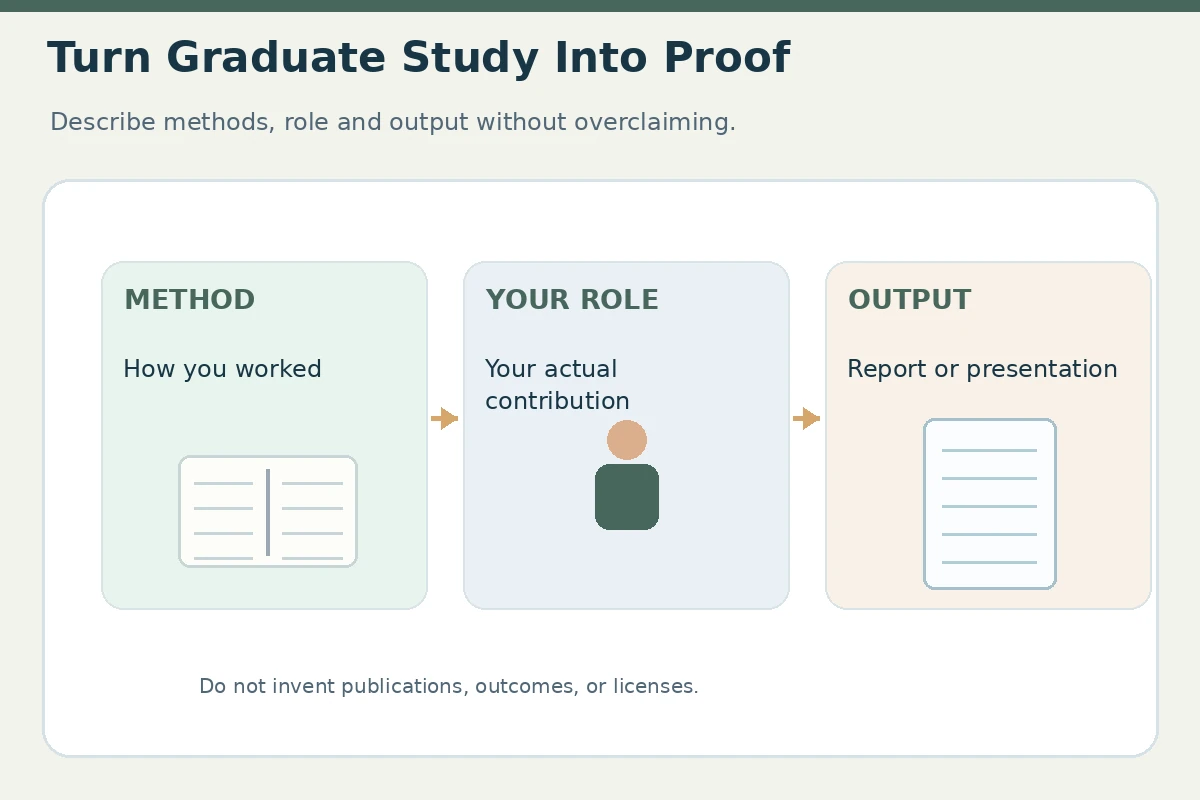
A thesis, capstone or research project can show analytical ability, writing, methods or collaboration if it relates to the opening. Describe the actual research question, your method, your contribution, and a verifiable deliverable. Graduate study does not automatically mean independent scientific or professional authority. An assistant who cleaned data for a supervised team should say so, not claim sole authorship of every result.
A fictional project line might say “Analyzed anonymized survey responses for a supervised capstone and explained limitations in a final report.” Do not invent publication, peer review, patents, cost savings or experimental outcomes. Where data are confidential, use non-identifying project descriptions or an independently created example. Keep the detailed work under Projects or Research when there is enough substance to justify more than a single Education line.
Separate a Degree From Licenses and Job Eligibility
An academic master’s degree is not the same as a professional license, board certification or permission to perform regulated duties. Depending on a profession and location, additional requirements may apply; do not suggest the degree itself grants practice rights. State any verified license or certificate in its proper section with the real issuing body and status. When a job posting requires a particular education level, read its exact wording.
Review the final PDF for the full university name, award, field, earned versus expected status, dates and project descriptions. If your graduation month changed, update your resume before applying. Do not upload transcripts or account numbers unless a verified employer requests them securely. The best graduate education entry is compact enough to scan and precise enough to survive a direct verification question.
How We Research Resume Education Claims
We checked the referenced career-center and registrar guidance on 2026-11-14: University of Scranton resume guide (The University of Scranton says graduate students can list graduate education first and include official credentials and dates.); SMSU resume education guidance (Southwest Minnesota State University describes how to display degree, major, minor, school, and completion date.); CareerOneStop education guide (CareerOneStop explains reverse chronology, education placement, when to include high school, and truthful expected dates.); Santa Monica College career services (Santa Monica College distinguishes earned awards from expected awards and commonly omits high school when postsecondary credentials are relevant.). We also compared this specific intent with the supplied WordPress title exports, the existing batch inventory and public search results to reduce overlap. Institutional academic terms and policies vary: always verify a credential, date and honor against your own official records. All person, school, program and date examples in this article are hypothetical unless explicitly identified as source policy. Read the JobAsk affiliate disclosure; no paid relationship or approved affiliate program is claimed.
More Resume and Cover Letter Guides
Yes, if you are genuinely enrolled and label the degree and date as expected or in progress, not completed.
Usually the graduate program goes first, followed by the undergraduate award, with each status and school stated clearly.
Do not suggest an awarded M.S. without conferral. Label the work as graduate coursework or an unfinished program accurately.
Only if it helps the employer evaluate relevant methods or work. A brief project summary is often more useful than a long title.
No. Licensure and certification rules are separate and depend on the occupation and jurisdiction. Check the specific role requirements.