
A hotel front desk cover letter without hotel experience should translate real customer-facing work into three useful signals: careful details, calm requests, and a clear shift handoff. Describe a service or scheduling task you actually performed, then say you are prepared to learn the hotel’s reservation system, identification rules, payment procedures, and room-assignment limits. You do not need to pretend you have operated a property-management system.
Hotel desk clerks typically assist with arrivals, departures, room reservations, guest requests and records. Policies vary by property and may depend on the shift. A new applicant should not claim authorization to waive charges, override room eligibility, distribute keys without verification, or resolve security incidents independently. Employers train desk agents on the systems and approval path applicable to their location.
Match the real opening before drafting the letter
Read the vacancy for specific needs: late arrivals, evening coverage, messages, reservation changes, housekeeping coordination, card handling, and accessibility requests. If you have used a restaurant or retail point-of-sale terminal, describe the real transaction process without pretending that it makes you an expert in hotel deposits or payment holds. If you helped with room bookings for a student organization, name that context instead of presenting it as commercial guest registration.
Before writing, separate the vacancy into three columns: work you can already explain, work that requires workplace training, and work that appears to need special authorization. For a hotel front desk agent role, these are not the same. In the first column, gather proof from coursework, volunteering, previous part-time work or an independently completed project. In the second, state clearly what you want to learn. In the third, avoid promising authority the job title alone does not give.
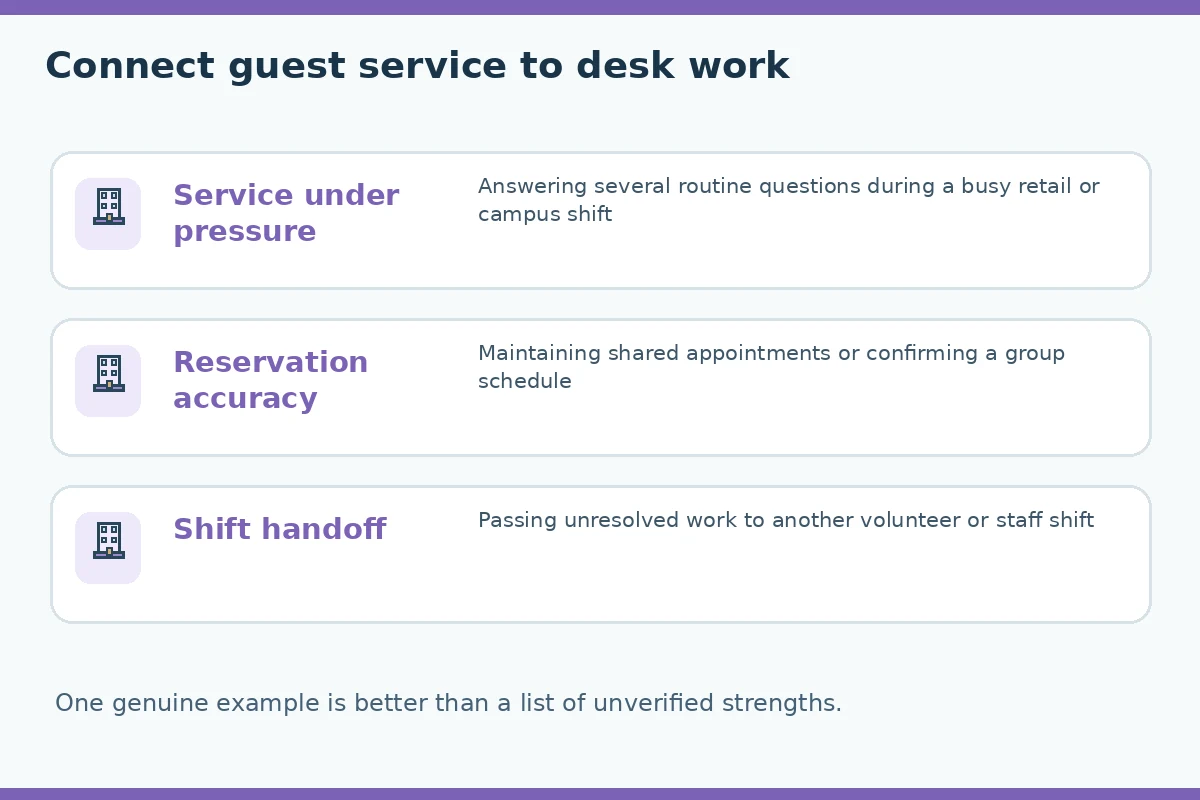
Choose a genuine example instead of claiming experience
Service under pressure: If your actual background includes answering several routine questions during a busy retail or campus shift, use that as a starting point. Show that you listened, provided accurate information, and checked with a supervisor about exceptions. Avoid claiming to have solved every complaint. When possible, mention a check, document, conversation or handoff that a supervisor could recognize; you do not need a grand achievement. Keep the setting and your responsibility visible so a hiring reader can distinguish a school exercise from employment.
Reservation accuracy: If your actual background includes maintaining shared appointments or confirming a group schedule, use that as a starting point. Describe verifying the correct person, time, and changed request. It is an evidence point about accuracy, not proof of knowing every hotel reservation system. When possible, mention a check, document, conversation or handoff that a supervisor could recognize; you do not need a grand achievement. Keep the setting and your responsibility visible so a hiring reader can distinguish a school exercise from employment.
Shift handoff: If your actual background includes passing unresolved work to another volunteer or staff shift, use that as a starting point. Name the information handed over and how the next worker knew what was still pending. Leave out customer names and private details. When possible, mention a check, document, conversation or handoff that a supervisor could recognize; you do not need a grand achievement. Keep the setting and your responsibility visible so a hiring reader can distinguish a school exercise from employment.
Make the evidence-to-role connection in one sentence rather than introducing a long list of adjectives. For example, “I maintained a current list and confirmed changes with the team” explains a process; “I am a natural leader, highly organized, and an excellent communicator” tells the reader very little. Do not copy numbers, awards, qualifications, job titles, or outcomes from another person’s sample letter. The employer may ask you to explain the story at an interview, so choose one you can discuss calmly and accurately.

Adapt this illustrative cover letter to your own experience
The following fictional training example is written for someone seeking an entry-level hotel front desk agent position. It is not a record of a real applicant or employer. Use the structure but replace every action with something you have actually done. Never send it word for word, and confirm the employer’s submission format first.
I am applying for the Front Desk Agent opening at your property. I am drawn to the combination of welcoming guests, maintaining accurate arrival information, and communicating clearly across shifts.
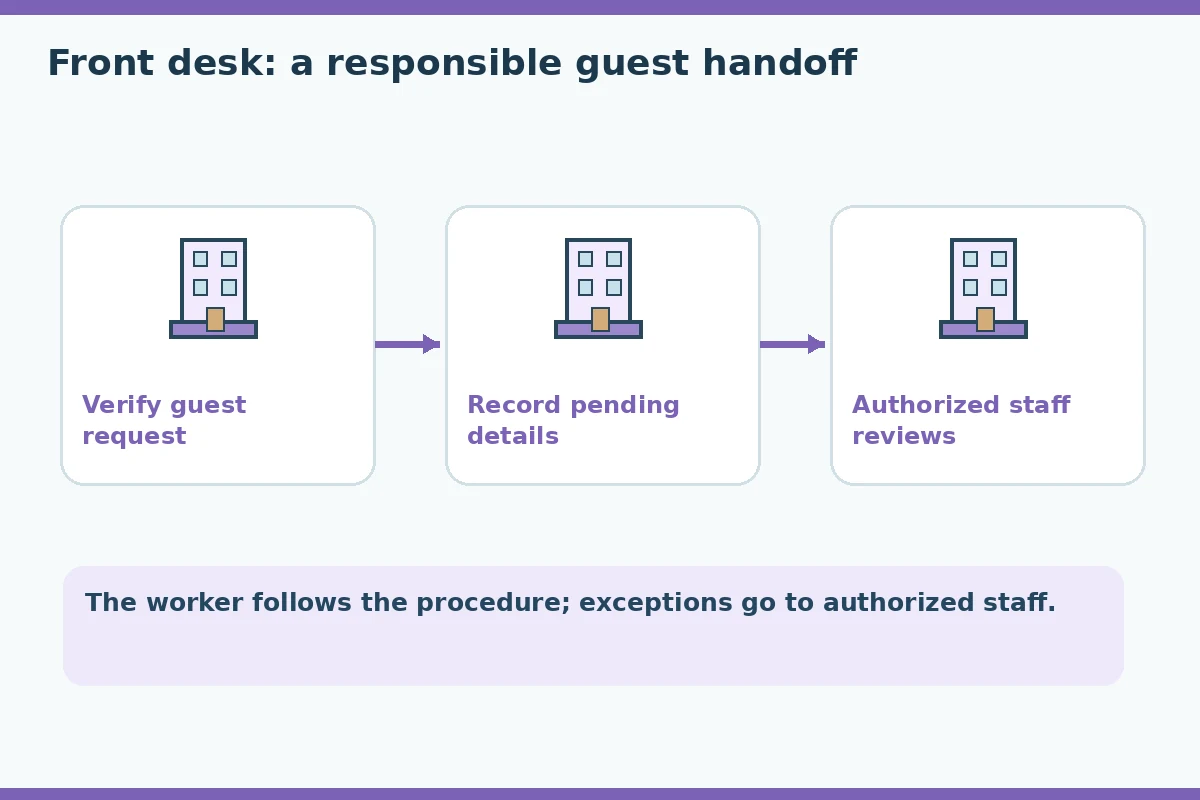
Although I have not worked at a hotel, I have handled guest questions and scheduling changes in a community activity setting. When a request could not be completed during my shift, I recorded the outstanding task and passed it to the next volunteer lead instead of promising a solution I could not approve.
I would bring that same attention to communication and records while learning your check-in procedures, reservation software, identification requirements, and payment controls. I understand that upgrades, refunds, key access, and security concerns must follow the property’s policies and management instructions.
Thank you for considering my application. I would appreciate a chance to discuss how I could contribute to a reliable and welcoming front desk.
This hypothetical sample uses a realistic boundary: handing off an unresolved request is a skill, while approving room changes is a separate authority. Replace the community activity with your own genuine experience. If your real background is food service, explain how you relayed customer requests or checked orders instead. The letter needs no invented guest satisfaction rating, booking volume, hotel brand knowledge, or reservation software certification.
Remove claims that are outside the beginner role
Do not claim that you can access every guest account, issue a replacement key without verification, handle disputed payments without supervision, or make safety calls beyond your role. If a posting requests night audit duties, say whether you have actually reconciled records; do not equate basic math with hotel accounting expertise. You can say you are willing to learn night-audit procedures while acknowledging that they must be taught and checked.
If a job advertisement lists a requirement you have not met, do not try to disguise the gap with an implied certification. Where the position is genuinely entry-level, explain closely related preparation and what supervision or training you would need. Where it is not entry-level, look for an opening with an appropriate scope. A cover letter can explain a match but cannot replace a mandatory qualification or a required background, license, or safety procedure.
Send a short letter that matches the employer instructions
A small inn may ask one person to answer calls, coordinate rooms, and greet arrivals; a larger hotel may divide reservations, concierge service, and accounting. Check shift expectations and transportation realistically. Do not state that you are available around the clock unless it is true. Tailor the reason for interest to verifiable facts about the employer—such as its advertised service model—rather than inventing awards or guest reviews.
CareerOneStop recommends a tailored cover letter, typically about 200–400 words across several short paragraphs. Open by naming the position; give one or two specific proof points; explain why the work itself interests you; and close politely. If the portal says not to upload a letter, follow its instructions. If it asks you to email an application, use a clear subject line and the requested attachment format. Check names, dates, contact details, links, and spelling in the final file before submitting.
For this hotel front desk agent application, read the vacancy a second time with a highlighter. Every important assertion in your letter should connect to something stated there, to something verifiable about the employer, or to your own experience. Delete promises that are not under your control, such as perfect attendance forever, guaranteed customer satisfaction, instant expertise with proprietary systems, or independent decisions beyond your authority. Save a copy of the letter that matches the version of the job posting you applied to.
How We Research and verify these recommendations
Our source review on 2026-10-30 used CareerOneStop cover letter guidance; BLS occupational description; official role, training, or privacy guidance. CareerOneStop provides advice about short, tailored letters. The occupational and safety or privacy sources describe work responsibilities and boundaries; our transfer examples and fictional letter are editorial illustrations, not quoted employer policies. We checked candidate topics against the provided JobAsk production index and WordPress title export, but cannot see unpublished WordPress drafts or guarantee a search engine has indexed every existing page.
No example in this article represents a real hiring outcome, employer endorsement, certification, or verified applicant. Use your own facts and review the specific employer’s instructions and applicable training requirements. The site’s affiliate disclosure explains our editorial and commercial relationships. There is no paid product recommendation or assumed affiliate partnership in this guide.
More Resume and Cover Letter Guides
- Hotel Housekeeping Cover Letter With No Experience: Prove Reliable Room Checks
- Event Coordinator Cover Letter With No Experience: Prove Planning and Handoffs
- Hotel Front Desk Resume Objective: Show Guest Service and Check-In Accuracy
- Hotel Front Desk Experience on a Resume: Show Guest Records and Shift Handoffs
- Library Assistant Cover Letter With No Experience: Show Service and Accuracy
Yes. Explain the actual guest-facing or record-accuracy task and how it relates to the front desk rather than calling it hotel experience.
Name it only if you really used it. Otherwise emphasize your ability to learn the property’s approved workflow.
State availability truthfully and consider the shifts in the posting; avoid guaranteeing coverage you cannot sustain.
No. Describe your communication and escalation habits. Refunds, room moves and security decisions may require approval.
A tailored three- or four-paragraph letter can be enough if it answers the posting and includes a concrete example.