
An HR assistant cover letter without HR experience should show accurate document work, respectful communication, and reliable handoffs—not pretend you have made hiring decisions or managed employee records. Focus on the employer’s actual support duties, such as scheduling interviews, maintaining approved files, or preparing routine correspondence. Use a real administrative, course, or volunteer example to demonstrate careful handling of details. The sample here is hypothetical and must be rewritten from your own experience; a class spreadsheet does not prove access to confidential personnel systems.
Distinguish HR support from HR decision-making
BLS lists human resources assistants among information clerks and describes administrative support that can include personnel records and job-posting materials. Individual assistant roles vary. A hiring manager may ask for interview scheduling, document tracking, employee inquiries, or data-entry support, while final decisions about hiring, compensation, investigations, and policies belong to authorized personnel. Read the posting line by line. If it asks for a system you have never used, say you are willing to learn; do not suggest you configured a human resources information system or approved employment changes. Clear role boundaries are an asset in a privacy-sensitive department.
Choose a genuine accuracy or scheduling example
Look for firsthand evidence such as maintaining a volunteer roster, preparing a club meeting calendar, organizing approved forms, or checking dates in a school spreadsheet. Name the record type at a general level and explain how you verified information before handing it to the person responsible. Avoid disclosing private classmates’ or coworkers’ data. A sentence that says “I matched meeting times against the room schedule and flagged conflicts to our coordinator” gives more evidence than “I am highly detail-oriented.” If you did not have final authority, say who reviewed the plan. Do not describe an informal student task as formal HR administration.

Open with support needs rather than exaggerated leadership
The opening can state the exact HR assistant job and the practical evidence you bring: accurate scheduling, dependable follow-through, or clear communications. Employers need to know that a beginner can perform the listed support tasks and learn approved systems. Avoid claims such as “I understand all employment laws” or “I would make fair hiring decisions,” which are not credible without relevant authority and knowledge. You can say you value careful records and respectful service because you have practiced those behaviors. Include a specific company reason only when it is true and supported by a published source or the job description.
Explain privacy as a habit, not a certification
An HR office handles sensitive information, but a beginner may never have seen confidential personnel files. You can show good judgment by describing approved access, not sharing restricted documents, and referring requests when authorization is unclear. The FTC provides general business guidance for protecting personal information; it does not make a student volunteer an HR privacy specialist. Do not reveal employee names, medical details, hiring notes, compensation files, or personal identifiers in a cover letter. If your only evidence is keeping a club mailing list private under group rules, label it accurately instead of suggesting you managed legal compliance for an employer.
Read this fictional cover letter paragraph
Fictional HR assistant letter excerpt: “Dear Hiring Team, I am applying for your HR assistant opening. As a volunteer scheduling coordinator for a community program, I updated a shared event calendar, compared new requests with existing commitments, and referred conflicting assignments to the program lead for approval. That taught me the value of accurate records and clear, respectful communication. I would welcome the opportunity to learn your HR team’s authorized document and scheduling procedures while supporting its administrative work. Thank you for considering my application.” The volunteer role is invented for teaching and should not be copied as a personal claim.

| Your draft element | Evidence to look for | Misleading version to remove |
|---|---|---|
| Opening | Exact role and genuine reason for applying | Unverified employer praise |
| Evidence paragraph | One real task, check and handoff | Invented years or results |
| Training note | Specific procedure to learn | Claimed authorization you lack |
| Closing | Correct name, attachments and application route | Conflicting dates or fake credentials |
Write an evidence paragraph with a review point
A hypothetical example: an administrative volunteer prepared an event volunteer schedule, saw that one person had been assigned to two shifts, checked the signup sheet, and asked the organizer to confirm the change before sending the final schedule. That action demonstrates tracking details and escalating an error. It does not prove experience maintaining personnel records or determining legal eligibility. If your actual example is a course group project, explain your role and the teacher’s or team lead’s review. Tie the real habit to interview scheduling or approved document preparation in the posting, not to HR authority you never exercised.
Close by offering dependable administrative support
The closing should express interest in learning the team’s procedures while supporting timely, accurate administrative work. State that your resume is attached if it is, thank the reader, and use the listed submission route. If applying by email, check recipient and attachment names; if using a portal, complete only the fields requested. Do not send private personnel information or references’ contact details into a general inbox. A concise letter makes your strongest evidence obvious. Resist using buzzwords such as “strategic HR transformation” when applying for a junior coordination role. Your realistic scope can make you more trustworthy than inflated expertise.
Review every claim about systems and authorization
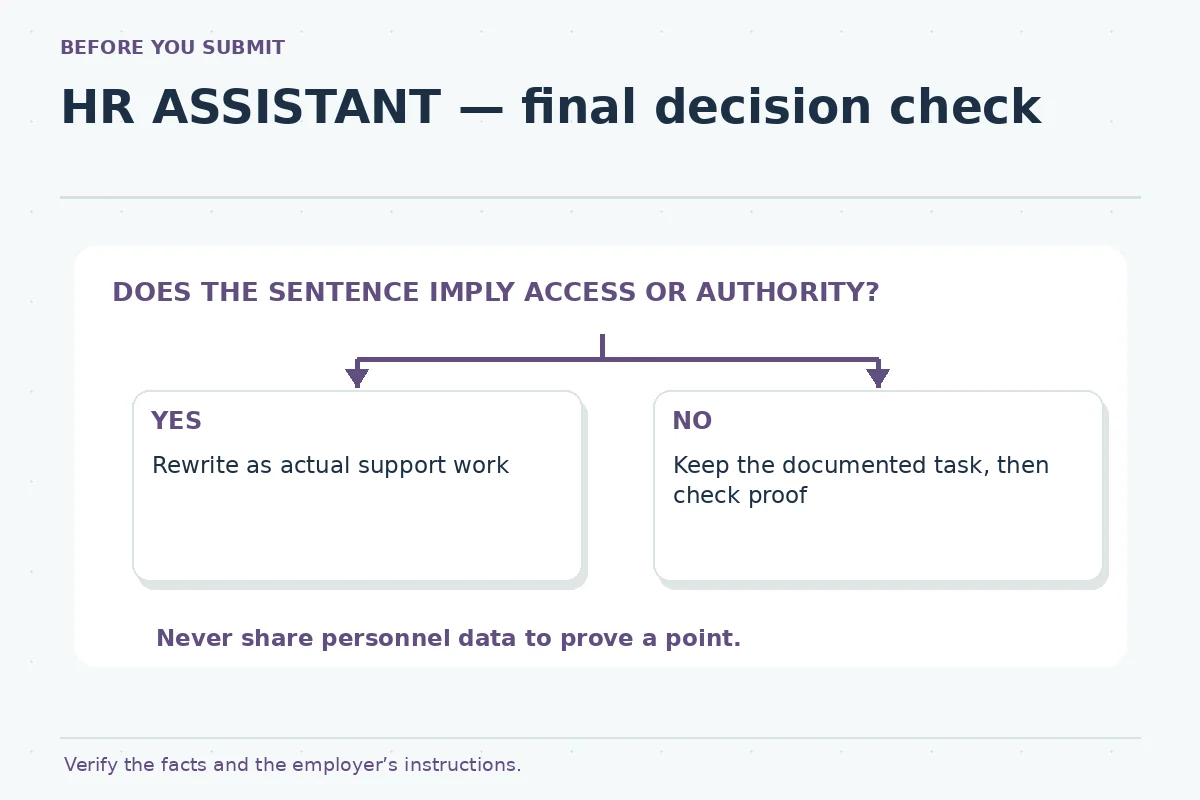
Before sending, underline system names, confidential-record tasks, and decision verbs in the draft. Ask whether you really used that platform, saw those records, or had that authority. Replace “managed recruiting” with “scheduled volunteer interviews for a club” if that is what happened. If you used a spreadsheet, name the actual functions you used instead of inventing sophisticated analytics. Confirm that your sample demonstrates a check and a responsible handoff. Employers have different systems and rules; no generic letter proves compliance expertise. Use the vacancy’s required qualifications, not a guessed HR career path, as your reference point.
Practice this specific cover letter rewrite
Make an evidence table with columns labeled real task, proof, and approval owner. In the first column, enter something you have done, such as preparing a study-group calendar. In the second, explain how you checked it. In the third, name who could approve changes. Then compare those points with the HR job ad: scheduling, file organization, or communication may match; hiring, payroll authorization, and compliance decisions may not. Remove employee details from examples. Finally, ask whether a recruiter reading your paragraph would know exactly what you did versus what someone else authorized.
How We Research Entry-Level Cover Letters
We reviewed these original sources on 2026-11-07: cloudfront.careeronestop.org (CareerOneStop offers guidance for tailoring cover letters to specific skills and job requirements.); www.bls.gov (BLS describes HR assistants as administrative staff supporting personnel records and job-posting processes.); www.ftc.gov (FTC guidance discusses limiting access to personal information and protecting sensitive records.). Each source supports general cover-letter methods or the occupational limits identified in this guide; none confirms that any particular applicant holds a credential or has performed the fictional example. Roles and employer requirements vary, so compare claims against the actual posting and your records. Sample stories and examples above are hypothetical teaching materials, not employment testimonials.
This is independent career-writing education, not a promise of interviews or hiring. We do not claim an affiliate arrangement for the organizations cited. See the JobAsk affiliate disclosure for further transparency. Do not attach confidential workplace or student records to prove past experience.
More Resume and Cover Letter Guides
Genuine scheduling, document checking, customer communication, or campus administrative tasks can provide relevant evidence.
No. Name it as a club roster and describe the actual privacy and checking steps used.
Responsibilities vary, but support work does not automatically confer decision authority. Check the posting and employer workflow.
No. Describe transferable system skills and training readiness without inventing platform experience.
Use its structure only. Replace the scenario, actions, and qualifications with genuine evidence before sending.