
A production worker cover letter with no factory experience should show that you can follow a sequence, notice a mismatch, and ask for training before handling unfamiliar equipment. Pick one genuine example from a class project, community build, packaging volunteer shift, or another task requiring reliable steps. Compare that example with the posted production role; do not assume the job is identical to every assembly-line position. The sample below is hypothetical, and it does not represent permission to operate machinery or perform safety inspections.
Identify the exact kind of production job advertised
“Production worker” can refer to assembling components, sorting materials, packaging products, monitoring a simple process, or supporting inspection records. BLS describes assemblers and fabricators, but a plant may have specialized tasks requiring additional training. Read the employer’s posting for product type, shift schedule, physical duties, required protective equipment, and whether machine operation is part of the assignment. If the listing says prior forklift authorization, welding certification, or advanced equipment experience is required, do not write as if you already have it. Consider genuinely entry-level openings that specify supervised training rather than stretching your credentials.
Choose a hands-on example that proves careful sequencing
A convincing example can be small: preparing kits for a school event from a written packing list, checking labels in a supervised classroom project, or assembling displays with instructions. Explain the sequence you followed and the point at which you checked the work. Avoid converting a hobby project into regulated production experience. If you used a basic tool in class, call it supervised coursework and name the actual tool only when accurate. A production manager needs to know whether you can follow instructions, communicate when something looks wrong, and avoid improvising beyond your training.
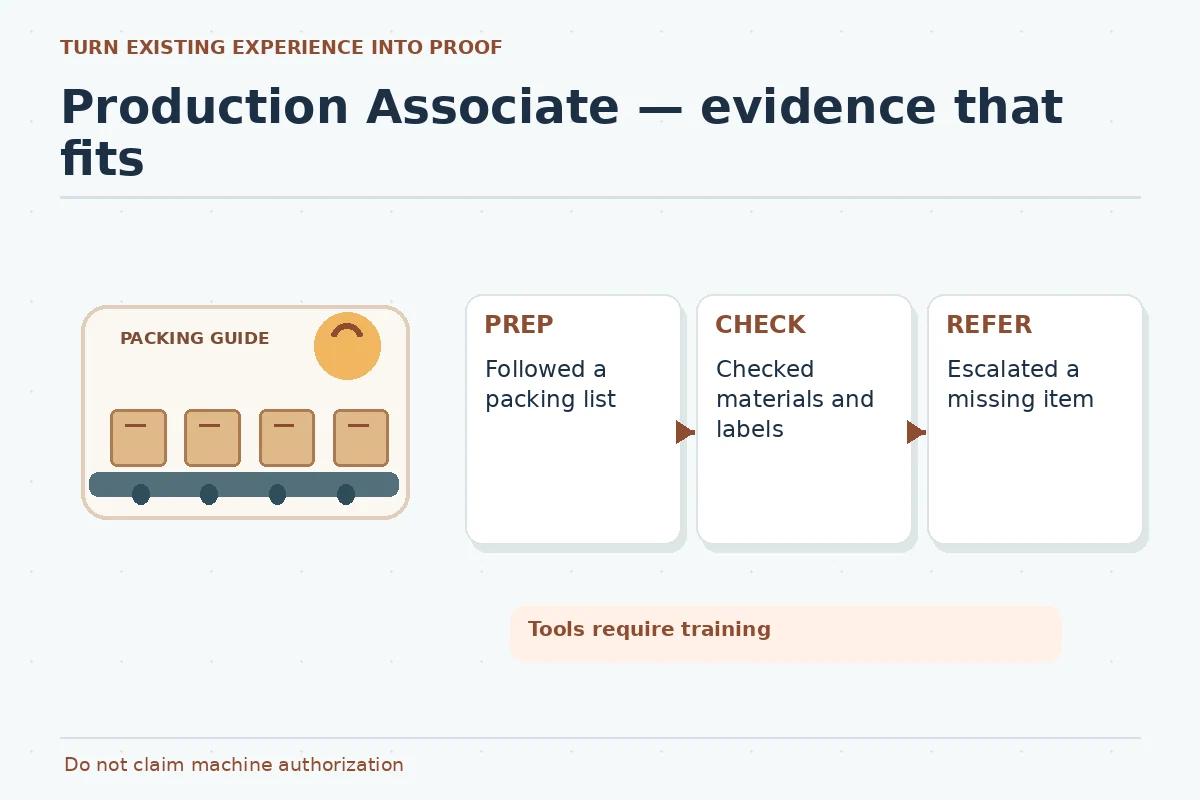
Write an opening that connects to a specific shift or task
State the exact opening and one relevant strength in the first paragraph. For instance, a candidate with a real volunteer packaging experience might lead with preparing correctly labeled materials under a checklist. Only mention a shift commitment if you can meet it; do not promise overnight or rotating availability just to sound flexible. The company’s product or quality requirement should come from its listing or reliable public information, not an imagined manufacturing line. A plain factual opening reads more credibly than promising to improve productivity by an invented percentage before you have worked there.
Demonstrate quality checks without claiming inspection authority
Use a true observation rather than a fabricated defect rate. Imagine a volunteer who noticed that a batch of event kits had the wrong instruction sheet, compared the packing list, and asked the lead to confirm the revision before continuing. That is useful attention-to-detail evidence, but it is not a claim of certified product inspection. Describe how the checklist worked and who had final approval. If no error occurred, you can still discuss completing a series of steps consistently and asking for feedback on the finished task. A sample cover letter should never portray an untrained person approving a regulated product.
Read this fictional cover letter paragraph
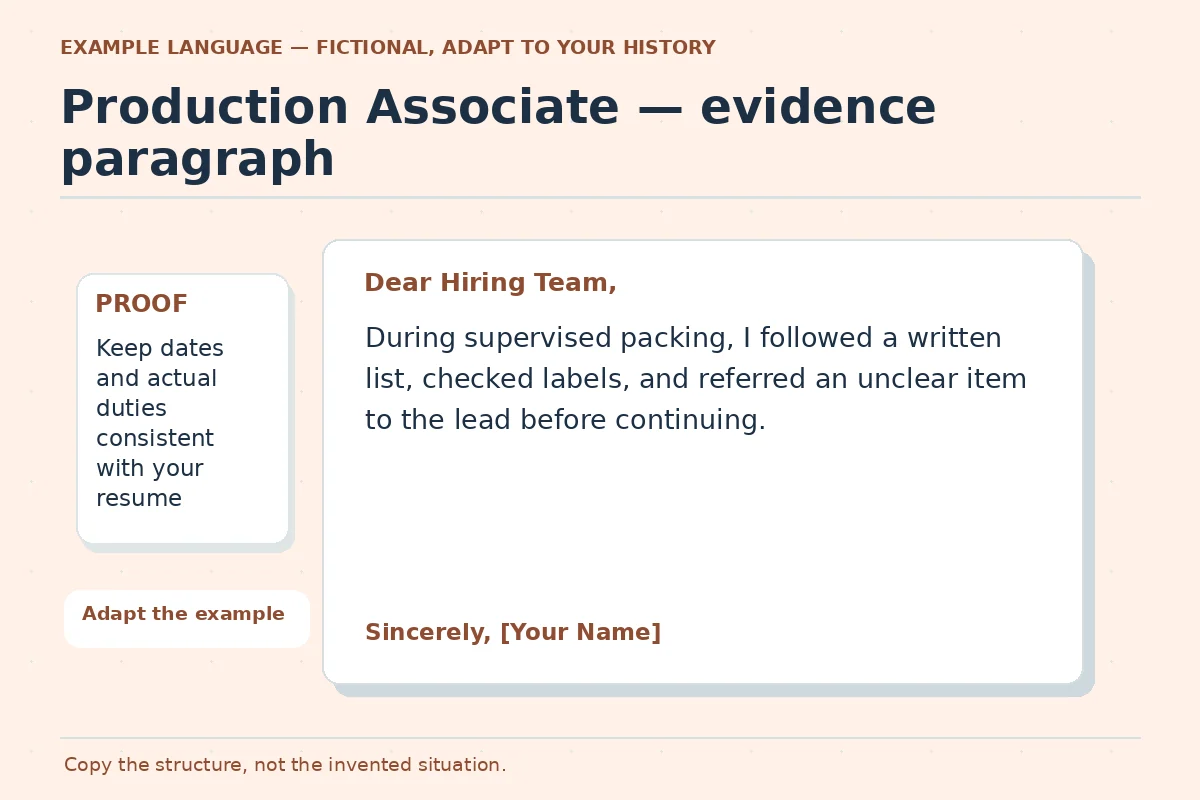
Fictional example — use only as a structure: “Dear Hiring Team, I am applying for the production associate position. During a supervised community packaging event, I followed a packing list, checked item labels, and flagged an unclear quantity to the shift coordinator before continuing. That experience taught me to work carefully with written instructions and to ask before guessing. I am interested in learning your documented production and safety procedures under the required training. Thank you for considering my application; I would welcome the chance to discuss the role and its shift requirements.” Do not copy the fictional activity as your own history.
| Your draft element | Evidence to look for | Misleading version to remove |
|---|---|---|
| Opening | Exact role and genuine reason for applying | Unverified employer praise |
| Evidence paragraph | One real task, check and handoff | Invented years or results |
| Training note | Specific procedure to learn | Claimed authorization you lack |
| Closing | Correct name, attachments and application route | Conflicting dates or fake credentials |
Treat training and safety as work requirements
OSHA identifies employer responsibilities for safety and appropriate training, while specific tasks and rules depend on the workplace. Say you follow posted instructions, use protective equipment when instructed and trained, and report an unfamiliar hazard. Do not suggest that a new employee can bypass lockout, repair moving equipment, or select chemical protections independently. If the job requires specific certification, confirm it before applying and state your status truthfully. You can be enthusiastic about learning a process without declaring that you already know how to operate a press, lift truck, industrial mixer, or other potentially hazardous machine.
Make the middle paragraph about a real supervised result
A hypothetical sample might describe organizing supplies for a community repair day: the applicant used a list, grouped parts, noticed missing labels, and asked the supervisor to check the count before distribution. It shows patience and communication. A claim such as “eliminated all waste” would not follow from that task, so leave it out. Readers with actual factory training can include it, but should identify the specific training and authorized tasks completed. The middle paragraph should connect the observed habit—following a work instruction—to the employer’s posted duties instead of repeating a generic list of personal adjectives.
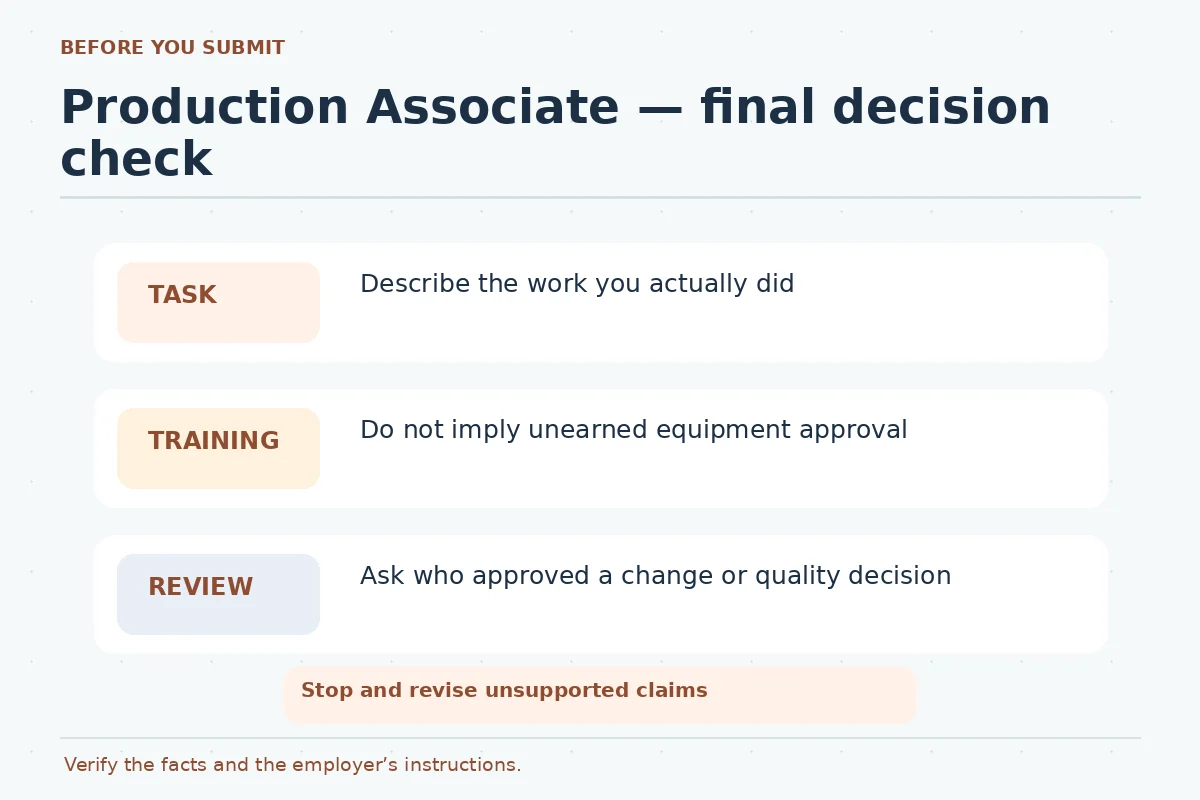
Perform a safety and credibility review before sending
Recheck every reference to machines, hazards, protective equipment, and inspections. Replace “operated production equipment” with the exact classroom or supervised action if that is the truth. Remove invented output rates, defects avoided, or safety outcomes. Confirm that your contact details and availability match the application form. If the job description is vague about training, ask the employer what onboarding covers rather than assuming you will be trained on every task immediately. A cover letter is an introduction, not authorization to use equipment. Your actual willingness to report uncertainty can be a stronger qualification than overstated confidence.
Practice this specific cover letter rewrite
Mark your letter with three different notes: a task you performed yourself, a check you actually made, and a decision that belonged to a supervisor. If the third note is missing from a process involving safety or quality approval, verify the responsibility. Compare the employer’s job description with one honest school, home, or volunteer project. Explain the product or materials only at a safe general level; you do not need to share company diagrams or proprietary work instructions. If you have never operated machinery, a sentence about learning standard procedures is accurate; a claim to be immediately ready to run machines is not.
How We Research Entry-Level Cover Letters
We reviewed these original sources on 2026-11-07: cloudfront.careeronestop.org (CareerOneStop explains choosing specific evidence for a cover letter.); www.bls.gov (BLS describes assembly duties and how training needs vary by manufacturing task and industry.); www.osha.gov (OSHA describes employer responsibilities for workplace training and hazard controls.). Each source supports general cover-letter methods or the occupational limits identified in this guide; none confirms that any particular applicant holds a credential or has performed the fictional example. Roles and employer requirements vary, so compare claims against the actual posting and your records. Sample stories and examples above are hypothetical teaching materials, not employment testimonials.
This is independent career-writing education, not a promise of interviews or hiring. We do not claim an affiliate arrangement for the organizations cited. See the JobAsk affiliate disclosure for further transparency. Do not attach confidential workplace or student records to prove past experience.
More Resume and Cover Letter Guides
Yes. Demonstrate careful sequence-following and genuine hands-on evidence, and be clear which production tasks require employer training.
Only if you earned a real, relevant credential. General safety awareness is not the same as authorization to operate machinery.
A supervised school or volunteer packing task may show checklist and quality-check habits, provided it is described truthfully.
Only if you have documented evidence and it was your contribution. Never invent productivity percentages.
Yes, when the posting requests it and your actual schedule supports the statement. Do not promise unavailable hours.